


Cushing Syndrome Understand Cushing syndrome occurs due to excessive production of the hormone cortisol in the body. This condition most commonly occurs in patients who take steroids to treat any other condition, but can also arise from endogenous overproduction of cortisol from pituitary, adrenal, or ectopic sources.
What is Cushing Syndrome?: Cushing Syndrome Understand
Cushing syndrome occurs due to excessive production of the hormone cortisol, either from internal overproduction or long-term use of corticosteroid medications. The condition can result from exogenous (drug-induced) or endogenous (body-originating) causes. The most common form overall is exogenous Cushing syndrome, which develops in patients taking glucocorticoids for chronic illnesses such as asthma, rheumatoid arthritis, or lupus. Endogenous Cushing syndrome, on the other hand, occurs when the body produces too much cortisol due to disorders of the pituitary, adrenal glands, or ectopic ACTH-secreting tumors.
Its key symptoms include buffalo hump (a pad of fat between your shoulders), moon face, truncal obesity, hirsutism, depression, skin changes, and purple marks called striae all over your body.[1]
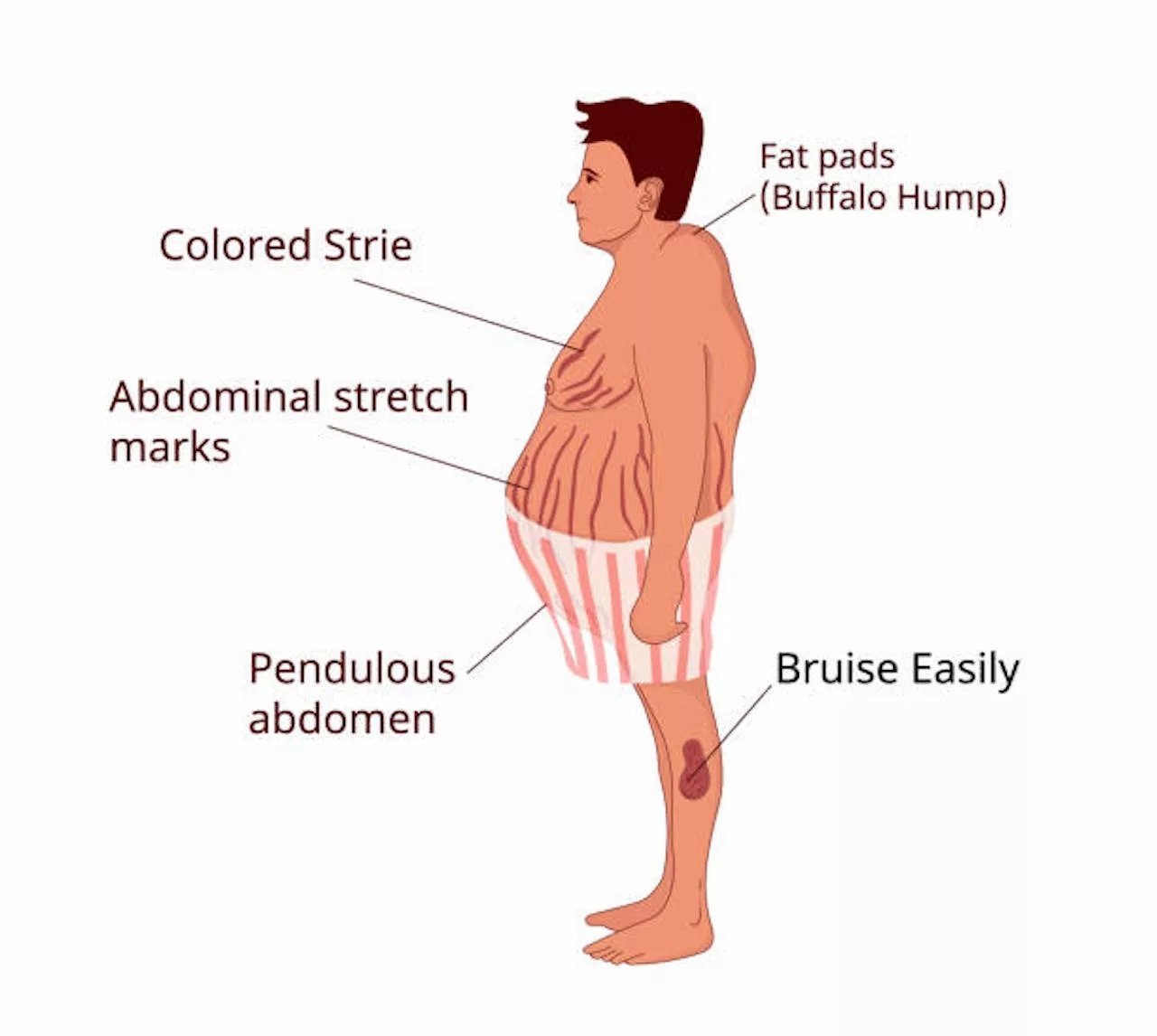
Cushing syndrome signs and symptoms.
Incidence of Cushing Syndrome
According to a 1992 study, the prevalence of Cushing syndrome in Europe was 39.1 cases per million per year, with an average incidence of 2.4 cases per million per year. Moreover, it is more common in women as compared to men.[2]
Causes of Cushing Syndrome
Cushing syndrome occurs due to excessive production of cortisol in your body. Cushing syndrome may occur due to problems with the pituitary gland, hypothalamus, or adrenal glands. Some causes of Cushing syndrome are:
Pituitary Adenoma:
Pituitary Adenoma is a benign tumor of the pituitary gland that produces excessive adrenocorticotropic hormone (ACTH). Excessive production of adrenocortical hormones stimulates the adrenal glands to secrete excess cortisol. This is the most common cause of endogenous Cushing syndrome.[3]
Adrenal Hyperplasia:
It is the overgrowth of adrenal gland cells that results in the production of excessive cortisol and Cushing’s syndrome
Adrenal Tumors:
Adrenal tumors also lead to Cushing’s syndrome due to excessive cortisol production. They might be adrenal adenomas or carcinomas.
Genetic Conditions:
Inherited disorders like primary pigmented nodular adrenocortical disease (PPNAD) or Carney complex can also cause Cushing syndrome.
Ectopic Adrenocortical Hormone Production:
Certain neuroendocrine tumors, such as small-cell lung carcinoma, bronchial carcinoid, pancreatic tumors, or thymic tumors, can secrete ACTH, resulting in ectopic Cushing syndrome.
Long-Term Use of Glucocorticoids:
Exogenous (iatrogenic) Cushing syndrome can occur in patients who use steroids (glucocorticoids) daily, such as those who have arthritis, asthma, or lupus erythematosus. Additionally, it can occur due to the misuse of steroids. This is the most common cause of all forms of Cushing syndrome.[4]
Signs & Symptoms of Cushing Syndrome
The following are the signs and symptoms of Cushing’s syndrome:
- Moon face
- Plethoric face (round, red face)
- Buffalo hump (a pad of fat between your shoulders)
- Purple or pink striae on your skin, particularly in the abdominal region
- Hirsutism
- Acne
- Muscle wasting
- Lethargy
- Edema
- Weight gain
- Dysmenorrhea (painful menstruation) in females
- Hypertension
- Diabetes
- Fractures
- Depression
- Reduced libido
- Skin thinning and easy bruising
- Memory problems
- Fatigue and muscle weakness
- Pot belly appearance[5]
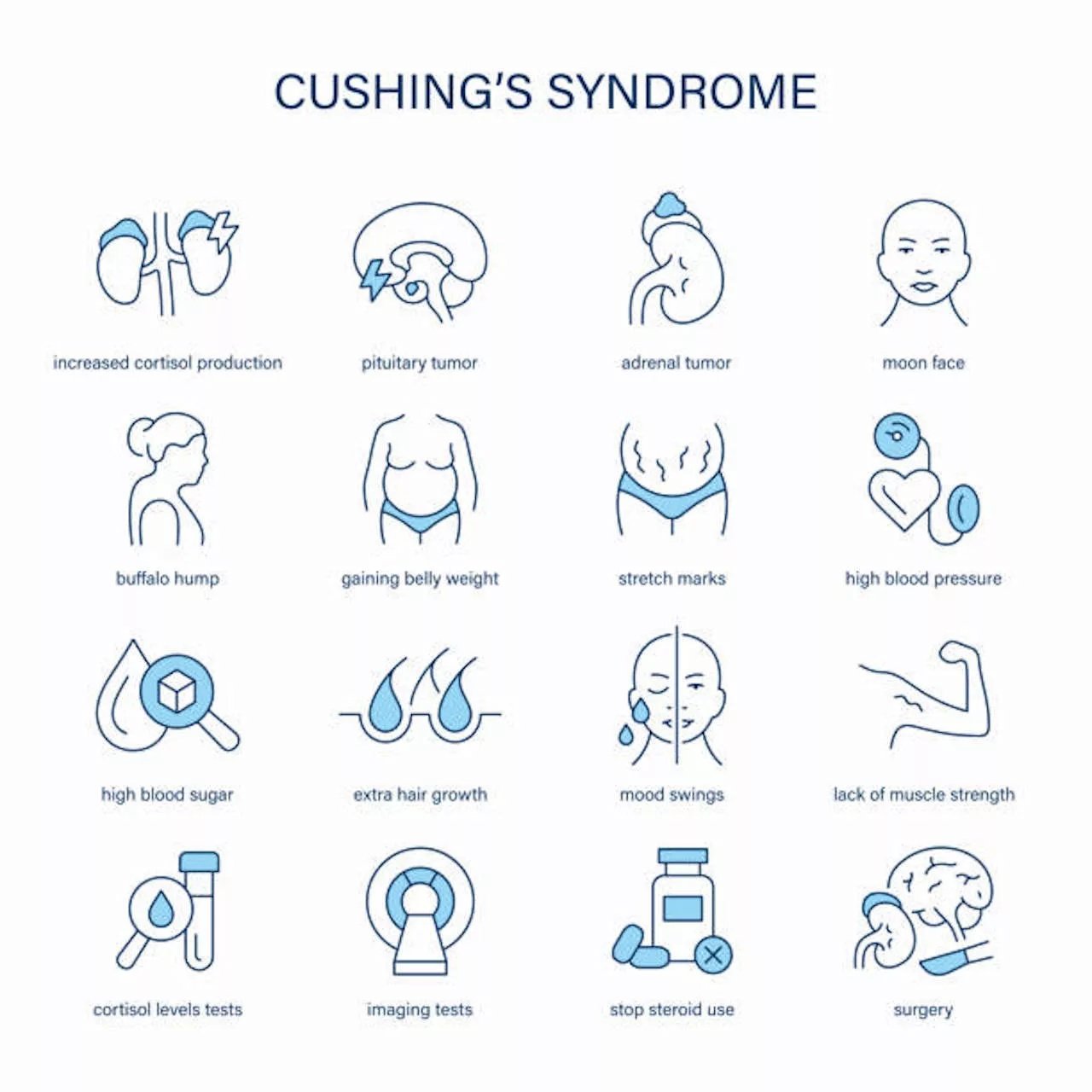
Cushing’s Syndrome Signs
Types of Cushing Syndrome
According to the cause and relation to adrenocortical hormone (ACTH) production, Cushing syndrome is divided into the following types:
1) Adrenocortical Hormone (ACTH) Dependent Cushing Syndrome:
In this type, there is excessive production of adrenocorticotropic hormone (ACTH), which results in excessive cortisol production. Its types are:
Pituitary-Dependent Cushing Syndrome
Pituitary-dependent Cushing syndrome is the most common cause of endogenous Cushing syndrome. It usually occurs due to the corticotroph adenomas.[6]
In addition, it can also occur due to the hypertrophy of corticotroph cells.
Ectopic Adrenocortical Hormone (ACTH) Syndrome & Excessive Corticotropin-Releasing Hormone (CRH ) Secreting Tumours
Ectopic Adrenocortical Hormone (ACTH) occurs due to some tumors other than pituitary gland tumors. The origin of these tumors is any malignant carcinoma that spreads to different areas of the body. These are neuroendocrine (hormone-secreting) tumors, which include bronchial carcinoma, pancreatic cancer, gastrointestinal tract tumours, lung carcinoma, thymic carcinomas, and pheochromocytoma.
Moreover, excessive corticotropin-releasing conditions are difficult to diagnose. In such cases, there is excessive production of the corticotropin hormone, which causes the adrenocorticotropic hormone (ACTH) to be produced.
2) Adrenocortical Hormone (ACTH) Independent Cushing Syndrome
Adrenocortical hormone (ACTH) independent forms of Cushing syndrome include:
Adrenal Carcinoma:
Adrenal carcinomas cause adrenocortical hormone-independent Cushing syndrome. Their incidence is 0.2 per million per year.[7]
Adrenal Adenomas:
Adrenal adenomas cause adrenocorticotropic hormone (ACTH) independent Cushing syndrome, which secretes glucocorticoids and adrenal hormones. They are most common in women over 35 years of age.
Bilateral Macro Nodular Adrenocortical Disease (BAMD):
It was previously known as bilateral adrenal hyperplasia. In this disease, there is hyperplasia (an increase in the number of cells) of the adrenal gland. These cells have receptors that secrete excessive cortisol, leading to Cushing syndrome.
Primary pigmented nodular adrenocortical disease (PPNAD):
Primary Pigmented Nodular Adrenocortical Disease (PPNAD) causes Cushing syndrome through autonomous overproduction of cortisol by multiple small pigmented nodules in the adrenal cortex.
3) Exogenous Glucocorticoids Administration:
Exogenous administration of glucocorticoids can also lead to Cushing’s syndrome. It is common in people who are dependent on steroids for the treatment of various diseases. Its incidence depends on the frequency and dose of steroids.
How is Cushing Syndrome Diagnosed?
For the diagnosis of Cushing syndrome, a detailed history, examination, and investigations are important:
History:
Your doctor may ask you questions like:
- Do you experience recent weight gain, skin changes, menstrual abnormalities, anxiety, mood swings, or glucose intolerance?
- Do you have a family history of this disease? Do you have a history of any other endocrine disease in the past?
- What kind of lifestyle do you have? Do you drink alcohol? Do you have a history of glucocorticoid intake for any disease?
- What is the onset, duration, and progression of your symptoms? Are there any factors that aggravate or relieve your symptoms?
Examination:
After taking a complete history, your doctor performs a complete general physical examination. The doctor looks for obesity, striae, moon face, buffalo hump, skin changes, and hair loss. They also check your pulse rate and blood pressure.
Investigations:
The doctor advises investigations like:[8]
24 Hours Urinary Cortisol Levels
This test tells cortisol levels in your twenty-four-hour urine sample. Your doctor asks you to collect a 24-hour urine sample and have it tested for cortisol levels at the laboratory. Elevated urinary free cortisol on at least two separate collections confirms hypercortisolism.
Midnight Salivary Cortisol Levels
Midnight Salivary Cortisol Levels are helpful in the diagnosis of Cushing syndrome because cortisol levels are very low at night. They check it between 11 and 12 pm. In Cushing syndrome, this circadian rhythm is lost, and midnight salivary cortisol remains high, making it a sensitive screening tool.
Dexamethasone Suppression Test:
The dexamethasone suppression test works on a feedback mechanism. It evaluates how your body’s cortisol responds to a synthetic glucocorticoid. Taking Dexamethasone reduces cortisol production in normal individuals but fails to reduce cortisol production in patients with Cushing’s syndrome. It can be performed as a low-dose dexamethasone suppression test, a high-dose dexamethasone suppression test, or an overnight dexamethasone suppression test.
- Low Dose Dexamethasone Suppression Test
In a low-dose dexamethasone suppression test, your doctor gives you one milligram of dexamethasone at 11 PM, and your serum cortisol is measured between 8 and 9 AM. Then, they check the cortisol levels in your body between 8:00 a.m. and 9:00 a.m. If cortisol levels reduce, it means you do not have Cushing syndrome. But if the levels are high, it means you have Cushing syndrome. In healthy individuals, cortisol levels fall below 1.8 µg/dL (50 nmol/L). Failure to suppress cortisol suggests Cushing syndrome.
- High Dose Dexamethasone Suppression Test
In this test, your doctor administers a high dose of dexamethasone (8 milligrams) at 11 pm, and cortisol levels are measured between 8 and 9 am. A >50% reduction in cortisol compared to baseline suggests Cushing disease (pituitary origin), while no suppression suggests an adrenal or ectopic ACTH source.
Interpretation Of the Dexamethasone Suppression Test
The interpretation of the dexamethasone suppression test is crucial for diagnosing and differentiating various causes of Cushing syndrome. Normally, dexamethasone suppresses adrenocorticotropic hormone (ACTH) secretion from the pituitary gland, leading to a fall in cortisol levels. In patients with Cushing syndrome, this suppression fails to occur, depending on the underlying cause.
In healthy individuals, dexamethasone administration causes more than a 50% decrease in plasma cortisol levels. Urinary free cortisol levels are typically less than 20 μg/24 hours (or <50 nmol/24 hours). Failure to suppress cortisol levels after dexamethasone confirms hypercortisolism, but further testing is needed to determine whether the condition is ACTH-dependent or ACTH-independent.[9]
Moreover, the dexamethasone suppression test also helps in differentiating different types of Cushing syndrome.
| Etiology Related To Cushing Syndrome | Low-dose dexamethasone suppression test | High Dose Dexamethasone Suppression Test |
|---|---|---|
| Pituitary tumor (Cushing Disease) | No suppression | Pituitary tumor (Cushing’s Disease) |
| Adrenal Tumor (Adenoma or Carcinoma) | No Suppression | No suppression |
| Ectopic Adrenocortical Hormone (ACTH) Secreting Tumours | No suppression | No suppression |
Plasma Adrenocorticotropic Hormone (ACTH) Test
After biochemical confirmation and interpretation of suppression tests, additional tests are performed to identify the source. Plasma ACTH measurement helps differentiate ACTH-dependent (pituitary or ectopic) from ACTH-independent (adrenal) Cushing syndrome.
- Low ACTH levels → suggest an adrenal cause (adrenal adenoma or carcinoma) because high cortisol suppresses pituitary ACTH.
- Normal or elevated ACTH levels → indicate an ACTH-dependent cause, such as Cushing disease (pituitary adenoma) or ectopic ACTH secretion from a non-pituitary tumor.
Your doctor may recommend imaging studies, such as an MRI of the pituitary gland or a CT scan of the adrenal glands, to identify the exact location of the tumor or abnormal tissue.
Magnetic Resonance Imaging (MRI)
Your doctor may suggest magnetic resonance imaging (MRI) of your pituitary gland to check for tumors. Mostly, magnetic resonance imaging studies detect adenomas. Doctors use its results in conjunction with biochemical studies to treat the condition.[10]
Additionally, your doctor may recommend a magnetic resonance imaging (MRI) scan of the abdomen to detect any masses in your adrenal glands.
Computed Tomography (CT) Scan Abdomen
Your doctor may advise you to undergo a computed tomography (CT) scan of the abdomen to detect any tumour in your adrenal glands, such as adenomas or carcinoma.
Management of Cushing Syndrome
The management of Cushing syndrome involves treating both the underlying cause and its symptoms.
Surgery:
Your doctors may perform surgery to remove the mass in your body that is causing Cushing syndrome. It can be an adrenal mass, a mass in the pituitary gland, or any other body mass releasing cortisol or adrenocorticotropic hormone (ACTH).
Transphenoidal Surgery
For adrenocortical hormone ACTH-dependent Cushing syndrome, transsphenoidal surgery is the treatment of choice. The preferred treatment for Cushing disease (pituitary adenoma).[11]
Bilateral Adrenalectomy
Another option for the treatment of Cushing’s syndrome is bilateral adrenalectomy. It is preferred in adrenal adenomas or carcinomas causing ACTH-independent Cushing syndrome. Moreover, it is effective in young people who have a desire to protect fertility, and radiotherapy is unsuitable. It is also considered in refractory cases, such as Primary Pigmented Nodular Adrenocortical Disease (PPNAD) or persistent disease after pituitary surgery. However, after this procedure, patients need to take glucocorticoids and mineralocorticoids for the rest of their lives.
Radiotherapy:
If the patient has no issues with fertility, radiotherapy is the first treatment option. In addition, your doctor may give you radiotherapy after transphenoidal surgery.
Chemotherapy:
If the tumor is malignant (e.g., adrenocortical carcinoma), chemotherapy may be required.
Medical Treatment:
Although treatment of Cushing syndrome is surgical, in many cases, medical treatment has a significant role in the management of this syndrome. It is also helpful in case of some contraindication for surgery, unfit patients for surgery, or failed surgery. Your doctor may also give you medical treatment months before surgery to reduce the levels of cortisol in your body.
Treatment options include adrenal enzyme inhibitors, adrenolytic agents, ketoconazole, and glucocorticoid receptor inhibitors.
Ketoconazole
It works by reducing cortisol production in your body (Inhibits adrenal steroidogenesis). Moreover, it is also effective in adrenocortical hormone production at ectopic sites.
Metyrapone
Metyrapone is an inhibitor of the enzyme 11 beta hydroxylase that inhibits cortisol production in your body.
Mitotaine
Your doctor may prescribe mitotane. It inhibits steroid synthesis by inhibiting cortisol and aldosterone production.
Etomidate
Your doctor may prescribe you etomidate. It inhibits adrenocortical hormone secretion by inhibiting the 11-beta hydroxylase enzyme.
Pasireotide
A somatostatin analogue used for Cushing disease when surgery fails or is not possible.
Addison’s Disease Vs. Cushing Syndrome:
| Cushing Syndrome | Addison Disease | |
|---|---|---|
| Definition | Cushing syndrome occurs due to excessive cortisol production in your body. | Addison’s disease occurs due toadrenal insufficiency,which causes low cortisol and aldosterone production in the body. |
| Symptoms | Symptoms of Cushing syndrome include striae, truncal obesity, moon face, hirsutism, buffalo hump, bruising, depression, and skin thinning. | Symptoms of Addison’s disease include fatigue, weight loss, skin pigmentation, low blood pressure, and electrolyte imbalance. |
| Causes | Causes of Cushing syndrome include adrenal hyperplasia, adrenal adenomas, adrenal carcinomas, pituitary gland tumours, and steroid intake. | Causes of Addison’s disease include infections, tuberculosis, tumors, autoimmune infection of your adrenal gland, and genetic disorders. |
| Treatment | Treatment of Cushing syndrome involves removing the cause of the disease from your body, such as any tumors or adenomas. | Your doctor treats Addison’s disease with hormone replacement therapy. |
Prognosis of Cushing Syndrome
The mortality rate of Cushing syndrome was 50 percent before the development of proper treatment. Common causes of mortality were cardiovascular, thrombotic, or hypertensive complications. Even now, the mortality rate is high. Mostly, it is due to increased coagulation and opportunistic infections.
Moreover, recent studies have shown that recurrence of Cushing syndrome is common even after complete treatment.[12]
Conclusion
Cushing syndrome is a neuroendocrine disorder that occurs due to excessive production of cortisol in your body. Its symptoms include obesity, moon face, striae, buffalo hump, skin thinning, mood changes, depression, and hypertension. Causes include pituitary mass, adrenal masses like adenomas and carcinomas. Treatment of Cushing syndrome is surgical removal of the mass causing the disease, as well as medical treatment.
References
[1] Valassi, E., Santos, A., Yaneva, M., Tóth, M., Strasburger, C. J., Chanson, P., Wass, J. A., Chabre, O., Pfeifer, M., Feelders, R. A., Tsagarakis, S., Trainer, P. J., Franz, H., Zopf, K., Zacharieva, S., Lamberts, S. W., Tabarin, A., Webb, S. M., & ERCUSYN Study Group (2011). The European Registry on Cushing’s syndrome: 2-year experience. Baseline demographic and clinical characteristics. European journal of endocrinology, 165(3), 383–392. https://doi.org/10.1530/EJE-11-0272
[2] Etxabe, J., & Vazquez, J. A. (1994). Morbidity and mortality in Cushing’s disease: an epidemiological approach. Clinical endocrinology, 40(4), 479–484.
[3] Feingold, K. R., Ahmed, S. F., Anawalt, B., Boyce, A., Chrousos, G., Dungan, K., Grossman, A., Hershman, J. M., Kaltsas, G., Koch, C., Kopp, P., Korbonits, M., McLachlan, R., Morley, J. E., New, M., Perros, P., Singer, F., & Trence, D. (2024).Cushing’s Syndrome.InEndotext. MDText.com, Inc.
[4] Nieman, L. K., Biller, B. M. K., Findling, J. W., Newell-Price, J., Savage, M. O., Stewart, P. M., & Montori, V. M. (2015). Cushing syndrome: update on signs, symptoms and biochemical screening.European Journal of Endocrinology, 173(4), M1–M12.
[5] Ross, E. J., & Linch, D. C. (1982). Cushing’s syndrome–killing disease: discriminatory value of signs and symptoms aiding early diagnosis. Lancet (London, England), 2(8299), 646–649.
[6] Gicquel, C., Le Bouc, Y., Luton, J. P., Girard, F., & Bertagna, X. (1992). Monoclonality of corticotroph macroadenomas in Cushing’s disease. The Journal of clinical endocrinology and metabolism, 75(2), 472–475.
[7] Lindholm, J., Juul, S., Jørgensen, J. O., Astrup, J., Bjerre, P., Feldt-Rasmussen, U., Hagen, C., Jørgensen, J., Kosteljanetz, M., Kristensen, L., Laurberg, P., Schmidt, K., & Weeke, J. (2001). Incidence and late prognosis of Cushing’s syndrome: a population-based study. The Journal of clinical endocrinology and metabolism, 86(1), 117–123.
[8] Findling, J. W., & Raff, H. (2017).Cushing’s Syndrome: Important issues in diagnosis and management.The Journal of Clinical Endocrinology & Metabolism, 102(12), 4523–4534. https://doi.org/10.1210/jc.2017-01313
[9] Nieman, L. K., Biller, B. M. K., Findling, J. W., Newell-Price, J., Savage, M. O., Stewart, P. M., & Montori, V. M. (2008).The diagnosis of Cushing’s syndrome: An Endocrine Society Clinical Practice Guideline.The Journal of Clinical Endocrinology & Metabolism, 93(5), 1526–1540. https://doi.org/10.1210/jc.2008-0125
[10] Hall, W. A., Luciano, M. G., Doppman, J. L., Patronas, N. J., & Oldfield, E. H. (1994). Pituitary magnetic resonance imaging in normal human volunteers: occult adenomas in the general population.Annals of internal medicine,120(10), 817–820.
[11] Biller, B. M., Grossman, A. B., Stewart, P. M., Melmed, S., Bertagna, X., Bertherat, J., Buchfelder, M., Colao, A., Hermus, A. R., Hofland, L. J., Klibanski, A., Lacroix, A., Lindsay, J. R., Newell-Price, J., Nieman, L. K., Petersenn, S., Sonino, N., Stalla, G. K., Swearingen, B., Vance, M. L., … Boscaro, M. (2008). Treatment of adrenocorticotropin-dependent Cushing’s syndrome: a consensus statement.The Journal of clinical endocrinology and metabolism,93(7), 2454–2462.
[12] Sarlis, N. J., Chanock, S. J., & Nieman, L. K. (2000). Cortisolemic indices predict severe infections in Cushing syndrome due to ectopic production of adrenocorticotropin. The Journal of clinical endocrinology and metabolism, 85(1), 42–47.