


Fructose Intolerance Identify Fructose intolerance is a broad term used to describe conditions in which the body is unable to properly absorb or metabolize fructose. Fructose is a naturally occurring simple sugar found in fruits, vegetables, honey, and table sugar (sucrose). When fructose is not adequately absorbed or metabolized, it can lead to gastrointestinal or metabolic disturbances. Importantly, fructose intolerance does not represent a single disease. Instead, it refers to two distinct conditions that differ significantly in their underlying mechanisms, severity, and long-term health consequences. The confusion of the terminology makes it significant to make a clear distinction between these forms.[1]
- Fructose malabsorption (also known as dietary fructose intolerance) is the first type of digestive disorder in which the small intestine fails to absorb fructose. This is a rather widespread condition that develops in adulthood.
- The second one is hereditary fructose intolerance or HFI, which is a rare genetic disorder that appears at birth and leads to severe and life-threatening complications unless properly treated.
Symptoms of Fructose Intolerance: Fructose Intolerance Identify
The symptoms manifested will depend on the type of fructose intolerance that one has. This knowledge of the differences assists in making a correct diagnosis and suitable treatment.
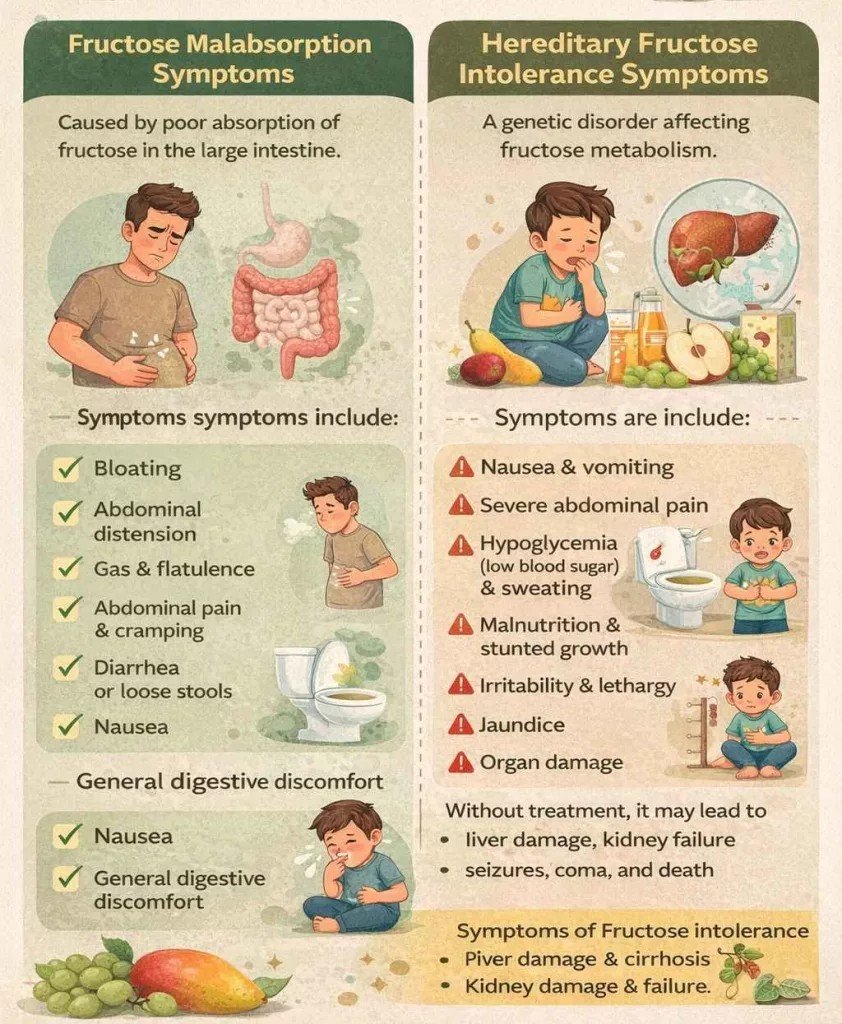
Visual overview of key symptoms of fructose intolerance, highlighting differences between fructose malabsorption and hereditary fructose intolerance.
Fructose Malabsorption Symptoms
Individuals who have fructose malabsorption usually develop gastrointestinal symptoms that manifest within a few hours of taking food rich in fructose. These symptoms are a consequence of undigested fructose that is fermented in the large intestine and is broken down by bacteria to produce gas.[2]
Common symptoms include:
- Bloating
- Abdominal distension
- Gas and flatulence
- Abdominal pain and cramping
- Diarrhea or loose stools
- Nausea
- General digestive discomfort
Symptoms of Hereditary Fructose Intolerance (HFI)
Hereditary fructose intolerance has more severe symptoms, which normally manifest in infancy when the infants start taking hard food or formula that contains fructose. The symptoms manifest the toxic accumulation of fructose-1-phosphate in the liver, kidneys, and intestines.[3]
In children, the following symptoms are seen:
- Fructose, after consumption, causes nausea and vomiting
- Severe abdominal pain
- Sweating with low sugar in the blood (hypoglycemia) and confusion
- Malnutrition and inability to grow
- Irritability and lethargy
- Jaundice
The further intake of fructose, without treatment, may result in:
- Liver damage and cirrhosis
- Hepatomegaly (enlarged liver)
- Kidney damage and failure
- Seizures
- Progressive coma
- Retarded growth in children
- Neurodevelopmental impairment due to recurrent hypoglycemia if untreated
- Death in severe cases
Fructose Intolerance Causes
The two major types of fructose intolerance have very different causes, and that is why the diagnosis is very important to effective treatment.
Causes of Fructose Malabsorption
The fructose malabsorption may be caused by a number of factors that influence the small intestine’s ability to absorb fructose effectively. The major mechanism is intestinal issues with GLUT5 transporters that normally facilitate the transfer of fructose out of the intestine into the blood.[4]
Fructose malabsorption may be caused by many factors.
- The absorptive capacity of the small intestine can be affected by inflammation or damage to the intestine. This is caused by celiac disease, inflammatory bowel disease (Crohn’s disease or ulcerative colitis), or acute gastroenteritis.
- Excessive intake of fructose may saturate the natural absorption process of the small intestine.
- Stress may influence the GI tract and accelerate the symptoms, especially among individuals with irritable bowel syndrome, but it is not a primary cause of fructose malabsorption.
- Disproportionate gut microbiota, which occurs after intestinal infections or administration of antibiotics, can change fructose tolerance.
- Genetic variation has an influence on the activity level of the fructose transport proteins, such as GLUT5, among individuals.
What Causes Hereditary Fructose Intolerance?
This is a disorder caused by gene mutations in the ALDOB gene, which is involved in the production of the enzyme aldolase B.[5] This enzyme is found in the liver, as well as in the kidneys and the lining of the small intestine. Aldolase B is a key factor in the metabolism of fructose, as it breaks down fructose-1-phosphate into two smaller molecules, namely glyceraldehyde and dihydroxyacetone phosphate.
How is it inherited?
The hereditary fructose intolerance is autosomal recessive in nature. It is implied that parents have to bear one copy of the mutated ALDOB gene to pass the condition on to their child. Carrying parents do not show any symptoms.[6]
When both parents are carriers:
- Every child will have a 25 percent probability of inheriting both mutated genes and the condition.
- Every child will be at a 50 percent risk of being a carrier similar to the parents.
- Each child stands a 25 percent probability of not inheriting any gene.
Its prevalence is estimated at 1-20000 to 30000, and carrier frequency is estimated at 1-70 in Europe. The condition cuts across all races and has no sex preference.[7]
Fructose Intolerance Diagnosis
A proper diagnosis must be done since the two forms of fructose intolerance should be handled in different ways. Depending on the condition that the healthcare givers suspect, they employ various diagnostic techniques.
Diagnosis of Fructose Malabsorption
Fructose malabsorption is assessed with the help of a test known as the hydrogen breath test. It is a non-invasive procedure that determines the level of hydrogen and methane gas in the breath samples following the intake of fructose solution.[8]

Breath test used in the evaluation of fructose intolerance and SIBO.
The mechanism of the test: When fructose remains unabsorbed, it reaches the large intestine, where gut bacteria ferment it and produce hydrogen gas. This hydrogen enters the bloodstream, travels to the lungs, and is exhaled, allowing clinicians to detect it in breath samples.
Results interpretation: If breath hydrogen levels rise by more than 20 parts per million (ppm) above baseline, clinicians consider the test positive for fructose malabsorption. The presence of gastrointestinal symptoms along with elevated hydrogen levels supports the diagnosis of dietary fructose intolerance.
Diagnosing Hereditary Fructose Intolerance
The severity of the condition and the risks of exposure to fructose make the diagnosis of hereditary fructose intolerance require other strategies.
The initial stage of clinical examination is a dietary history. Clinicians seek a correlation between the symptoms and the intake of fructose, especially among infants.
Laboratory results that are indicative of hereditary fructose intolerance are:
- Hypoglycemia after intake of fructose.
- Decreased phosphate
- Increased Uric acid
- Elevated liver enzymes (AST and ALT)
- High levels of magnesium
- Lactic acidosis
- Prolonged coagulation times in severe cases
- Fructosuria may occur after fructose exposure, but it is not diagnostic
Genetic testing is the choice of diagnostic technique as it is not invasive and is very sensitive. The test involves the analysis of DNA in a blood sample or cheek swab to determine the mutation in the ALDOB gene.[9]
Fructose Malabsorption vs Intolerance
You can differentiate the two conditions with the help of the following table.
| Feature | Fructose Malabsorption | Hereditary Fructose Intolerance |
|---|---|---|
| Cause | Intestinal dysfunctional GLUT5 transporters | Aldolase B enzyme deficiency is a genetic mutation of the ALDOB gene |
| Age of onset | Usually develops in adulthood | Present from birth, symptoms manifest in infancy |
| Inheritance | Not hereditary, brought about by several factors | Autosomal recessive inherited disease |
| Prevalence | Common, with a high rate of breath-test positivity, fewer individuals develop clinically significant symptoms | Rare, affects 1 in 20,000-30,000 individuals |
| Location of the problem | Small intestine absorption issue | Problems with liver, kidney, and intestinal cell metabolism. |
| Fructose location | Present in stool | Present in urine |
| Severity | Not serious, however, uncomfortable. | When left untreated it is life-threatening. |
| Symptoms | Mostly of digestive (bloating, gas, diarrhea, pain) origin. | Metabolic disorders |
| Tolerance level | Usually can handle 10-15g of fructose per day | Should not take fructose at all in life |
| Prognosis | Good with dietary management | Good when early diagnosed and diet adhered to; bad when untreated. |
| Diagnostic test | Hydrogen breath test | Genetic testing (DNA analysis) |
| Treatment approach | Low-fructose diet with some flexibility | Permanent strict fructose-free diet. |
Fructose Intolerance Treatment
Treatment varies depending on the type of fructose intolerance diagnosed. With appropriate dietary modifications, clinicians can successfully manage both conditions.
Treatment of Fructose Malabsorption
Fructose malabsorption mainly requires treatment with a low-fructose diet, reducing the intake of fructose. Complete elimination is not typically required, as opposed to hereditary fructose intolerance.[10]
First elimination phase: Start by entirely eliminating foods high in fructose in the diet within 2-4 weeks. This will help the symptoms resolve and establish a baseline of a symptom-free zone.
Gradual reintroduction: Once the symptoms are gone, gradually reintroduce fructose-containing foods one by one to determine the level of tolerance. The majority of individuals with fructose malabsorption would be able to absorb 10-15 grams of fructose daily without any symptoms.
Keep to the diet of low-fructose diet, but within individual tolerability. It is also found that a lot of people can enjoy small portions of the lower-fructose foods, particularly when they are taken together with foods with glucose that can help to facilitate the absorption of the fructose food.[11]
Therapy of Hereditary Fructose Intolerance
The management of hereditary fructose intolerance involves lifelong adherence to a strict diet that is free of fructose. This is not only to make one feel good but to survive and avoid organ damage.[12]
Full avoidance of fructose: All the sources of fructose, sucrose (table sugar), and sorbitol should be avoided in the diet. This is not only the natural sources within fruits and vegetables, but also the added sugar within the processed foods, drugs, and even certain infant formulas.
Critical dietary restrictions:
- No fruits or fruit juices
- None of the honey or sweeteners should contain fructose.
- No high fructose corn syrup products
- None of the table sugar (sucrose) decomposes to fructose and glucose
- No sorbitol, which is developed into fructose in the body
- Test all medicines, vitamins, and supplements for fructose or sorbitol
Oral glucose may be used for mild hypoglycemia, while severe episodes require intravenous glucose in a medical setting. Management must always be supervised by healthcare professionals. Every individual affected by hereditary fructose intolerance should always have glucose pills.
Medical alert identification: The patient must be wearing a medical alert bracelet identified as having a condition, since in emergency situations, accidental administration of fructose may be fatal.
Fructose Malabsorption/ Intolerance Diet Plan
To develop a realistic diet plan, one has to be familiar with the foods to avoid and the ones that are safe to consume. The given limitations are for whether one has fructose malabsorption or hereditary fructose intolerance.[13]
Foods to Avoid
You should strictly avoid high-fructose foods. Apples, pears, mangoes, watermelon, cherries, and all dried fruits are problematic fruits. Do not use sweeteners, such as high-fructose corn syrup, honey, agave syrup, and fruit juice concentrates. Certain vegetables, e.g, artichokes, asparagus, and enormous amounts of onions, can also cause symptoms. Do not take fruit juices or sweet drinks and sugar alcohols like sorbitol and xylitol present in sugar-free items.
In hereditary fructose intolerance, even trace amounts must be avoided, such as all fruits, honey, or table sugar.
Generally Safe Foods
Numerous healthy foods with low or no fructose may form the basis of a healthy diet:
Proteins (naturally fructose-free):
- Fresh meat (beef, pork, lamb)
- Poultry (chicken, turkey)
- Fresh fish and seafood
- Eggs
- Tofu (firm, unseasoned)
- Nuts (some, such as almonds, walnuts, and peanuts, may be tolerated in small amounts; cashews and pistachios may trigger symptoms)
- Seeds
Grains and starches:
- Rice (white, brown, wild)
- Oats
- Bread products (wheat, pasta, not sweetened)
- Corn (plain)
- Potatoes
- Quinoa
Dairy products (unflavored):
- Milk
- Plain yogurt
- Cheese
- Butter
- Cream
Lower-fructose fruits (for malabsorption only, in moderation):
- Berries
- Citrus fruits
- Bananas (small amounts)
- Cantaloupe
Vegetables:
- Leafy greens (spinach, lettuce, kale)
- Cucumbers
- Zucchini
- Green beans
- Carrots (in moderation)
- Broccoli
- Cauliflower
- Bell peppers
Fats and oils:
- Olive oil
- Vegetable oils
- Coconut oil
- Avocado
Beverages:
- Water
- Plain tea and coffee
- Milk (unflavored)
Important Dietary Tips
Be careful with the labels: Fructose is disguised in processed foods in the form of high-fructose corn syrup, fruit juice concentrate, honey, and corn syrup solids. Avoid sugar-free products- many of these have sorbitol or other sugar alcohols.
Glucose enhances absorption: When you take glucose together with fructose, it has better tolerance. Food items containing equal quantities of fructose and glucose (as seen in small portions of table sugar) are more tolerable than those with surplus fructose.
Maintain a food diary: This is a journal of food writings and symptoms to examine stimuli and the level of individual tolerance.
Check drugs: Fructose, sorbitol, or sucrose in most drugs, vitamins, and supplements. One should never take new drugs without checking with the pharmacist.
Reintroduce gradually: One will need to test one new food at a time, with intervals of several days between each food to clearly determine the problem foods.
Conclusion
Fructose intolerance consists of two different conditions that necessitate varying treatment methods. Fructose malabsorption is a common digestive disorder with undesirable but manageable symptoms through a flexible diet low in fructose. Hereditary fructose intolerance is a very rare genetic condition that involves life long food-free fructose diet that may prevent serious health problems.
The guiding factors to the best results are early symptom identification and partnership with the medical practitioners. Having the right dietary control, people with fructose intolerance are able to live a good life and live.
In case you or your child cannot tolerate fructose, visit a medical professional and receive the required assessment. When it comes to the treatment of this condition, everything is a matter of time.
References
[1] Rumessen JJ, Gudmand-Hoyer E. Absorption capacity of fructose in healthy adults. Comparison with sucrose and its constituent monosaccharides.Gut. 1986;27:1161-1168.
[2] Jones HF, Butler RN, Brooks DA. Intestinal fructose transport and malabsorption in humans.American Journal of Physiology-Gastrointestinal and Liver Physiology. 2011;300(2):G202-G206.
[3] Steinmann B, Gitzelmann R, Van den Berghe G. Hereditary fructose intolerance. In: Valle D, Beaudet AL, Vogelstein B, et al., eds.The Online Metabolic and Molecular Bases of Inherited Disease. McGraw-Hill; 2014
[4] Andrade D, Charlebois A. Fructose malabsorption, gut microbiota and clinical consequences: A narrative review of the current evidence.Life. 2025;15(11):1720.
[5] Davit-Spraul A, Piraud M, Dobbelaere D, et al. Hereditary fructose intolerance: Frequency and spectrum mutations of the aldolase B gene in a large patient cohort from France—Identification of eight new mutations.Molecular Genetics and Metabolism. 2008;94(4):443-447.
[6] Malay AD, Allen KN, Tolan DR. Structure of the thermolabile mutant aldolase B, A149P: molecular basis of hereditary fructose intolerance.Journal of Molecular Biology. 2005;347(1):135-144.
[7] Gibson PR, Newnham E, Barrett JS. Dietary restriction of fermentable oligo-, di-, monosaccharides and polyols (FODMAPs) in patients with irritable bowel syndrome.Journal of Human Nutrition and Dietetics. 2007;20:363-373.
[8] Misselwitz B, Pohl D, Frühauf H, et al. Lactose malabsorption and intolerance: pathogenesis, diagnosis and treatment.United European Gastroenterology Journal. 2013;1(3):151-159.
[9] Bijarnia-Mahay S, Movva S, Gupta N, et al. Molecular Diagnosis of Hereditary Fructose Intolerance: Founder Mutation in a Community from India.JIMD Reports. 2016;26:39-46.
[10] Iacovou M, Tan V, Muir JG, Gibson PR. The Low FODMAP Diet and Its Application in East and Southeast Asia.Journal of Neurogastroenterology and Motility. 2015;21(4):459-470
[11] Staudacher HM, Whelan K. The low FODMAP diet: recent advances in understanding its mechanisms and efficacy in IBS.Gut. 2017;66(8):1517-1527
[12] Shepherd SJ, Gibson PR. Fructose malabsorption and symptoms of irritable bowel syndrome: guidelines for effective dietary management.Journal of the American Dietetic Association. 2006;106(10):1631-1639.
[13] Enko D, Meinitzer A, Mangge H, et al. Concomitant prevalence of low serum diamine oxidase activity and carbohydrate malabsorption.Canadian Journal of Gastroenterology and Hepatology. 2016;2016:4893501.