

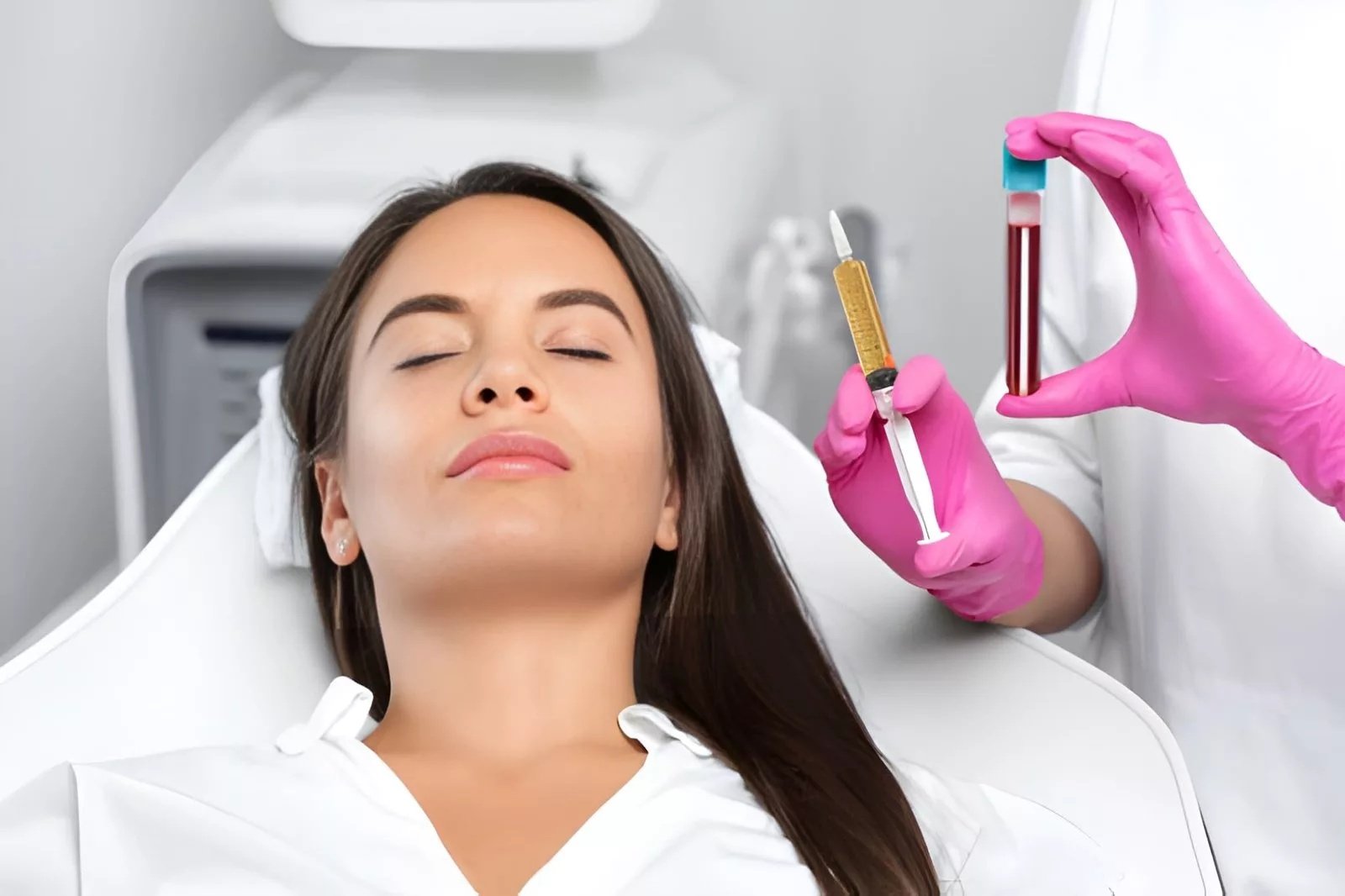
PRP Treatment Everything Imagine that the greatest healing weapon and the best tool to heal your hair, skin, and joints was already in your own body? People spend thousands on treatments that hardly cover up conditions such as loss of hair, aging skin, and chronic pain in the joints. PRP treatment is a therapy that directly uses the natural growth factors of your own blood, which is a clinically proven method of recovery and renewal without surgery or chemicals.
What Is PRP Treatment?: PRP Treatment Everything
PRP stands for Platelet-Rich Plasma. To know what PRP treatment is, you should first know what blood is composed of. Blood has red cells, white cells and platelets suspended in a liquid known as plasma. Platelets are probably most commonly known to create clots when you cut yourself, but that is not all they do. They can store hundreds of growth factors that are natural signals of the body to heal and repair tissues.[1]
PRP is formulated in a manner that it has five to ten times more platelets than a normal blood sample, and when this supersaturated plasma is injected into diseased or damaged tissue, the growth factors within it could be effective in enhancing symptoms and wound healing.
The process is simple and has the following steps:
- A small sample of blood is taken from the arm of the patient.
- The blood is put in a centrifuge, which is a machine that is rotated at a high speed.
- The centrifugation divides the blood into three layers: platelet-poor plasma, PRP, and red blood cells, with the PRP being placed in between the other two layers.
- The PRP so obtained is then removed and injected into the area of need.
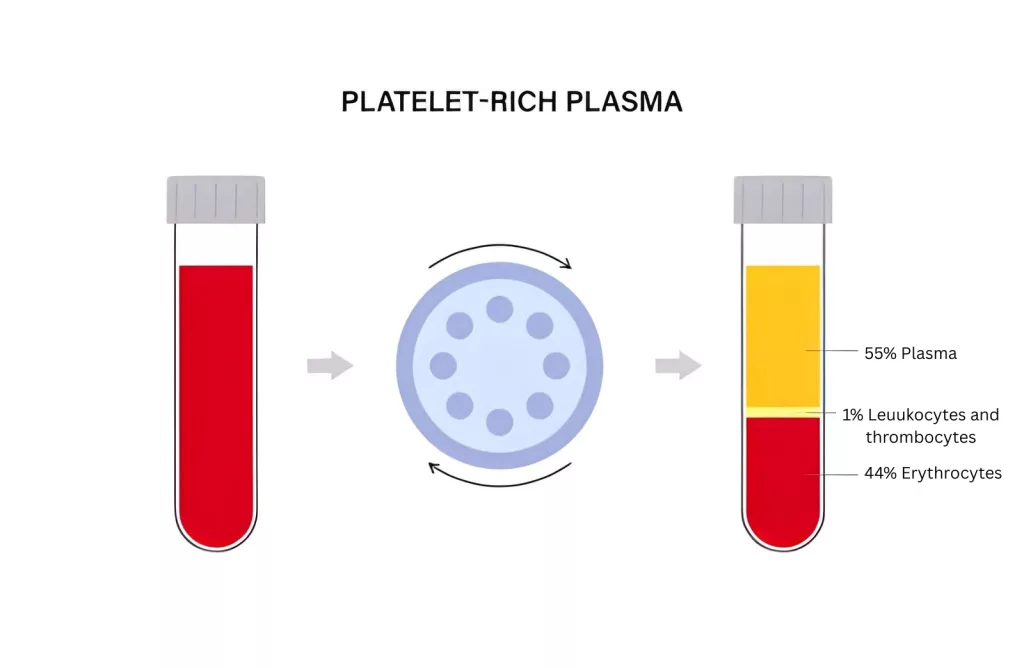
Illustration of centrifugation process separating erythrocytes and platelet-rich plasma used in PRP treatment.
Since PRP is produced by your own body, there is a low possibility of an allergic reaction as compared to other injectable drugs, and the treatment may be conducted independently or may be employed with other procedures.
How Does PRP Actually Work?
PRP has a biological basis to its healing mechanism. Blood platelets have vital roles, such as the liberation of growth factors that are necessary in the healing of wounds, and the growth factors trigger the stem cells to generate the new host tissue as fast as possible.
The platelet-derived growth factor (PDGF), insulin-like growth factor (IGF), vascular endothelial growth factor (VEGF), and transforming growth factor beta (TGF-beta) are some of the key growth factors that are stored in platelet granules. These molecules participate in processes such as cell proliferation, tissue regeneration, and the formation of new blood vessels.[2]
Just imagine that you are providing your body with a boost of electricity. Rather than letting your system build a healing pool of resources at a point of injury slowly, PRP puts the concentrated resources in the exact location they are required.
What Conditions Can PRP Treat?
PRP is not a one-trick solution. It has been used in the fields of orthopedics, dermatology, sports medicine, and aesthetics.
PRP is useful in treating patellar tendinopathies, knee osteoarthritis, and lateral epicondylitis. Several recent randomized controlled trials have demonstrated the superiority of PRP over both corticosteroids and hyaluronic acid in treating knee osteoarthritis-related symptoms.
PRP treatment is extensively applied to the cosmetic aspect and is used to:[3]
- Hair loss and thinning
- Under-eye dark circles and fine lines
- Facial skin rejuvenation
- Acne scarring
- Post-surgical healing
PRP Hair Treatment: Does It Really Regrow Hair?
Hair loss is the most emotionally painful experience that a human being may go through, and PRP hair treatment has become one of the most promising non-surgical treatments that can be offered today.[4]
PRP hair treatment is focused on androgenetic alopecia, the most prevalent form of hair loss that results in up to 80 percent of men and 50 percent of women at some stage of their lives. When the PRP is injected into the scalp, the growth factors spread to the hair follicles and act to reverse miniaturization which is the process through which follicles reduce in size and eventually cease to produce hair.
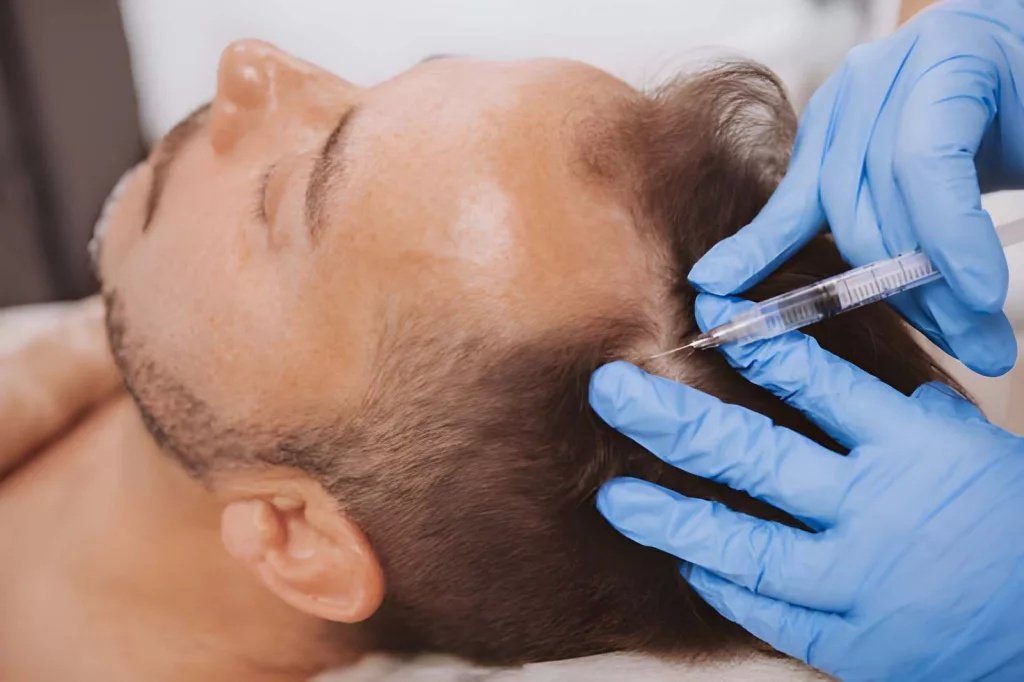
Close-up of a trichologist performing scalp injections to treat male pattern hair loss (alopecia).
Research suggests PRP may help prolong the growth phase (anagen phase) of hair follicles and increase follicle activity.
A historic clinical trial had quantifiable outcomes. Patients treated after three PRP treatment sessions showed a mean increase of 33.6 hairs in the target area and 45.9 hairs/cm² in hair density compared with baseline.[5]
A typical treatment plan involves three to six sessions spaced about four weeks apart, followed by maintenance sessions every four to six months. Typical results are seen in two to three months after the initial session and further improvement in six to twelve months.
PRP Under Eye Treatment: A New Dark Circles Solution
The skin below the eyes is one of the thinnest on the whole face. It does not contain the fatty tissue that pads other parts and thus is highly sensitive to the dark circles, fine lines, loss of volume, and a generally tired look. PRP under-eye therapy has already become a real trend due to its biological and low-risk nature in this difficult area.[6]
Clinical measurements have shown a significant improvement in skin firmness due to increased collagen production and an increase in skin elasticity due to increased elastin production following PRP injections in the lower eyelid region. The procedure is safe, effective, and virtually pain-free.

Illustration of PRP plasmolifting therapy showing facial skin tightening and rejuvenation effects.
The expected outcome of PRP under-eye treatment is a 30 to 50 percent decrease indark circleappearance, skin texture, and fine lines in one to two months of treatment. Most patients showed maximum improvement after three sessions with a four-week gap between the sessions, with effects lasting twelve to eighteen months.
It is also notable that PRP under the eyes does not replace the surgery or filler in all instances. PRP may be useful in enhancing the skin of the eyelids to treat wrinkles, sun damage, and discoloration; it will not give a lifting or tightening effect, and it does not treat bags under the eyes as a result of prolapsed orbital fat. A candid discussion with a certified practitioner will assist in defining which PRP, filler, or both should be used on a particular concern.
The Vampire Facial and Beyond: PRP Treatment for Face
You may have heard of the so-called Vampire Facial, a social media–driven trend that combines microneedling with the topical application of PRP. However, PRP for the face extends far beyond celebrity trends. Clinicians use it as a well-established option to improve overall skin quality, texture, tone, and visible signs of aging.[7]
At the three and six-month follow-up, clinical assessments indicated moderate to excellent improvements in periorbital dark circles, periorbital wrinkles, nasolabial folds, and skin rigidity of patients who underwent PRP facial injections, with the greatest effect observed in dark circles and wrinkles.
When applied to the face, PRP stimulates the collagen and elastin-making fibroblasts. The higher the level of collagen, the firmer the skin and the more elastic. Fine lines soften. The general texture becomes better. Since the improvement is produced by your own tissue repair processes, it will not appear artificial.
PRP may be applied to the face using two major methods:
- Injection: PRP is injected directly into targeted areas such as the tear troughs, nasolabial folds, or temples.
- Microneedling with PRP: Multiple tiny channels are formed in the skin by means of a microneedling device, and PRP is applied over the skin so that it can absorb deeply into the skin. This is especially used on acne scarring as well as overall skin texture.
Most providers recommend two to three treatment sessions spaced four to six weeks apart, followed by maintenance treatments once or twice per year.
PRP Treatment Success Rate: Research Results
This is because one of the most frequently asked questions by individuals before commencing treatment is: Does PRP work? The fair answer is that it will depend on the condition being addressed and the way the treatment is performed. Although the overall scenario is positive.
The following is a brief description of what the available clinical evidence indicates:[8]
| Condition | Reported Success / Improvement Rate | Notes |
|---|---|---|
| Androgenetic Alopecia (Hair Loss) | 70 to 84% of patients | Higher success with early-stage hair loss |
| Hair Density Increase | 30 to 40% increase after 3 to 6 months | Based on clinical trials |
| Under-Eye Skin Firmness | Statistically significant improvement | Increased collagen and elastin confirmed |
| Facial Dark Circles | Up to 74% improvement at 6 months | Evaluated by a physician’s assessment |
| Knee Osteoarthritis | Outperforms corticosteroids and hyaluronic acid | Supported by multiple RCTs |
| Patient Satisfaction (Hair) | 76% average satisfaction rate | Across meta-analyses |
Review Study
Hair loss studies often report improvements in hair density or thickness in approximately 60–80% of patients, particularly in early-stage androgenetic alopecia.[9] Clinical results indicate that the average growth of hair thickness is 31 percent after half a year of use.
A review identified 84 percent of published studies reporting a positive effect of PRP for the treatment of hair loss, and therefore, PRP is a well-supported treatment in the medical literature.
However, PRP does not necessarily cure. The outcomes depend on age, the severity of the condition, sessions attended, the quality of PRP preparation, and the overall health of a patient. It is better when initiated in early stages and adhered to the prescribed measures.
PRP Treatment Price: What Will It Cost You?
One of the most realistic issues that people consider is the cost of PRP treatment. It significantly differs between providers, places, and treatment areas.[10]
The cost of treatment ranges between $250 to $1,500 per session, and the treatment might require several sessions before showing results. In the case of hair restoration in particular, an initial series of three to four hair treatments may cost an average of $1,500 to $3,500, and follow-up treatments may cost $500 and $1,000 on average.
In the case of joint and orthopedic applications, the average yearly PRP injection costs have been reported between about $711 and $1711, depending on the body part being injected, with the average cost per injection generally hitting $1,000 in 2019.[11]
In the majority of countries, cosmetic PRP treatment is not reimbursed by health insurance. And therefore, the entire cost of PRP treatment is usually borne by the patient. Other providers have package pricing in which they offer discounts on the per-session cost when you purchase a group of sessions.
Who Should (and Should Not) Consider PRP?
PRP is a good choice that is suitable for individuals who:[12]
- Reporting to have early to moderate thinning of hair.
- Desire a non-surgical method of skin rejuvenation that is natural.
- Need to enhance the under-eye with no filler.
- Dealing with chronic joint pain or tendon injuries
PRP should not be used in patients:[13]
- Those who have a history of clotting, bleeding, or any other blood disorders.
- Those who have a history of some cancers, such as skin cancer.
- The pregnant, breastfeeding patients
- Those on anti-coagulants and with active infections at the site of the treatment are also usually not good candidates.
What to Expect Before, During, and After Treatment
Most providers will request you to discontinue taking medications that thin the blood, such as aspirin and ibuprofen. Before your session, drink a lot of water and take a light meal. The process itself normally lasts 30 to 60 minutes from the drawing of blood to the injection.[14]
The initial effect of PRP treatment will be some swelling and pain. That is an indication of inflammation and the commencement of the healing process. These symptoms can last for a day or two after treatment.
It may take several weeks before initial results begin to manifest themselves. And the entire impact may require three to six months to manifest itself. In hair, the effects keep improving up to a year after therapy. The PRP shots remain active in the body up to six months or nine months.
Final Thoughts
PRP treatment occupies a very interesting niche in contemporary medicine. It is not a magic pill, and neither is it hype with no substance. It is a science-based, least invasive method that utilizes what you already produce to assist in healing and regeneration. In the case of hair loss, under-eye issues, facial rejuvenation, or joint pain, the study indicates significant improvements in the patients.
When looking at PRP, the very first thing that should happen is to talk with an experienced, qualified provider who can diagnose your particular case and set realistic expectations. Outcomes are a long process, and to most patients, the time is worth it.
References
[1] Anitua, E., Andia, I., Ardanza, B., Nurden, P., & Nurden, A.T. (2004). Autologous platelets as a source of proteins for healing and tissue regeneration.Thrombosis and Haemostasis, 91(1), 4–15.
[2] Eppley, B.L., Woodell, J.E., & Higgins, J. (2004). Platelet quantification and growth factor analysis from platelet-rich plasma: Implications for wound healing.Plastic and Reconstructive Surgery, 114(6), 1502–1508.
[3] Kon, E., Buda, R., Filardo, G., Di Martino, A., Timoncini, A., Cenacchi, A., … Marcacci, M. (2010). Platelet-rich plasma: Intra-articular knee injections produced favorable results on degenerative cartilage lesions.Knee Surgery, Sports Traumatology, Arthroscopy, 18(4), 472–479.
[4] Gentile, P., Garcovich, S., Bielli, A., Scioli, M.G., Orlandi, A., & Cervelli, V. (2015). The effect of platelet-rich plasma in hair regrowth: A randomized placebo-controlled trial.Stem Cells Translational Medicine, 4(11), 1317–1323.
[5] Gentile P, Garcovich S, Bielli A, Scioli MG, Orlandi A, Cervelli V. The effect of platelet-rich plasma in hair regrowth: A randomized placebo-controlled trial.Stem Cells Transl Med.2015;4(11):1317-1323. doi:10.5966/sctm.2015-0107.
[6] Mehryan, P., Zartab, H., Rajabi, A., Pazhoohi, N., & Firooz, A. (2014). Assessment of efficacy of platelet-rich plasma (PRP) on infraorbital dark circles and crow’s feet wrinkles.Journal of Cosmetic Dermatology, 13(1), 72–78.
[7] Sclafani, A.P., & Azzi, J. (2015). Platelet preparations for use in facial rejuvenation and wound healing: A critical review of current literature.Facial Plastic Surgery, 31(1), 8–19.
[8] Gupta, A.K., Renaud, H.J., & Rapaport, J.A. (2022). Rising use of platelet-rich plasma in dermatology: A review.Dermatologic Surgery, 48(1), 1–10.
[9] Anitua, E., Tierno, R., & Alkhraisat, M.H. (2025). Platelet-Rich Plasma in the Management of Alopecia: A Systematic Review and Meta-Analysis of Clinical Evidence.Dermatology and Therapy, 15(11), 3213–3252.
[10] Yerlan, A., Dmitriy, B., Alisher, K., & Zarina, A. (2020). Health economic evaluation of platelet-rich plasma therapy in musculoskeletal medicine: A systematic review.Orthopaedic Journal of Sports Medicine, 8(9), 2325967120950292.
[11] Lana, J.F., Weglein, A., Sampson, S.E., Vicente, E.F., Huber, S.C., Souza, C.V., … Belangero, W.D. (2016). Randomized controlled trial comparing hyaluronic acid, platelet-rich plasma and the combination of both in the treatment of mild and moderate osteoarthritis of the knee.Journal of Stem Cells and Regenerative Medicine, 12(2), 69–78.
[12] Fitzpatrick, J., Bulsara, M., & Zheng, M.H. (2017). The effectiveness of platelet-rich plasma in the treatment of tendinopathy: A meta-analysis of randomized controlled clinical trials.The American Journal of Sports Medicine, 45(1), 226–233.
[13] Lacci, K.M., & Dardik, A. (2010). Platelet-rich plasma: Support for its use in wound healing.Yale Journal of Biology and Medicine, 83(1), 1–9.
[14] Filardo, G., Di Matteo, B., Kon, E., Merli, G., & Marcacci, M. (2018). Platelet-rich plasma in tendon-related disorders: Results and indications.Knee Surgery, Sports Traumatology, Arthroscopy, 26(7), 1984–1999.