
 is an infection that is so widespread that more than 90 percent of adults around the world have...)

Epstein Barr Virus Epstein-Barr virus (EBV) is an infection that is so widespread that more than 90 percent of adults around the world have this virus in their bodies.[1] In the majority of cases, the infection goes unnoticed, and the symptoms are often not present at all. However, in some individuals, especially adolescents and young adults, EBV can cause an illness called infectious mononucleosis (commonly known as “mono”). Beyond mono, EBV has a complex relationship with the immune system and has been linked to several rare but serious health conditions.
What Is the Epstein-Barr Virus?: Epstein Barr Virus
Epstein-Barr virus is classified under the family herpesvirus and is officially known as human herpesvirus 4 (HHV-4). British virologist Michael Epstein and Irish researcher Yvonne Barr first identified the virus in 1964 as they worked on a form of cancer known as Burkitt’s lymphoma.[2]
The most important point to note about the EBV is that, after being infected, the virus remains in your body forever. Once the primary infection is resolved, EBV does not go away; it merely goes into the so-called latent stage, and silently lies dormant in some immune cells (primarily B lymphocytes) without causing any disease. The healthy immune system puts it in check, and in the case of the vast majority of people, that is where the story stops.
How does someone get infected with EBV?
EBV is transmitted mostly by saliva, which is why the disease, which most often causes infectious mononucleosis, was informally referred to as the kissing disease. Transmission through blood transfusion, organ transplantation, or sexual contact is possible but uncommon, and the virus generally requires close contact involving saliva rather than casual exposure.[3]
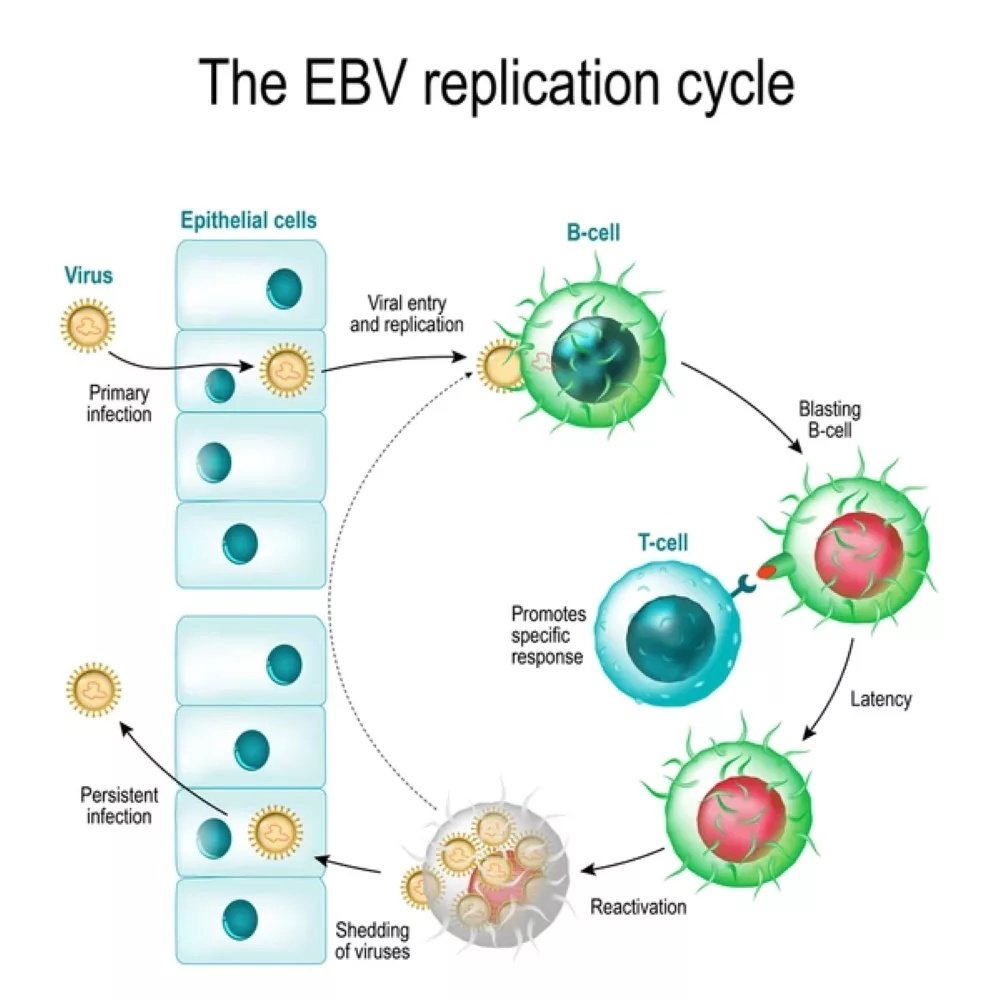
The Epstein–Barr virus replication cycle, including infection of epithelial cells, B-cell latency, and viral reactivation.
What is the difference between the Mono and Epstein-Barr Virus?
EBV and mono are also not similar terms, though they are often used interchangeably. EBV is the virus itself -a microorganism that enters your organism and stays there forever. Mono or infectious mononucleosis is the disease caused by EBV in its active stage. Not all people who get infected by EBV contract mono; a large number of people, especially children, do not show any symptoms at all. Also, other viruses such as cytomegalovirus may be the cause of mono-like symptoms, though it is EBV that causes approximately 70–90 percent of mononucleosis.[4]
What are the Symptoms of EBV?
The symptoms of an active EBV infection can be extremely different and are, in many cases, dependent on the individual and, in most cases, the age of the infected person. A large number of individuals, especially young children, do not have any visible signs at all or only a few of them. The virus is effectively resisted by their bodies, and they develop immunity and are never aware that they were ill.[5]
People who are first exposed to EBV during their teenage years or early adulthood tend to develop more noticeable and severe symptoms. Infectious mononucleosis is the most common manifestation, and it may also involve:
- Severe fatigue – this is usually characterized by an acute or long-lasting tiredness that may take weeks or, in some individuals, several months.
- Fever – high and protracted at times
- Sore throat – frequently severe, making swallowing painful
- Swollen lymph nodes – You can find these in the neck, but also in the armpits or the groin.
- Mild abdominal pain – sometimes with a swollen spleen or liver, and hence the need to rest and take care during the healing process.
It is important to note that not all people who have EBV get full-blown mono. There is mild fatigue and a sore throat in some of them, and some can feel much worse over a number of weeks. The speed of recovery differs, although in the majority of cases, individuals are well enough in two to four weeks.
Diagnosis and EBV Antibodies
Doctors will usually request a blood test in case they suspect EBV. The Monospot test is the most frequent first-line screening test and detects antibodies produced against the virus. This test is, however, not always reliable during the initial stage of infection and may sometimes give a false negative.[6]
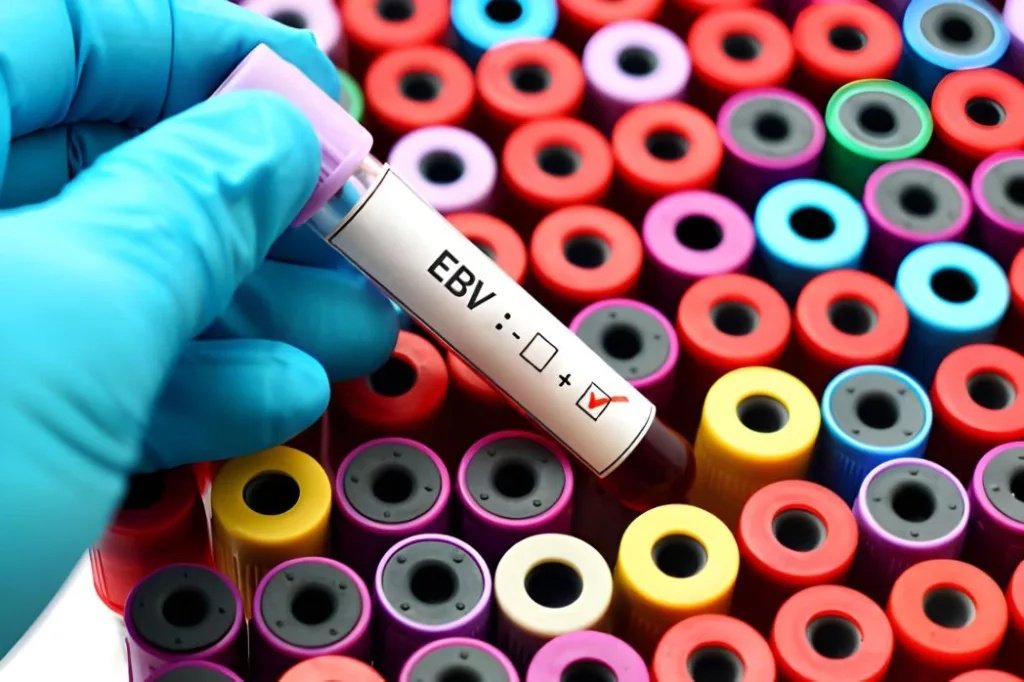
A laboratory blood sample showing a positive test result for Epstein–Barr virus (EBV), commonly used to help diagnose infectious mononucleosis and EBV infection.
To get an even better diagnosis, physicians may have tests run to detect certain EBV antibodies. These are specific tests that are quite handy since various antibodies convey various narrations:
- VCA IgM (Viral Capsid Antigen IgM): The test result of this antibody is usually a sign of a recent or ongoing infection of EBV. It is among the initial antibodies that are present in the body.[7]
- VCA IgG (Viral Capsid Antigen IgG): This antibody occurs when one has a previous infection and stays in the blood throughout life. Its existence in you proves that you have contracted EBV once, in the past or the present.
- EBNA (Epstein-Barr Nuclear Antigen): It is an antibody that usually manifests some weeks after infection. The presence of EBNA together with VCA IgG and the absence of VCA IgM is a great indication that there was a previous infection that has healed.[8]
Knowledge of these antibody patterns assists physicians in identifying individuals with an ongoing battle against EBV. And it is also helpful for those who had an infection many years ago and have already recovered. In case you have been tested on EBV antibody results and are confused by the results, a healthcare professional can explain to you the specifics of how it relates to your case.
Associated Conditions: What Diseases Are Connected to EBV?
This is one of the areas where EBV gets the most attention, and, understandably, causes the most anxiety. Besides infectious mononucleosis, the virus also has some relation to several health-related conditions. One should be able to make clear the difference between being associated with a condition and causing it. It involves many factors, which are genetic, environmental, and immunological.
Infectious Mononucleosis
Infectious Mononucleosis is, by far, the most common condition directly caused by EBV. It is the illness that most people think of initially, and due to the reasons outlined above, it is usually manageable by rest and time.
Cancers
EBV can cause certain types of cancer. These include:
- Burkitt’s lymphoma – a non-Hodgkin lymphoma that is mostly prevalent in some parts of Africa. It has a close relationship with EBV infection in childhood.
- Nasopharyngeal carcinoma – a cancer of the throat and the back of the nose. This is common in some areas of Southern China and Southeast Asia.[9]
- Hodgkin lymphoma – EBV occurs in some of these cases.
- There are certain forms of stomach cancer and other epithelial cancers – the relationship between the two is under investigation.
Other Conditions
Inflammatory and autoimmune diseases have also attracted a lot of attention. EBV has been researched in relation to multiple sclerosis (MS). And there is a growing body of research that indicates it may contribute to the development of the disease in genetically vulnerable individuals. Although it is one of the factors that can cause the disease.[10]
Chronic Active EBV (CAEBV) is a rare disease whereby the immune system does not adequately regulate the latent virus, and the condition results in chronic and recurrent symptoms, including fever, fatigue, and complications with the organs. This is a severe disease that should be medically managed, though it is rare.[11]
EBV is so incredibly widespread, and most of those who harbor the virus never encounter any of these diseases.
Life Expectancy and EBV: Does This Virus Shorten Your Life?
This is among the most frequent questions when people get to know about EBV – and the good news is that in the vast majority of cases EBV has no impact on life expectancy.
Think of it this way. EBV is carried by more than 90 percent of the adult population in the world. In case the virus has been reducing life expectancy, it would be one of the largest public health crises ever. Rather, it simply co-exists with the immune systems of billions of individuals without causing them any permanent damage.
EBV-associated diseases, such as some forms of cancer, themselves are severe, but occur in a very limited proportion of infected individuals, and are affected by many other factors. Being a carrier of EBV does not necessarily mean that you will definitely be sure to get these conditions.
The most important thing in long-term health is to have a healthy functioning immune system. Eating well, getting sleep, dealing with stress, and avoiding habits that undermine your immune system (drinking alcohol or smoking in large amounts, etc.) are all options to assist your body in remaining EBV-free and other dormant viruses.
In case you worry about your health or a history of some family members having an EBV-related disease, the best thing you can do is to discuss it with your doctor. They may assist you in knowing your risk profile as an individual and any form of monitoring that may be suitable.
The EBV Rash: What’s Going On with That?
A rash is also noticeable in some of the people who develop infectious mononucleosis, and that can be very frightening when you do not know what is behind it. The best-known case is antibiotics. When a person with active mono is put on amoxicillin or ampicillin (in some cases, the sore throat was confused with strep throat), a characteristic rash may appear on a large part of the body.[12]
This rash is most often maculopapular, i.e., these are flat red spots (macules), with small raised spots (papules). It may extend to the torso and arms, and it may be itchy. The positive thing is that it is mostly benign and will clear up when you stop the antibiotic. In most cases, this is not an indicator of an actual antibiotic allergy, so it is worth bringing up to your doctor in order to have it in your medical history.

A generalized maculopapular rash may appear in some patients with Epstein–Barr virus infection.
Also, rashes may sometimes appear without taking antibiotics in cases of mono, but this case is less frequent. When you have any unexplained rash when you are sick, it is always a good idea to have it examined by a medical expert.
Treatment and Management: Is There a Cure for EBV?
The concise and straightforward response is: No, at least there is neither a cure nor a special antiviral drug that will help rid the body of EBV. When the virus is present, it is in a dormant state forever. This may sound alarming, yet one should bear in mind that your immune system is exceptionally good at handling this.
In individuals with acute symptoms of infectious mononucleosis, supportive care is the main treatment. The aim is to assist the body in getting through the illness, as it does the actual work of combating the virus. This typically includes:[13]
- Rest – and plenty of it. Overworking the body can increase recovery.
- Hydration– because of a sore throat, hydration is important.
- Pain and fever relievers – the over-the-counter products such as acetaminophen or ibuprofen can treat the pain. It is also not recommended to use aspirin during viral infections, because of the possibility of a very rare side effect known as Reye syndrome.
- Avoiding contact sports, this is especially relevant in case of enlargement of the spleen; a ruptured spleen is a medical emergency of the first order.
Outside of the acute mono, researchers are also developing a treatment for EBV-associated cancers and chronic active EBV disease. There is research going on in antiviral drugs, immunotherapy modalities, and vaccine development. Although there is still no real cure yet to stop EBV at the moment, the research is heading in the right direction.[14]
To the average individual with a latent EBV infection, the most beneficial form of treatment is merely a normal, healthy, well-supported immune system. You can achieve this by making healthy lifestyle choices and being well within reach.
Conclusion:
Epstein-Barr virus is an interesting case study of human co-existence with infectious agents. Though the idea of its almost universal nature may appear frightening, the actual state of things is calming. The majority of individuals lead healthy lives with this virus despite having it. The knowledge of EBV will aid in demystifying such common diseases as mono and place some of its rare complications in perspective. The most important thing is that your immune system is extremely strong to ensure that EBV is under control forever. Making sure to keep your body healthy with the aid of proper nutrition, sleep, and managing stress, you are adding to the natural defenses of your body. In case of any concerns, request medical personnel who can give individual advice, depending on your specific situation.
References
[1] Khan G, Hashim MJ. Global burden of deaths from Epstein-Barr virus attributable malignancies 1990-2010.Infect Agent Cancer. 2014;9:38.
[2] Esau D. Viral Causes of Lymphoma: The History of Epstein-Barr Virus and Human T-Lymphotropic Virus 1.Virology (Auckl). 2017;8:1178122X17731772.
[3] Balfour HH Jr, Odumade OA, Schmeling DO, et al. Behavioral, virologic, and immunologic factors associated with acquisition and severity of primary Epstein-Barr virus infection in university students.J Infect Dis. 2013;207(1):80-88.
[4] Grotto I, Mimouni D, Huerta M, et al. Clinical and laboratory presentation of EBV positive infectious mononucleosis in young adults.Epidemiol Infect. 2003;131(1):683-689.
[5] Henle G, Henle W, Diehl V. Relation of Burkitt’s tumor-associated herpes-ytpe virus to infectious mononucleosis.Proc Natl Acad Sci U S A. 1968;59(1):94-101.
[6] Hess RD. Routine Epstein-Barr virus diagnostics from the laboratory perspective: still challenging after 35 years.J Clin Microbiol. 2004;42(8):3381-3387.
[7] Henle W, Henle GE, Horwitz CA. Epstein-Barr virus specific diagnostic tests in infectious mononucleosis.Hum Pathol. 1974;5(5):551-565.
[8] Klutts JS, Ford BA, Perez NR, Gronowski AM. Evidence-based approach for interpretation of Epstein-Barr virus serological patterns.J Clin Microbiol. 2009;47(10):3204-3210.
[9] Raab-Traub N. Epstein-Barr virus in the pathogenesis of NPC.Semin Cancer Biol. 2002;12(6):431-441.
[10] Bjornevik K, Cortese M, Healy BC, et al. Longitudinal analysis reveals high prevalence of Epstein-Barr virus associated with multiple sclerosis.Science. 2022;375(6578):296-301.
[11] Cohen JI, Jaffe ES, Dale JK, et al. Characterization and treatment of chronic active Epstein-Barr virus disease: a 28-year experience in the United States.Blood. 2011;117(22):5835-5849.
[12] Chovel-Sella A, Ben Tov A, Lahav E, et al. Incidence of rash after amoxicillin treatment in children with infectious mononucleosis.Pediatrics. 2013;131(5):e1424-1427.
[13] Candy B, Hotopf M. Steroids for symptom control in infectious mononucleosis.Cochrane Database Syst Rev. 2006;(3):CD004402.
[14] Cohen JI. Optimal treatment for chronic active Epstein-Barr virus disease.Pediatr Transplant. 2009;13(4):393-396.