

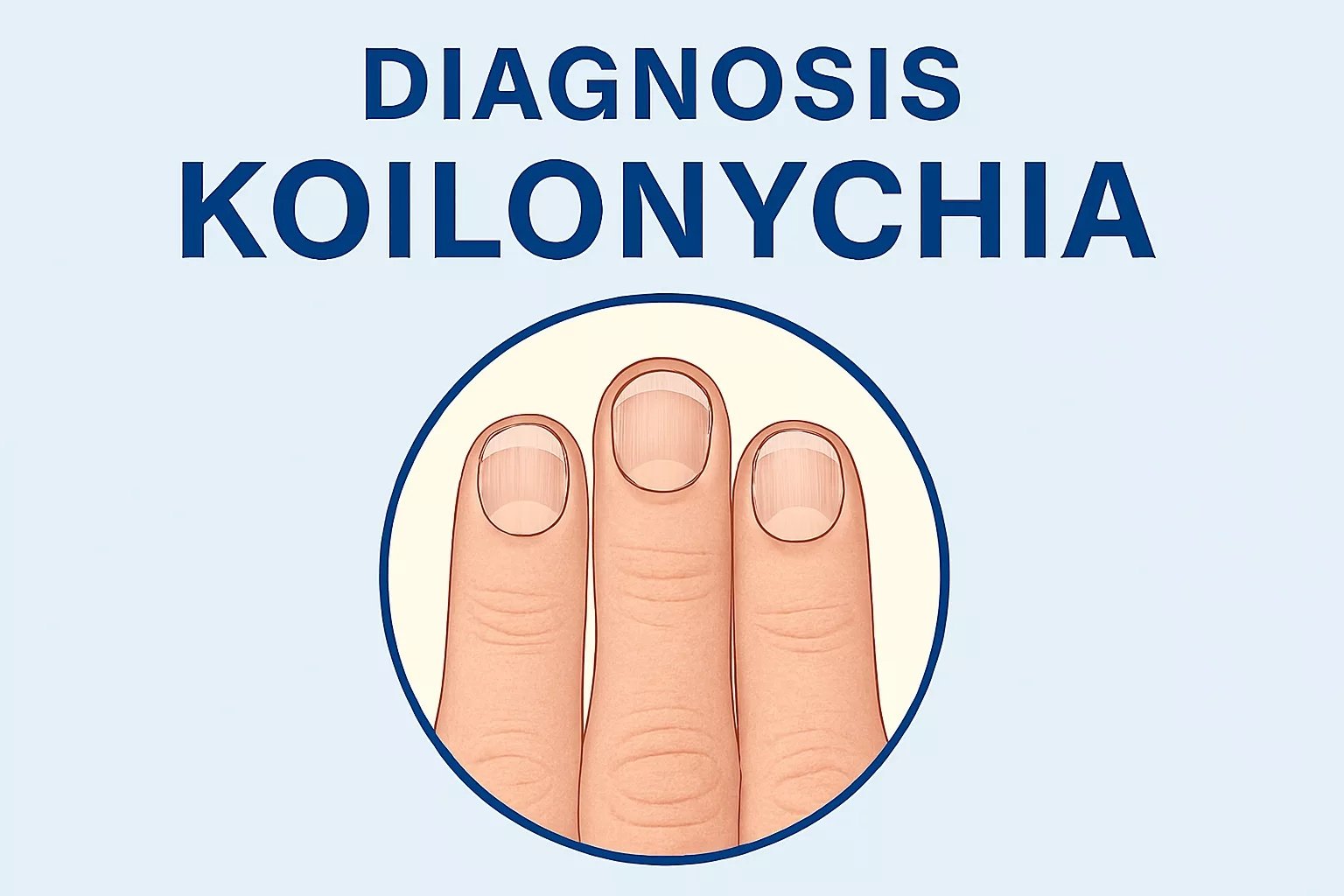
Koilonychia Spoon Nails Spoon-shaped nails, spoon nails, or koilonychia is the name given to a condition characterized by indentation of the nails, which makes them concave. It is a deformity of the nails in which the central portion of the nail plate is depressed while the lateral edges are elevated, giving it a characteristic spoon-like appearance. The term “koilonychia” is derived from the Greek words koilos, meaning “hollow” and onychia meaning “nails.”
The nail disorder is prevalent in residents of high altitudes. Reports find an estimated prevalence of 7-47% in Indian Himalayan communities.[1] Moreover, concave, spoon-shaped nails are frequently seen in infants. In a study of 52 cases, researchers noted koilonychia in 32.7% infants.[2]
The most common cause of kolinocyhia is iron deficiency. However, it may develop in patients with autoimmune disorders and thyroid issues. Healthcare providers treat the disorder by treating the underlying cause (mainly fixing iron deficiency with iron supplementation and dietary changes).
Koilonychia Symptoms : Koilonychia Spoon Nails
The onset of symptoms is usually gradual, and you will notice the changes in the nail over time. The nail condition can affect a few or all of your nails. Health experts divide koilonychia into different stages of progression.
What Are The Different Stages Of Koilonychia?
The nails don’t take a concave shape straight away, but rather follow a course of structural changes. To better understand the structural alterations in koilonychia, doctors divide the condition into three different stages:
Stage 1: Brittleness Of The Nails
The first step in the development of spoon nails is the increased fragility of the nails. The hard structures become rough and more prone to chipping. Thus, they break easily. Nail thinning usually accompanies brittleness.[3]

A normal and a thin, brittle, spoon-shaped nail.
Stage 2: Flattening Of The Nails
The next stage is characterized by an abnormal flattening of the nails, a condition known as platonychia. There have been adult kolinocyhia patients who have had flattened spoon nails since early childhood.[4] A flat-shaped stage is important to lay the foundation for concavity in the nails.
Stage 3: Spooning Of The Nails
The final stage of koiloncyhia is the spooning of the nails. There is a distinct spoon-like shaping, which the patient can notice. The curvature of the nail becomes so evident that patients can hold water in their nail. Hence, the water drop test is used as a diagnostic test for this nail deformity.[5]
Symptoms Associated With Underlying Causes Of Kolionychia
Koiloncyhia is a presentation of some underlying morbidity. In the vast majority of cases, it develops secondary to iron deficiency. A lack of this nutrient leads to a poor formation of red blood cells and consequent development ofanemia. Thus, most patients exhibit symptoms of iron deficiency anemia, like unexplained fatigue and shortness of breath. Iron deficiency anemia typically causes microcytic, hypochromic red blood cells due to reduced hemoglobin production rather than increased red blood cell fragility. Weakness and skin pallor are also common.
What Causes Koilonychia?
Several different causes are known to contribute to spooning of the nails. The most prevalent causes of koilonychia are discussed below:
Nutritional Deficiencies
Clinical studies conclude that nutritional deficiencies/imbalances are linked to changes in the nail structure. Iron deficiency is the most well-established nutritional cause of koilonychia. Vitamin E deficiency can induce changes in nail structures, leading to deformities like yellow nail syndrome. Similarly, a deficiency of iron can directly lead to leukonychia (white spot in nails) or spoon nails.[6]
The most common nutritional deficiency that converts the nail’s shape from convex to concave is iron deficiency. In a study, out of the 33 young children diagnosed with iron deficiency, 31 (94%) presented with koilonychia and 6 (18.2%) presented with platonychia. The study highlighted the high occurrence of spoon-shaped nails in iron-deficient kids.[7]
Other nutritional deficiencies, such as vitamin B12 and folate, may contribute indirectly through anemia, but they are not classic primary causes of koilonychia.
How Iron Deficiency Leads To Spoon Nails?
Iron, a micronutrient, is necessary for the development of a normal nail bed epithelium (a thin layer of skin present under the nail plate). Many experts believe that a deficiency of the nutrient causes abnormal growth and development of the nail, which contributes to spooning of nails.
Certain disorders, like the Plummer-Vinson syndrome and hemochromatosis, present with abnormal iron levels in the body. Plummer-Vinson patients have iron-deficiency anemia, leading to spoon nails.[8] On the other hand, hemochromatosis is characterized by iron overload. Although nail changes have occasionally been described in hemochromatosis, koilonychia is classically associated with iron deficiency rather than iron overload.
Trauma And Infection
Nail trauma is another cause of koilonychia. Injury to the nails can affect nail shape and induce concavity. Acquired nail disorders in pediatric patients are usually the result of direct trauma or injury.[9] In rare instances, fungal infections can also lead to spoon nails.
Autoimmune Disorders
Various autoimmune diseases can manifest as spoon nails. However, koilonychia is not a classic feature of most autoimmune disorders and is considered an uncommon association. Many systemic lupus erythematosus (SLE) patients note subtle changes in the nail shape. Similarly, dermatological autoimmune disorders likelichen planus and psoriasis can bring about changes in the nails. Nail psoriasis can cause pitting of the nails, which may convert into spooning.
Alopecia areata (AA) is an autoimmune disorder that leads to hair loss. In a 2021 clinical study, a 25-year-old female patient diagnosed with AA focalis presented with kolinocyhia.[10] Celiac disease is another immune disorder that causes inflammation of the small intestine in response to the consumption of gluten-containing products. Some people with celiac disease present with spoon nails.
Exposure To Organic Products
Repeated exposure of nails to organic solvents containing petroleum products is known to cause koilonychia. It has been noted that petroleum products present in cosmetic items (like chemical depilatories) can lead to nail changes. Unilateral koilonychia as a side effect of chemical depilatories has been reported in the literature.[11]
Health Conditions
Senile individuals suffering from different comorbidities can share similar nail dystrophies. Systemic diseases are known to have an impact on nail and hair health.[12] Turning normal convex nails into a water-holding concave shape structure is seen in plenty of disorders, including:
Raynaud’s Disease:
Raynaud’s phenomenon or disease is an abnormality of the blood vessels characterized by narrowing that eventually leads to severe compromise of blood flow to the skin and nails. This hypoxic (lack of oxygen) environment potentiates changes in the nail structure. Koilonychia in Raynaud’s disease is a rare finding, but it can still happen.[13] It can lead to long-term scooping of the nails on both hands.[14]
Hypothyroidism:
Thyroid insufficiency interferes with your normal growth. Medical literature shows that hypothyroidism (lack of thyroid hormone due to an underactive thyroid gland) is linked to different changes in nails, including nail brittleness, onycholysis (nail separation from the bed), and spoon nails. However, koilonychia is not a classic or common nail manifestation of diabetes and, when present, is often related to associated anemia or systemic factors.[15]
Diabetes:
Patients with advanced diabetes may also end up having abnormally shaped nails. Skin presentations (eczema, painful peeling of palms/soles’ skin) and nail presentations (koilonychia) are frequently seen in diabetes patients. These presentations seem to have a relationship with the intensity of the disease.[16]
Nail analyses reveal that spoon-shaped nails are present in hemochromatosis patients who also suffer from diabetes.[17]
Cardiac pathologies can also manifest as changes in your nails.
Genetic Factors
Nail dystrophy may accompany different genetic disorders. Therefore, many experts believe kolionychia to have a genetic component too. Nail-patella syndrome is a disease in which patients have abnormal kneecaps, hip bones, and nails.
Risk Groups
A lack of oxygen in the blood and a deficiency of iron in the body increase your propensity to develop koilonychia. Following is a list of groups who are at a higher risk of spoon nails and why they have an increased likelihood:
- Old people have poor absorption of iron from the diet.
- Malnourished children suffer from different nutritional deficiencies (iron and vitamins, etc.).
- Vegetarians have low dietary intake of iron (due to non-consumption of meat).
- People living at high altitudes are constantly exposed to low oxygen levels, making them prone to nail and skin changes.
- Hairstylists have their hands persistently exposed to kolionychia-causing petroleum products (present in skincare/hair products).
- Cancer patients have iron storage and absorption abnormalities.
Koilonychia Diagnosis
In the vast majority of cases, patients visit a clinic for associated symptoms instead of the nail indentations. Doctors begin with a physical examination of your nails and notice the extent of structural changes. Your health provider may allot your condition a stage (flattening, platonychia, etc.).

Close-up image of a finger with koilonychia.
After the examination, your doctor will take your history and ask questions related to iron deficiency anemia. These steps may be paired with a diagnostic test for koilonychia.
Water-Drop Test
A famous diagnostic test for kolinychia is the water-drop test. In this test, the doctor places a few drops of water on the affected nail and observes the water drop. In normal. Healthy nails, the water runs off, but in the presence of scooping, the water stays, confirming a diagnosis of koilonychia.
Another similar test is the bead retention test, in which the health provider places a small bead (mostly spherical plastic beads) in the concavity of your nail. In true kolinychia cases, the bead stays put. This confirms the diagnosis and also helps differentiate spooning from other types of nail changes. [18]
The next step is to identify the underlying causes that are leading to indenting in the nails. For this, your doctor might order a battery of tests. The most commonly ordered tests include:
Iron Studies
As the most common cause of koiloncyhia is iron deficiency, serum levels of the mineral are crucial in diagnosing and treating the nail dystrophy accordingly.
The serum iron test checks the amount of iron in your blood, while the serum ferritin test measures the amount stored in the body. Low levels of ferritin are indicators of iron deficiency. A total iron-binding capacity (TIBC) reveals the ability of your blood to carry iron by measuring the levels of transferrin (an iron-transport protein). Transferrin levels (and consequently TIBC values) rise when there is low iron in the blood due to deficiency or hemochromatosis.
CBC
A complete blood count is done to check anemia, which may be linked to iron deficiency. A CBC is usually paired with iron levels for diagnosis.
Thyroid tests
An underactive thyroid can also contribute to spooning of nails. Therefore, a thyroid test is ordered when hypothyroidism is suspected.
Autoimmune Markers
Notably, autoimmune disorders like psoriasis and alopecia can induce changes in your nails. Therefore, when suspected, doctors recommend that you have autoimmune markers checked.
Differential Diagnosis
Different nail dystrophies can have similar presentations. Therefore, doctors must differentiate between the various conditions to aptly treat the deformity.
Koilonychia Vs Clubbing
Both nail deformities result from changes in nail matrix growth, but the causes and results are completely different. Where koilonychia causes upward curving of the nail (changing it to a concave shape), clubbing causes downward curving (making the nail a highly convex, upside-down spoon). Koilonychia arises mainly due to iron deficiency, and clubbing of nails develops as a result of heart and lung pathologies. Moreover, spoon nails are brittle and easy to break, while clubbed nails are thick and spongy.
Koilonychia Treatment
In infants, the nail shape becomes regular in time if there’s no genetic disorder. In the vast majority of infants diagnosed with kolinychia, the condition resolves completely without any intervention. However, adults need treatment for the indenting nails. Improving iron reserves/levels of the body is the mainstay of koilonychia, as it is the most prevalent cause of nail spooning. The first step in management is shifting to an iron-rich diet and taking iron supplements.
You can find ample amounts of iron in the following items:
- Red meat and seafood (fish)
- Vegetables (especially green-leafy) like spinach, kale, and peas
- Beans and lentils
- Fortified grain products (like cereals)
- Nuts (cashew) and seeds
- Tofu
- Fruits like figs and dates
- Dark chocolate
You can also get iron in the form of a medicinal supplement to cover up your body’s nutritional deficiencies. These supplements are known to improve kolinychia and wound healing in patients.[19]
In cases other than iron-deficiency, healthcare providers target the underlying morbidity and irritation causing the nail changes. For example, thyroid medications can improve hypothyroidism, and disease-modifying antirheumatic drugs (DMARDs) can control autoimmune disorders, which can reverse nail changes.
Can Koilonychia Be Reversed?
Yes, in cases of spooning due to iron deficiency, koilonychia can be reversed with dietary modifications and supplementation. However, it is a slow and long process that usually takes 6-18 months.
How Can You Prevent Koilonychia?
You can prevent iron deficiency (anemia) and kolinychia by taking the officially recommended dose of iron daily, i.e., 8 milligrams in adult males and 18 milligrams in females. If you are a vegetarian, you must consume more iron (almost twice) as plant-based diets make absorption of iron (in the gut) difficult. Moreover, you will also need to take foods rich in vitamin B12 and C to ensure better absorption of the mineral.
Hairstylists and professionals who repeatedly expose their hands to petroleum products should use gloves to prevent skin/nail.
Wrapping Up
Koilonychia is a nail dystrophy characterized by upward turning of the nails into a spoon shape. It most commonly arises due to iron deficiency in the body (and associated disorders), but is also linked to other causes like autoimmune disorder, hypothyroidism, diabetes, and repeated exposure to petroleum products, etc. According to the stages of the disease, the nails become brittle (first stage) and then go flat (in the 2nd stage), and finally become concave. In addition to nail fragility, patients may also experience other symptoms of iron deficiency anemia (because of the high prevalence of koilonychia in iron deficiency anemia patients).
Physical examination and the water-drop/bead test help doctors diagnose the nail dystrophy. However, doctors order iron studies too to investigate iron levels in detail. In most cases, treatment involves increasing iron intake. This is achieved by consuming iron-rich foods (like green vegetables, red meat, etc.) and iron supplements. You can reverse the nail changes with dietary alterations, but it generally takes several months.
References
[1] Hill, R. C., & Lipner, S. R. (2025). Koilonychia. InAtlas of Nail Disorders Across All Skin Colors: A Comprehensive Guide to Navigating Nails(pp. 251-259). Cham: Springer Nature Switzerland.
[2] Chinazzo, M., Lorette, G., Baran, R., Finon, A., Saliba, É., & Maruani, A. (2017). Nail features in healthy term newborns: a single‐centre observational study of 52 cases.Journal of the European Academy of Dermatology and Venereology,31(2), 371-375.
[3] Walker, J., Baran, R., Vélez, N., & Jellinek, N. (2016). Koilonychia: an update on pathophysiology, differential diagnosis and clinical relevance.Journal of the European Academy of Dermatology and Venereology,30(11), 1985-1991.
[4] Hashizume, Y., Nakamura, D., Suzuki, S., & Endo, Y. (2017). Very rare familial spoon nails (Koilonychia).Journal of General and Family Medicine,18(4), 168.
[5] Chelidze, K., & Lipner, S. R. (2017). The water-drop test for the diagnosis of koilonychia.Journal of the American Academy of Dermatology,77(6), e157-e158.
[6] Muddasani, S., Lin, G., Hooper, J., & Sloan, S. B. (2021). Nutrition and nail disease.Clinics in dermatology,39(5), 819-828.
[7] Cheng, M. M., Hsiao, C. H., Liu, Y. L., Chang, H., Lee, Y. L., Tsai, M. L., … & Chang, C. Y. (2023). Iron Deficiency in Young Children Beyond Anemia: Clinical Features, Maternal Factors, and the Predictor for Neuropsychomotor Development Delay.Blood,142, 5233.
[8] Vanam, C., & Thammisetty, D. P. (2019). Case report on Plummer Vinson syndrome.International Journal of Basic & Clinical Pharmacology,8(10), 2334.
[9] Cedirian, S., Alessandrini, A., & Starace, M. V. (2024). Pediatric Nail Disorders.Skin Appendage Disorders,10(5), 342-356.
[10] Litaiem, N., Charfi, O., Bacha, T., & Zeglaoui, F. (2021). Koilonychia in a patient with alopecia areata.The Journal of Clinical and Aesthetic Dermatology,14(2), 42.
[11] Gupta, I., Tyagi, M., Dayal, S., & Singh, J. (2021). Unilateral koilonychia secondary to chemical depilatory product.Skin Appendage Disorders,7(1), 25-28.
[12] Ramos-e-Silva, M., Azevedo-e-Silva, M. C., & Carneiro, S. C. (2008). Hair, nail, and pigment changes in major systemic disease.Clinics in dermatology,26(3), 296-305.
[13] Butler, F. M. (2024). Nail Abnormality for Several Months.American Family Physician,110(3), 309-310.
[14] Ashrafzadeh, S., & Imadojemu, S. (2021). Koilonychia secondary to Raynaud’s phenomenon: A rare co-occurrence.JAAD Case Reports,7, 117-119.
[15] Rosenberg, A., & Lipner, S. R. (2022). Nail changes associated with thyroid disease.Cutis,110(2), E8-E12.
[16] Azizian, Z., Behrangi, E., Hasheminasabzavareh, R., Kazemlo, H., Esmaeeli, R., & Hassani, P. (2019). Prevalence study of dermatologic manifestations among diabetic patients.Advances in preventive medicine,2019(1), 5293193.
[17] Hillson, R. (2017). Nails in diabetes.Practical Diabetes,34(7), 230-231.
[18] Razmi, T. M., & De, D. (2019). Bead retention test in koilonychia.Indian Journal of Dermatology, Venereology and Leprology,85, 229.
[19] Alhiti, H. (2021). Iron supplements enhanced wound healing.J Haem Clin Ther,4(1), 3.