

Striae Distensae Stretch Striae Distensae can be understood by breaking them down: the term “striae” literally means a linear mark or line, whereas “distensae” is translated as extended or stretched. Hence, they are commonly known as “Stretch Marks,” and are defined as: “linear, narrow streaks or bands that develop on the skin due to rapid growth or stretching of the skin. They are a form of dermal scarring characterized by epidermal atrophy and disruption of collagen and elastin fibers within the dermis. Striae can appear on various parts of the body, including the abdomen, breasts, thighs, and buttocks, and are often associated with pregnancy, rapid weight gain or loss, and growth spurts during puberty.” by Yale Medicine.[1] Although permanent, treatments such as topical creams, laser therapy, microneedling, etc., can help to reduce their appearance and boost self-esteem.
Causes of Stretch Marks: Striae Distensae Stretch
Our skin consists of three major layers. The epidermis is the outermost layer, followed by the dermis and hypodermis. The dermis forms the bulk of the skin and contains connective tissue made up of collagen and fibrous bands. As our skin grows or stretches, the dermis has the ability to grow and adapt as well. However, rapid growth or excessive stretching can overwhelm this adaptive capacity, leading to structural disruption of collagen bundles and elastin fibers within the reticular dermis. This disruption triggers inflammation and subsequent scar formation, which initially appears as red or purple streaks.
Primary conditions that cause rapid growth are:
- Pregnancy: Extensive growth of the belly and breasts is seen in the second and third trimesters of pregnant women. Together with changes in hormones, this can lead to accelerated stretching of the skin.
- Weight: If you gain or lose weight suddenly, your skin can stretch at a rate that does not allow the skin to adapt properly, leading to scarring.
- Puberty: Rapid growth spurts, especially in young boys, can lead to the development of stretch marks on the back, thighs, or arms. In adolescence and teenage years, our bones and muscles grow faster than our bodies can adapt.
- Increased cortisol: Cortisol is a hormone that weakens the skin and makes it more prone to tearing. Diseases such as Cushing’s syndrome and adrenal tumors increase cortisol. Exogenous corticosteroid use can also trigger stretch mark appearance.

Close-up of a pregnant abdomen showing red to purple stretch marks (striae gravidarum), a common skin change caused by rapid stretching and hormonal shifts during pregnancy.
Where do the stretch marks occur the most?
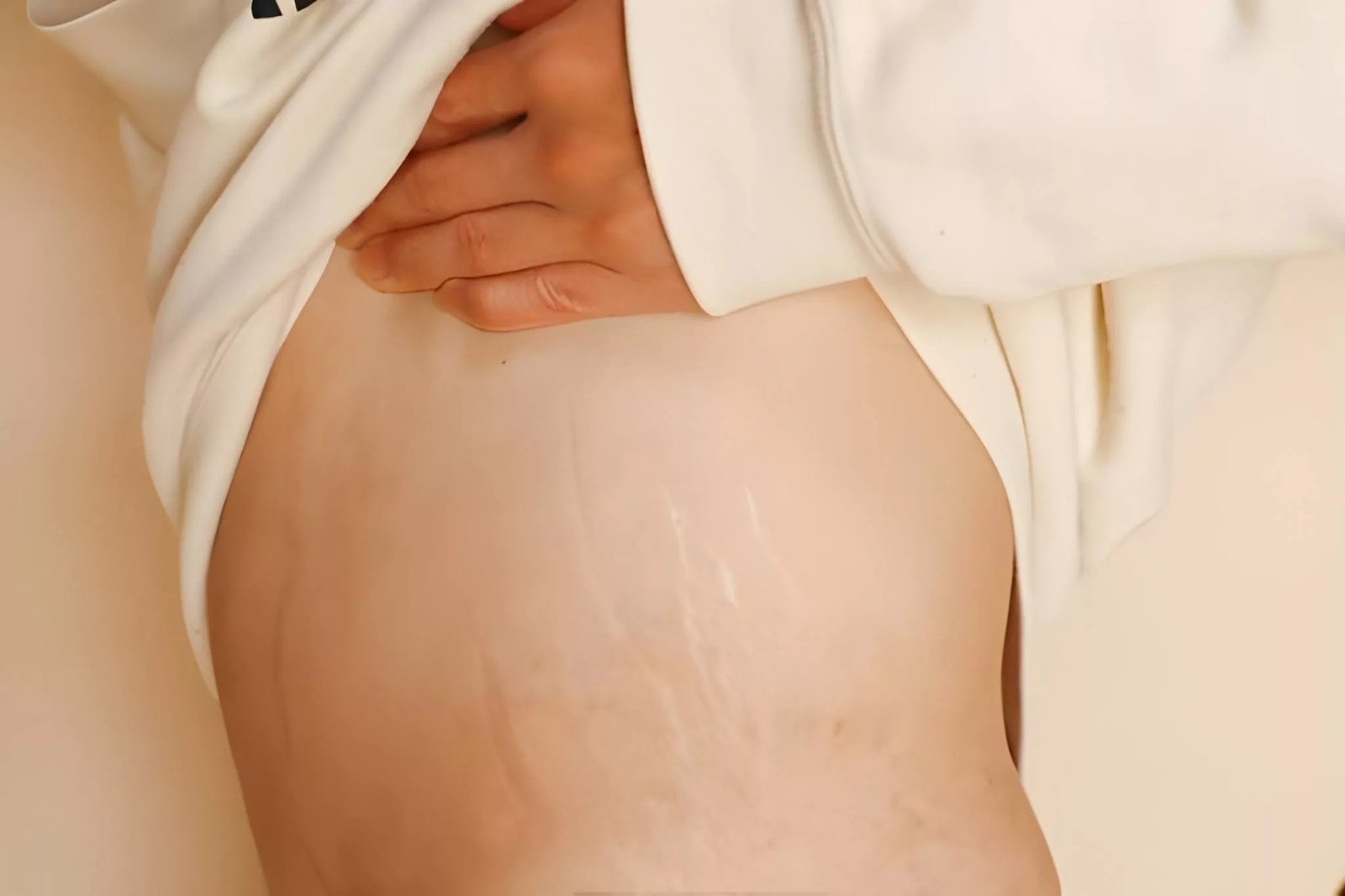
They affect 50-90% of the total population, including both men and women. Women are affected more than men due to hormonal changes, a tendency to gain weight easily, and pregnancy. They also affect up to 86%[2] of teenagers going through puberty. Key areas of occurrence include the abdomen, thighs, hips, breasts, buttocks, and even the upper arms or back. Striae are more likely to occur in people of color, such as South Asian, Hispanic, or Black populations, indicating a genetic predisposition.

Clinical presentation of striae distensae (stretch marks) on the flank of an adolescent male, illustrating the characteristic linear dermal atrophy seen in rapid skin stretch. Image courtesy of James Heilman, MD / CC BY-SA 4.0 (Wikimedia Commons).
Types of Stretch Marks
Based on their origin, causes, mechanism of formation, color, and various other characteristics, Striae Distensae can be further classified into different types:
Striae Rubrae (Early Stage):
The initial lesion caused by excessive dermal stretching is red or purple, hence the name “rubrae.” They can be itchy or associated with slight swelling. They are more responsive to treatment because they are in the early stage of the lesion. If left untreated, they mature and turn into “Striae Albae.”
Striae Albae (Mature Stage):3Fatemi Naeini F, Behfar S, Abtahi-Naeini B, Keyvan S, Pourazizi M. Promising Option for Treatment of Striae Alba: Fractionated Microneedle Radiofrequency in Combination with Fractional Carbon Dioxide Laser. Dermatology Research and Practice. 2016;2016:1–7.
As striae rubrae mature, they turn into white, hypopigmented scars that are known as striae albae. They can appear wrinkled or atrophic and are resistant to treatment.
Striae Gravidarum:4Farahnik B, Park K, Kroumpouzos G, Murase J. Striae gravidarum: Risk factors, prevention, and management. International Journal of Women’s Dermatology [Internet]. 2017 Jun;3(2):77–85.
They are exclusively linked with pregnancy, affecting up to 90% women. Due to the rapid expansion of the belly in pregnancy, they occur mostly on the abdomen, but can also appear on the breasts.
Striae Atrophicae:5Alexander, Barankin B. Physiological Striae Atrophicae of Adolescence with Involvement of the Upper Back. Case Reports in Pediatrics [Internet]. 2013 Jan 1;2013:1–3.
“Atrophicae” refers to thinning of the skin. The symptoms and clinical presentation are almost the same as those of Striae Distensae, but those are caused by overstretching of the skin, and these are caused by thinning of the skin due to metabolic conditions. They are associated with increased cortisol levels, as seen in Cushing’s syndrome and exogenous use of corticosteroids.
Striae Nigrae:
They are a less common and hyperpigmented variant of normal stretch marks, and appear in darker skin tones. They are of dark color (brown or black), due to increased melanin production in these individuals.
Striae Caerulea:
They are a rare type of stretch marks, characterized by blue or purple striae, due to underlying medical conditions. They can be challenging to treat.
Bullous Striae:6Hunashikatti, Varsha Babu; Philip, Shilpa Mary. Bullous Striae Distensae: Three Cases, One Common Thread. Indian Dermatology Online Journal ():10.4103/idoj.idoj_276_25, November 21, 2025.
It is a rare subtype characterized by fluid-filled blisters that occur over existing stretch marks. They are most commonly seen in patients receiving high doses of steroids over a prolonged time period. These corticosteroids decrease the strength of collagen, making it thin and prone to breaking down. As the dermis breaks down, fluid is accumulated in the lesion, and the formation of bullae occurs.

Comparison of six clinical variants of striae distensae, illustrating differences in color, texture, and morphology, including striae rubrae, albae, gravidarum, atrophicae, nigrae, caerulae, and bullous striae.
How to prevent Striae Distensae (Stretch Marks)?
Preventing the development of stretch marks is easier than treating them. The key to prevention is maintaining good skin hydration and adopting a healthy lifestyle.
- Skin Hydration: You should moisturize your skin daily using cocoa butter, shea butter, hyaluronic acid, and oils. This will ensure the skin is hydrated. Well-hydrated skin has increased elasticity, leading to reduced dermal tearing and scarring.
- Diet: Foods rich in Vitamin A, C, and D (such as carrots, citrus, and milk) play an important role in boosting skin collagen. Zinc-rich foods (nuts, fish) reduce inflammation and support healing. Eat in your optimal calorie window.
- Hydration: Drink plenty of water. Dehydration can lead to our skin being fragile and less elastic.
- Weight Management: Achieve a steady weight gain or loss. Avoid rapid weight gain, as that can lead to overstretching of the skin and formation of stretch marks.
- Exercise: Regular exercise enhances circulation, leading to rejuvenated and healthier skin.
- Controlled muscle gain: Aiming for rapid gains in the gym can lead to excess skin stretching and striae forming on the areas targeted (e.g., biceps)
Why are Stretch marks difficult to treat?
Striae Distensae occur due to deep dermal injury, where the collagen and elastin are torn and lost. Our body can not automatically repair the damaged connective tissue to its original state, but forms an irreversible scar in that area. Early lesions (striae rubrae) have some vascularity in them and are hence more responsive to treatment. As the striae mature, they turn into white atrophic scars with no vascularity or normal skin cells present, but only fibrous scar tissue. Mature striae (striae albae) are harder to treat and may require more sessions or a prolonged treatment period.
Stretch Marks Treatment
As discussed, stretch marks are the permanent scarring of the body and are hard to treat. Your physician may use different treatment modalities to reduce their appearance, but complete eradication is difficult and should not be expected.[3]
Topical Treatments:
They work best for early lesions (Striae Rubae), but are not very effective on older stretch marks.
- Tretinoin (Vit A): Topical formulation of vitamin A stimulates collagen production and boosts skin cell turnover. Thus, new stretch marks will show improvement through stimulated collagen production. Tretinoin formulations are to be strictly avoided if pregnant or nursing, as they can cause birth defects.
- Hyaluronic Acid: It plays a key role in hydrating your skin, improving elasticity, and protecting against tearing or scarring. For enhanced skin repair, it can be paired with peptides.
- Centella asiatica: A herb with renowned wound healing, improving skin barrier, and skin soothing capabilities. It promotes collagen synthesis and enhances the elastin fiber network as well. Creams containing C. asiatica are safe to use in pregnancy.
Collagen Boosting Techniques:
These devices and therapies work by stimulating collagen production and improving the appearance of stretch marks.
- Laser therapy:[4] Lasers, such as Fractional CO₂ lasers and Er:YAG lasers, are effective non-invasive methods to reduce stretch marks. They work by causing controlled microinjuries to the dermis, leading to the formation of new and better collagen. They work well on older lesions (Striae Albae).
- Radiofrequency: uses heat energy to penetrate the deep dermal layer, triggering collagen and elastin production to remodel skin, improve texture, and reduce the visibility of both new and old stretch marks.
- Microneedling: uses tiny needles that puncture the skin, causing microinjuries that stimulate collagen and elastin, and improve skin texture. Combining microneedling with platelet-rich plasma (PRP) or radiofrequency (RF) can produce faster, more effective results.
Vascular Targeted Procedure:
Lasers such as the Pulsed Dye Laser (PDL) or Long-Pulsed Nd: YAG are the standard treatment option that targets blood vessels. They target the dilated blood vessels in Straie Rubrae, reducing their red color and also stimulating collagen production simultaneously. These lasers improve the aesthetic appearance of early lesions.
Surgical Options:
- Abdominoplasty: also known as “tummy tuck” for people who have lost weight after being extremely obese and have a lot of extra skin. The extra skin is removed, and the remaining skin is stretched and repositioned. Tightening of the skin plays an important role in decreasing the appearance of the upper belly. Abdominoplasty only removes the marks located on the lower abdomen, along with the skin.
- Subcision: A small needle or blade is inserted into the dermis, which releases the depressed skin and improves the appearance of shallow scars. This is an invasive procedure and works for Striae Albae.
Combination Therapy (Gold Standard):
Energy-based procedures, either lasers or radiofrequency, can be combined with mechanical techniques such as microneedling to produce effective results. Topical creams containing retinoids and glycolic acids can be paired with these techniques to accelerate collagen production and elastin formation. Despite providing the best of the results, a maximum of only 40-60% improvement is expected in the appearance of stretch marks.

Laser Stretch Mark Removal – Before and After Comparison
Conclusion
Striae Distensae are a common aesthetic concern affecting all genders and ages. Striae are caused by deep dermal injury due to conditions that rapidly stretch the skin beyond its capacity, resulting in disruption of the collagen and elastin network in our skin. They present in various forms, and the female abdomen is the most affected site. The irreversible scar formation is difficult to treat, with only up to 60% of improvement seen. A personalized, stage-based approach combined with realistic patient expectations remains the cornerstone of effective management.
References
[1] Striae (stretch marks) [Internet]. Yale Medicine. 2026 [cited 2026 Feb 11].
[2] Oakley AM, Patel BC. Stretch Marks [Internet]. PubMed. Treasure Island (FL): StatPearls Publishing; 2021.
[3] Fatemi Naeini F, Behfar S, Abtahi-Naeini B, Keyvan S, Pourazizi M. Promising Option for Treatment of Striae Alba: Fractionated Microneedle Radiofrequency in Combination with Fractional Carbon Dioxide Laser. Dermatology Research and Practice. 2016;2016:1–7.
[4] Farahnik B, Park K, Kroumpouzos G, Murase J. Striae gravidarum: Risk factors, prevention, and management. International Journal of Women’s Dermatology [Internet]. 2017 Jun;3(2):77–85.
[5] Alexander, Barankin B. Physiological Striae Atrophicae of Adolescence with Involvement of the Upper Back. Case Reports in Pediatrics [Internet]. 2013 Jan 1;2013:1–3.
[6] Hunashikatti, Varsha Babu; Philip, Shilpa Mary. Bullous Striae Distensae: Three Cases, One Common Thread. Indian Dermatology Online Journal ():10.4103/idoj.idoj_276_25, November 21, 2025.
[7] Mysore V, Lokhande A. Striae distensae treatment review and update. Indian Dermatology Online Journal [Internet]. 2019;10(4):380.
[8] Wollina U, Goldman A. Management of stretch marks (with a focus on striae rubrae). Journal of Cutaneous and Aesthetic Surgery [Internet]. 2017;10(3):124.