
 is a systemic disorder in which we see the growth and color of nails distinctly changed. It is rare, frequently...)
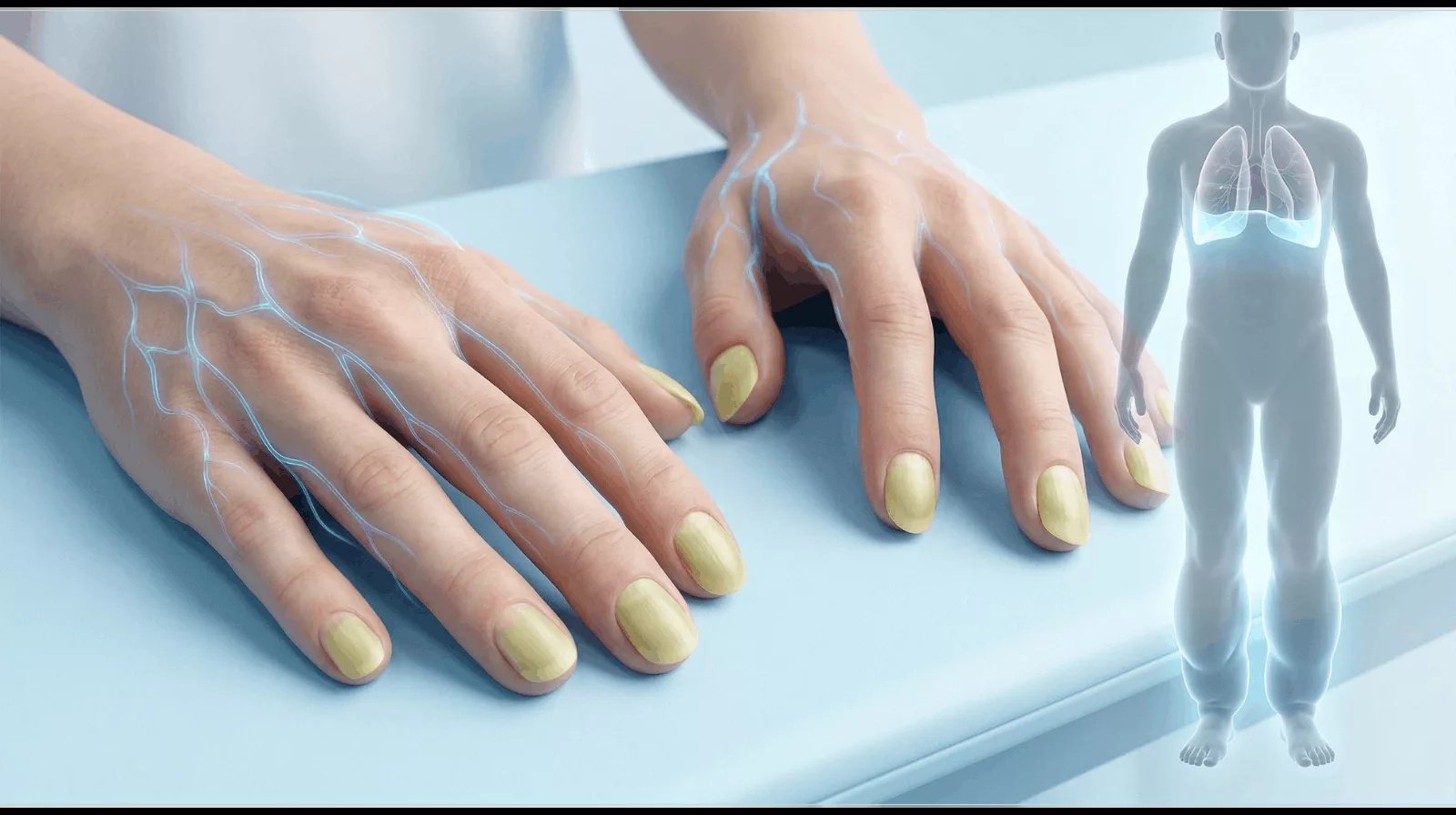
Yellow Nail Syndrome (YNS) is a systemic disorder in which we see the growth and color of nails distinctly changed. It is rare, frequently misunderstood, and most patients have no idea what they are dealing with for years. But it is not primarily a nail condition. It is a sign of problems with the body’s lymphatic drainage. The exact cause remains unclear, but YNS is very often clinically associated with issues in the lungs and chronic swelling in the limbs, and impacts the overall quality of life.
The condition was first formally described in 1964 by British physicians Peter Samman and William White, who noticed a peculiar triad of findings in a small group of patients: slow-growing, yellow-discoloured nails, swelling of the limbs caused by lymphoedema, and respiratory problems.
The Classic Yellow Nail Syndrome Triad
To diagnose Yellow Nail Syndrome, we look for the clinical triad of findings:
| Feature | Clinical Presentation | What’s Happening? |
|---|---|---|
| Nail changes | Thick and grow slowly, pale yellow to yellow-green nails, loss of cuticles, often curved, and may separate from the nail bed (onycholysis)2Emerson PA. Yellow nails, lymphoedema, and pleural effusions. Thorax. 1966;21(3):247–53. | The nail matrix stops producing new cells at a normal rate. |
| Lymphoedema | Significant swelling, usually in the lower legs and feet | Lymph fluid is not draining properly from the extremities. |
| Respiratory manifestations | Chronic cough, bronchitis, bronchiectasis, or recurrent respiratory infections | Fluid is accumulating in or around the lungs (pleural effusion) |

Nail changes, mainly yellow discoloration of the fingernails as well as toenails in a patient with YNS (Image Courtesy: Al Houri H, Al-Tarcheh H, Zghaier O, et al. (September 21, 2022) Amlodipine as a Suggested Cause of Yellow Nail Syndrome: A Case Report. Cureus 14(9): e29396. Available fromCureusand licensed under CC by 4.0)
As per textbooks, the required criteria for a diagnosis of Yellow Nail Syndrome are at least two of these three features. It is true, though, that nail changes are considered the most specific finding. In actual clinical practice, clinicians treat the triad more as a framework than a checklist. Essentially, nail changes are so specific that the triad concept is mostly to guide clinical thinking rather than something to be etched in stone.
The exact prevalence is not well established, because it is underdiagnosed and partly because its presentation is widely variable. It is generally thought to affect adults over the age of 50, though it can occur at any age. There is no strong sex predisposition, though some studies do suggest a slight female predominance.
Pathophysiology of The Triad
The common pathophysiology through all three components is thought to be lymphatic dysfunction, specifically impaired or abnormal lymphatic drainage. Your lymphatic system acts as the body’s secondary sewerage network, returning interstitial fluid to the bloodstream. When these vessels are narrow, blocked, or poorly formed, two things happen: stagnation and oxidative stress.
1. Changes in Nails
The nails in Yellow Nail Syndrome are distinctive enough that an experienced clinician can often recognise them at a glance.
- They grow extremely slowly (in some cases, almost not at all), thicken considerably, and have a yellow to yellow-green hue.
- The surface may be smooth or show exaggerated transverse ridging, but the overall picture is unmistakable once you’ve seen it
- The cuticle may disappear entirely. In advanced cases, the nail lifts off the bed entirely.
In fact, these nails are very commonly mistaken for onychomycosis (fungal nail infection). Consequently, if a fungal culture is negative in a patient with other features of the triad, it should increase the clinician’s index of suspicion for YNS. Researchers have not fully established the exact mechanism of the yellow discoloration; some suggest lipofuscin deposition, but evidence has not definitively proven this.
2. Lymphoedema
The most common form of lymphedema in YNS is a painless swelling of the feet, ankles, occasionally the facial, or hands. It is the primary kind of lymphedema in which the lymphedema results from an abnormal lymphatic structure or transport function. Also, the swelling is more visible after a long period of standing on the feet.
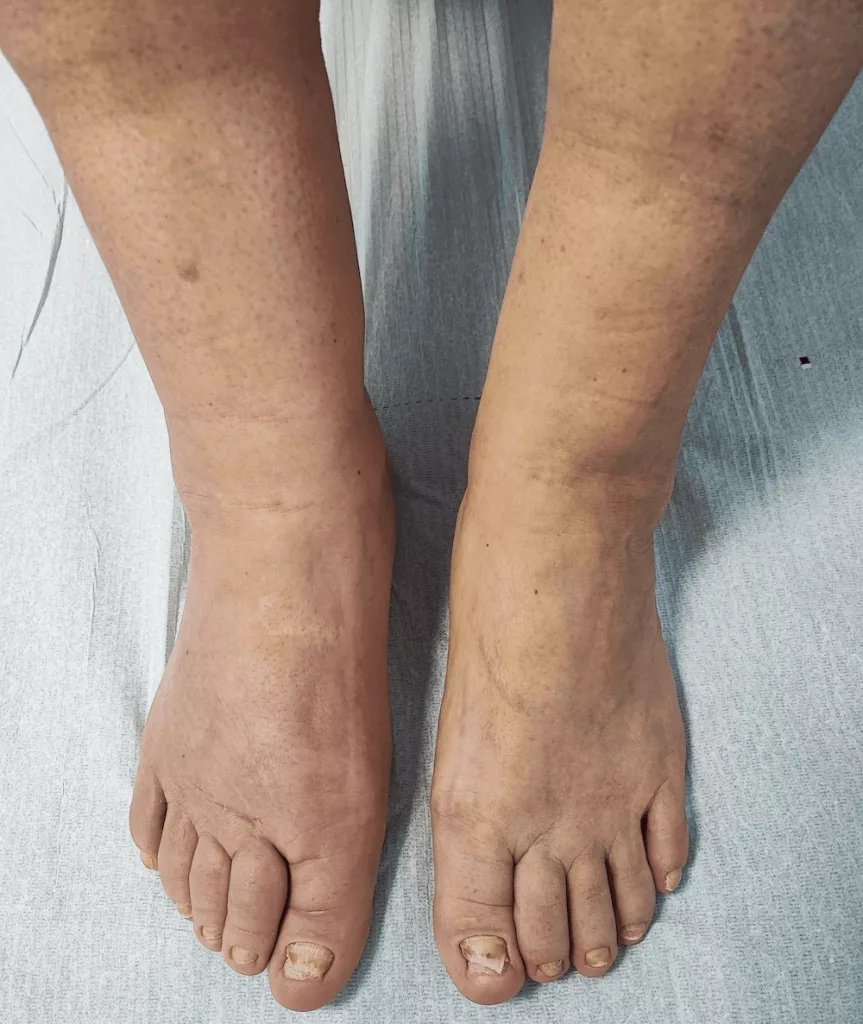
Swollen ankles and thickened yellow nails in a patient with Yellow Nail Syndrome: Both are driven by lymphatic failure, which traps fluid in the limbs and metabolic waste in the nail matrix, and this dual presentation is a hallmark of the Yellow Nail Syndrome triad (Image Courtesy: Genrinho I, Diz-Lopes M, Morais A, et al. (November 02, 2025) Yellow Nail Syndrome: A Differential Diagnosis That Must Be in Mind. Cureus 17(11): e95953. Available fromCureusand licensed under CC by 4.0)
3. Respiratory Components
The respiratory component is where YNS can get serious, and it’s also the most unpredictable. Patients may present with:
- Pleural effusion: accumulation of fluid in the space between the lung and chest wall, typically exudative and bilateral.
- Bronchiectasis, i.e., permanent widening and damage of the airways, leading to chronic cough, sputum, and recurrent infections
- Chronic sinusitis and recurrent pneumonia caused by the same lymphatic dysfunction affect the mucosa of the nasal passages and sinuses
Pleural effusion is the most important, can even be the presenting feature, and may be large enough to cause significant breathlessness.
Chylothorax in Yellow Nail Syndrome
Lung involvement in YNS is what makes it a potentially life-threatening condition sometimes. About 40% of patients develop pleural effusions, but the most specific respiratory complication to watch for is chylothorax.

A PA chest X-ray that demonstrates the severity of lung involvement in some YNS cases: The complete whitening of the right side (opacity) indicates that the pleural space is entirely filled with fluid, displacing the lung, but still,thoracocentesisis required to confirm if the effusion is a standard serous fluid or the milky, triglyceride-richchylothorax, characteristic of lymphatic failure in Yellow Nail Syndrome (Image Courtesy: Scholz, G.A., Sirbu, H., Semrau, S. et al. Persisting right-sided chylothorax in a patient with chronic lymphocytic leukemia: a case report. J Med Case Reports 5, 492 (2011). Available fromSpringer Natureand licensed under CC by 2.0)
A chylothorax occurs when lymph fluid (chyle) leaks into the pleural space surrounding the lungs, as thoracic lymphatic vessels leak or are disrupted. The fluid is characteristically milky white or turbid. The diagnosis is confirmed when pleural fluid triglyceride levels are elevated (typically >110 mg/dL or >1.24 mmol/L). Patients typically complain of breathlessness and a persistent dry cough, symptoms easy to attribute to something else entirely.
However, not every pleural effusion someone develops in YNS is going to be chylothorax; it can only be confirmed by thoracocentesis and biochemical analysis. Large or recurrent chylothorax may require repeated drainage, a low-fat diet with medium-chain triglycerides, and, in refractory cases, surgical approaches such as thoracic duct embolisation.
Causes of Yellow Nail Syndrome
The exact cause of YNS remains a hypothesis, but evidence points to structural or functional lymphatic vessel abnormalities, which explain why all triad components involve lymphatic-dependent tissues. Clinicians should also consider associated conditions during evaluation.
| Category | Examples |
|---|---|
| Malignancy | Lung cancer,lymphoma, breast cancer, and other solid tumours. The relationship is not yet fully established |
| Autoimmune disease | Rheumatoid arthritis, thyroid disorders, and immunodeficiency states |
| Drug-induced | D-penicillamine and gold therapy have been implicated. Some reports link bucillamine and other drugs. |
| Idiopathic | In many cases, no underlying cause is found, sometimes referred to as primary or idiopathic YNS. |
When clinicians identify YNS in a new patient, they should investigate for associated conditions, especially malignancy in older adults, while keeping in mind that many cases remain idiopathic.
How Is Yellow Nail Syndrome Diagnosed?
There is no pathognomonic diagnostic test for Yellow Nail Syndrome. In practice, the workup involves both confirming the triad and excluding other conditions:
- The first step is generally a proper nail assessment, and this would include inspection and photography, as well as fungal culture and microscopy to exclude fungal causes. In practice, most patients we see have already been through two or three rounds of antifungals by the time YNS is considered.
- If limb swelling is present, the limb circumference has to be measured to determine institutional lymphoedema grading
- Then comes investigating the respiratory component, which is done via chest imaging (chest X-ray, CT chest), pleural fluid analysis, and sometimes respiratory function assessment via spirometry and full pulmonary function tests.
- Plus, YNS workup has to be initiated with a baseline set of blood tests: CBC, inflammatory markers, thyroid function test, and, if age appropriate, cancer screening (in older patients)

CT scan of the chest showing bilateral pleural effusion in the lungs (Image Courtesy: Nagpal S, Pokhriyal S C, Magacha H M, et al. (March 05, 2024) Four-Year Follow-Up of a Case of Yellow Nail Syndrome With IgM Deficiency. Cureus 16(3): e55545. Available fromCureusand licensed under CC by 4.0)
Differential Diagnosis for Yellow Nails
Before labelling it YNS, we must verify the yellowing is not a side effect of medication or another systemic illness. The most common differentials:
| Onychomycosis (fungal infection) | The most important differential. Fungal infections cause the nail to become brittle and crumbly. In YNS, they are hard and smooth, just very slow to grow. |
|---|---|
| Psoriasis | Can cause yellowing, but usually presents with pitting (tiny dents) in the nail surface |
| Green Nail Syndrome | Produces a dark green spot under the nail rather than a uniform pale yellow across the whole plate |
| Drug-induced / malignancy-associated | Gold salts, penicillamine, and internal cancers (often lung or breast) can all produce YNS-like nail changes |
| Smoking | It causes surface stains only. |
Yellow Nail Syndrome Treatment
Currently, there is no universally accepted or curative treatment for yellow nail syndrome. Instead, management is symptomatic, and the goal is to stimulate drainage and protect the nail matrix.
Treating the Nail Changes:
The nail changes can improve spontaneously, as long as the underlying associated condition is able to be treated.
- Oral Vitamin E (alpha-tocopherol) at doses of 400–800 IU daily
- Some case reports describe nail improvement with triazole antifungals (e.g., itraconazole), possibly through mechanisms independent of antifungal activity
- Zinc supplementation used in some centres

Significant improvement in the appearance of nails after identification of the trigger in a patient with Yellow Nail Syndrome because of Amlodipine (Image Courtesy: Al Houri H, Al-Tarcheh H, Zghaier O, et al. (September 21, 2022) Amlodipine as a Suggested Cause of Yellow Nail Syndrome: A Case Report. Cureus 14(9): e29396. Available fromCureusand licensed under CC by 4.0)
Managing Lymphoedema:
Lymphoedema in Yellow Nail Syndrome is managed using the same principles as other primary lymphedemas. The main method is decongestive therapy, which combines manual lymphatic drainage, compression bandaging, exercise, and skin care. Other than manual drainage, compression stockings during the day work. Other suggestions are to keep the limbs elevated and avoid any triggers that can worsen the pool-up.
Managing Respiratory Component:
- Pleural effusion: Thoracocentesis for symptomatic large effusions; pleurodesis or octreotide for recurrent cases
- Chylothorax: Low-fat diet with medium-chain triglyceride supplementation; octreotide; thoracic duct embolisation for refractory cases
- Bronchiectasis: Airway clearance techniques, chest physiotherapy, antibiotics for infective exacerbations
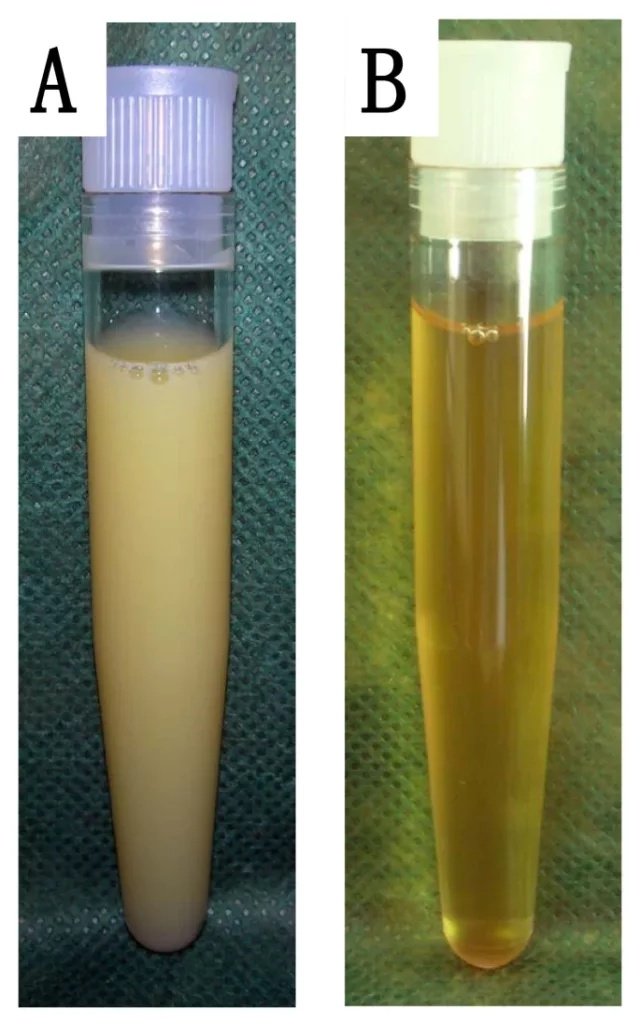
Visualizing the Dietary Effect on Chylothorax: In panel (A), the high lipid (fat) burden on the leaking lymphatic vessels causes the characteristic milky white appearance of the chyle, and panel (B), after the patient followed a strict low-fat diet, the gut produced significantly less lipid fluid, directly lowering the triglyercide concentration and transforming the effusion into a clear, amber fluid (Image Courtesy: Scholz, G.A., Sirbu, H., Semrau, S. et al. Persisting right-sided chylothorax in a patient with chronic lymphocytic leukemia: a case report. J Med Case Reports 5, 492 (2011). Available fromSpringer Natureand licensed under CC by 2.0)
As far as prognosis is concerned, YNS is manageable for the most part. In fact, the nail changes are reversible in ~ 30% of cases, sometimes spontaneously and sometimes with consistent high-dose Vitamin E. The respiratory and lymphatic symptoms, however, are often chronic. Management is confined to maintaining a stable baseline to prevent complications such as pneumonia or severe skin infections in the swollen limbs.
Final Words
YNS is rare, but not as rare as it probably is undiagnosed. Most patients spend years under investigation for changes to their nails, often in combination with having lymphoedema or other respiratory symptoms. YNS is totally treatable, and sometimes, in some patients, can even be partially or fully reversible, but you have to have someone who has in their mind the suspicion of this triad.
For clinicians, the key question to ask when a patient presents with slow-growing, discoloured nails that have not responded to antifungal treatment is whether they also have any lower limb swelling or any respiratory symptoms, and then, accordingly, run investigations. Yellow Nail Syndrome is a diagnosis that, once made, can give isolated symptoms a coherent explanation and a rational treatment plan.
References
[1] Samman PD, White WF. The “yellow nail” syndrome. Br J Dermatol. 1964;76:153–7.
[2] Emerson PA. Yellow nails, lymphoedema, and pleural effusions. Thorax. 1966;21(3):247–53.
[3] Vignes, S., Baran, R. Yellow nail syndrome: a review. Orphanet J Rare Dis 12, 42 (2017).
[4] Genrinho I, Diz-Lopes M, Morais A, et al. (November 02, 2025) Yellow Nail Syndrome: A Differential Diagnosis That Must Be in Mind. Cureus 17(11): e95953.
[5] Genrinho, I., Diz-Lopes, M., Morais, A., & Brito, I. (2025). Yellow Nail Syndrome: A Differential Diagnosis That Must Be in Mind. Cureus, 17(11), e95953.
[6] Lambert, E. M., & Antaya, R. (2004). Topical vitamin E solution versus placebo in the treatment of yellow nail syndrome: A randomized double-blind study. Journal of the American Academy of Dermatology, 50(3), P130.
[7] Ur Rehman, K., & Sivakumar, P. (2022). Non-traumatic chylothorax: diagnostic and therapeutic strategies. Breathe (Sheffield, England), 18(2), 210163.
[8] Vignes, S., & Baran, R. (2017). Yellow nail syndrome: A review. Orphanet Journal of Rare Diseases, 12, 42.
[9] Vignes, S., & Baran, R. (2017). Yellow nail syndrome: a review. Orphanet journal of rare diseases, 12(1), 42.