

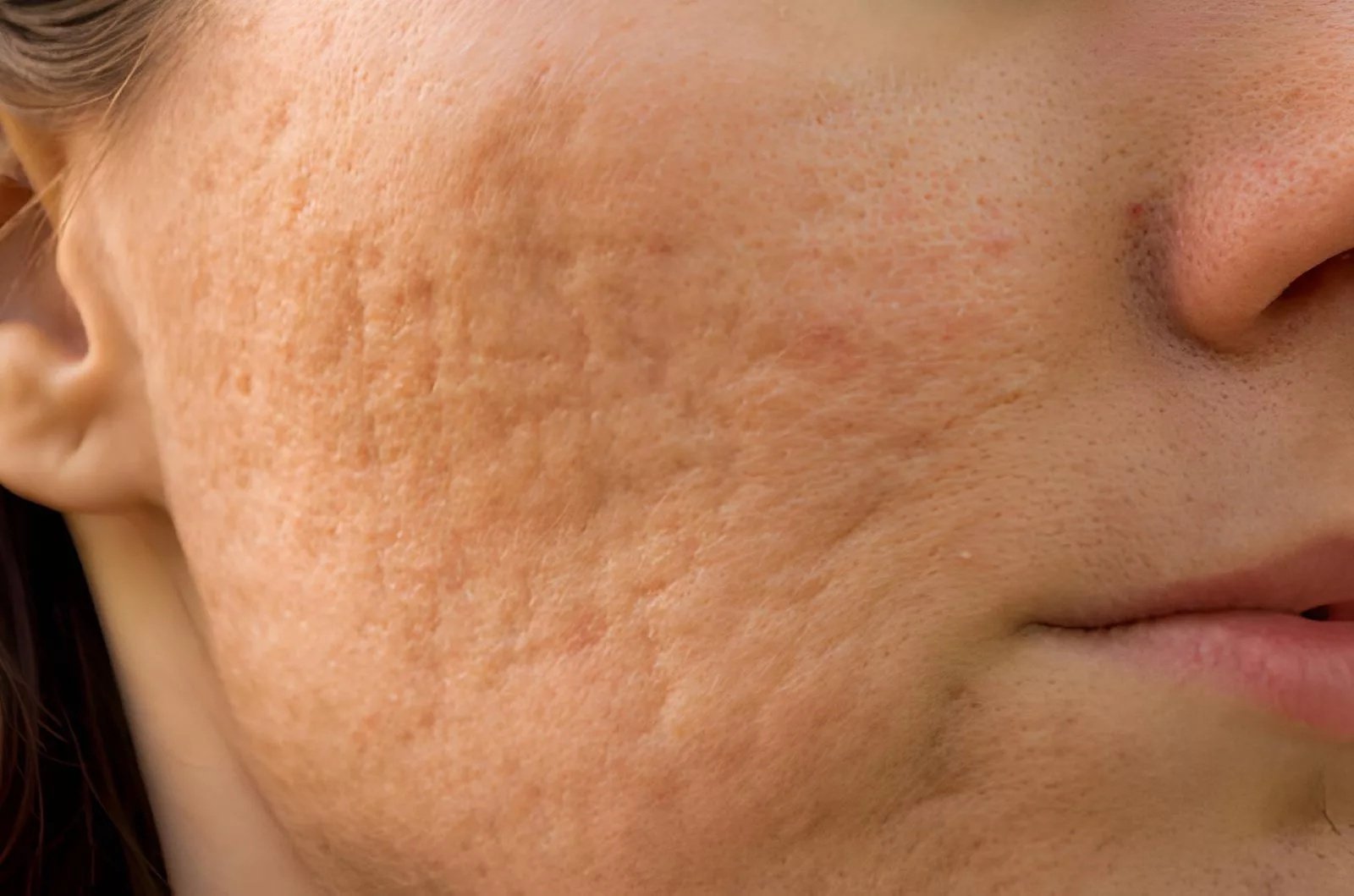
Atrophic Scars Best Scars are a normal process of the human body’s healing. In case the skin is damaged, it strives to seal the wound and regenerate itself. However, occasionally the repair process does not proceed without a hitch. Rather than restoring normal skin architecture, the skin heals with a loss of underlying tissue, leaving behind a depression or indentation. This is what occurs with atrophic scars, and to millions of individuals in the world, it is much more than a cosmetic issue.
What Is an Atrophic Scar?: Atrophic Scars Best
An atrophic scar refers to a depressed scar or a sunken scar that is below the surface of the skin. As opposed to hypertrophic or keloid scars, which are elevated, atrophic scarring is the outcome of a net loss of dermal tissue and collagen underneath the surface of the skin. When the body produces insufficient or disorganized collagen during wound healing, the area appears to sink, leaving behind an indentation.
The atrophic scars are skin depressions that occur when the skin is exposed to the absence of collagen in the healing process. Collagen is the structural protein that makes the skin firm, resilient, and strong. In case the normal collagen structure is demolished by a wound and the body is unable to restore it properly, a noticeable hole in the skin appears.
Atrophic acne scars are the most prevalent, and their pathogenesis is probably connected with inflammatory mediators and the breakdown of collagen fibers and subcutaneous fat due to the influence of enzymes.
Types of Atrophic Scars
Not all atrophic scars look the same. Their shapes are different, as well as their depth and the manner in which they influence the surface of the skin. It is important to understand the type of scar since various types tend to respond better to various treatments.
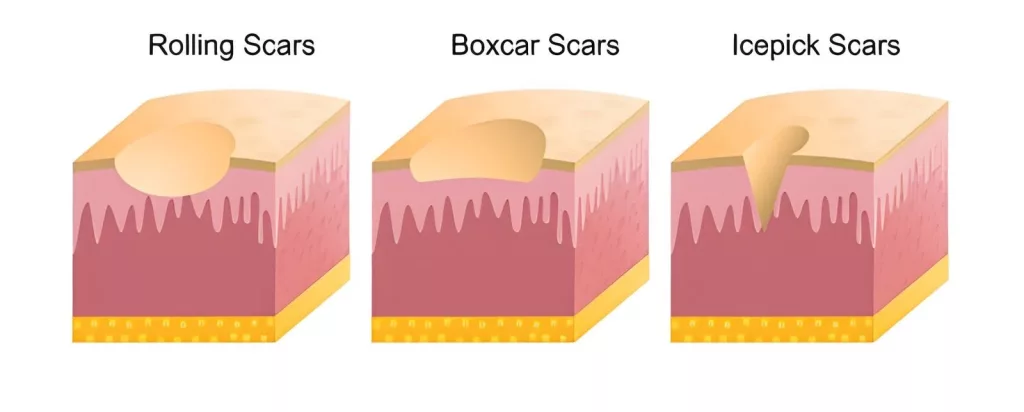
Types of atrophic scars: rolling, boxcar, and ice pick, based on depth and shape
1. Ice Pick Scars
Ice pick scars are deep, narrow, pitted scars, which are deeper than they are wide. They resemble small, sharp puncture wounds on the skin. And it may be very hard to treat due to their infiltration into the deeper dermis layers. In atrophic scars, the ice pick type constitutes 60-70 percent of all scars.
2. Boxcar Scars
Boxcar scars are rectangular, sharp-edged, broad, and may happen on the cheeks and temples. These are either shallow or deep. And due to the clear walls they have, they cast a shadow and become more visible in specific lighting. They account for roughly 20 to 30% of atrophic acne scars.
3. Rolling Scars
Rolling scars are broad depressions whose edges are rounded and sloping. And as a result of this, the skin has a wave-like effect. They are caused by fibrous tissue bands that develop between the skin surface and the underlying subcutaneous tissue that tethers the skin downwards.
4. Cigarette Paper Atrophic Scars
Another variant that is clinically important but not well discussed is the cigarette paper atrophic scar. Papyraceous scarring (named papyraceus, meaning literally paper-like, in Latin) describes the crinkled, atrophic thin scars which have a similar appearance to cigarette paper. These scars are very unique and are a characteristic of Classical Ehlers-Danlos Syndrome (EDS), a connective tissue disorder.
The skin in this condition is hyperfragile, i.e., the dermis tears easily even after minor trauma, particularly at the pressure-prone areas, e.g., the knees and the elbows. The healing of wounds is retarded, and the scars are hyperpigmented and wide, and have the appearance of a cigarette-paper, or papyraceous. Clinicians need to be aware of this pattern as it might be an initial indication of a connective tissue disorder that needs a specialist referral.
What Leads to Atrophic Scarring?
The atrophic scars are mainly caused by the disruption of normal dermal repair and collagen remodeling in the wound healing process. This can be provoked by the following conditions and behaviors:
- Acne: This is caused principally by inflammatory acne, which includes cystic acne or nodular acne. Popping, picking, or squeezing acne lesions complicates the situation considerably because it further penetrates bacteria into the depth and aggravates inflammation.
- Chickenpox: The blisters produced by the chickenpox infection usually heal with poor production of collagen, leaving small holes in their place.
- Surgical wounds: When some cuts, especially those that are under tension, are healed below the skin surface.
- Trauma and injury: Atrophic scarring may occur in any of the cases of cuts, burns, insect bites, and deep abrasions when there is a loss of tissue.
- Skin infections: Some infections (bacterial and fungal) destroy the dermis layer of skin, resulting in pitted scars.
Atrophic scars are broadly described as exhibiting generalised cutaneous atrophy resulting in loss of cutaneous cells in the epidermis, although they appear clinically as a loss of normal dermis.
It is also to be noted that genetic factors contribute. Individuals who are known to have some connective tissue conditions, such as Ehlers-Danlos Syndrome, are predisposed to atrophic scar formation due to the fact that their collagen is already structurally defective.
The Impact of Atrophic Scars on the Skin and Quality of Life
Atrophic scarring has physical manifestations, which are diverse and evident. The skin surface gets uneven with the indentations that can cast shadows and seem more dramatic when the light is directly focused. The texture is not smooth anymore, and in certain instances, the scarred portion is also characterized by coloration, either a light or darker shade, compared to the rest of the skin.
The psychological effect of this should not be underestimated beyond the skin itself. Atrophic scars can significantly affect emotional well-being and quality of life. They tend to be underestimated causes of significant morbidity for the individual patient who often either loses all hope of amelioration or presents with unrealistic expectations.
Most individuals, especially those with severe acne scars on the face, complain of low self-esteem, social problems, and even anxiety or depression. This is the reason why the timing of treatment is important.
Atrophic Scars Diagnosis and Grading
The dermatologist will normally consider atrophic scars by their type, depth, width, and distribution. There are clinical tools such as the ECCA scale (Echelle d’Evaluation Clinique des Cicatrices d’Acnes), the qualitative grading system of Goodman and Baron, that are used to record severity and response to treatment over time.
Before initiating any treatment, there should be a detailed history of the past treatment attempted, the skin type, whether there is a history of keloids or hypertrophic scar formation, and the history of medication. Those patients who are currently on isotretinoin therapy may require modified treatment approaches.
Atrophic Scar Treatment Options
This is where things get exciting. During the last 20 years, the management of atrophic scars has improved tremendously. It is necessary to highlight that only the existing treatment modalities may enhance the atrophic scars, but they cannot absolutely eliminate them. With that said, it is possible to have substantial cosmetic enhancement in most patients.
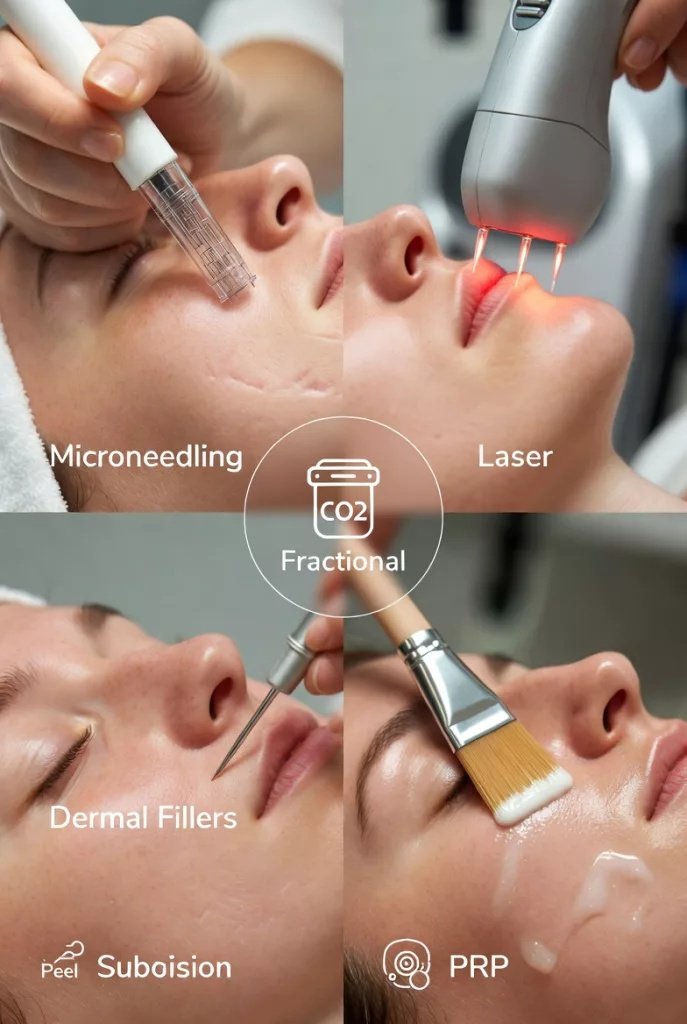
Common treatment options for atrophic scars include microneedling, laser resurfacing, fillers, and chemical peels
The following table gives a brief analysis of the key treatment options:
| Treatment | Best For | Downtime | Key Benefit |
|---|---|---|---|
| Microneedling | Rolling and boxcar scars | Low | Stimulates collagen, improves texture |
| Fractional CO2 Laser | Moderate-to-severe scars | Moderate to high | Deep resurfacing, collagen remodeling |
| Dermal Fillers | Rolling and boxcar scars | Minimal | Immediate volume correction |
| Chemical Peels | Mild-to-moderate scars | Low to moderate | Exfoliates and smooths the skin surface |
| Subcision | Rolling scars with tethering | Low | Breaks fibrous bands beneath the skin |
| PRP Therapy | All types (adjunct) | Minimal | Promotes regeneration via growth factors |
| Dermabrasion | Multiple types | High | Deep resurfacing with physical abrasion |
Microneedling
Microneedling (also called collagen induction therapy) is a procedure that uses the creation of micro-injuries on the skin controlled by a device loaded with extremely thin needles to induce skin contractions. These micro-injuries increase collagen synthesis and enhance scar remodelling. It is quite a tolerated procedure with a fairly small downtime and can be used on a variety of skin tones, so it can be easily applied to a wide range of patients. This usually requires many sessions separated by four to six weeks.
Fractional CO2 Laser Resurfacing
Laser resurfacing or fractional CO2 laser involves the utilization of focused light to eliminate the damaged skin layers and stimulate collagen synthesis, which induces the development of new, healthier skin cells and decreases the appearance of atrophic scars. It can be used especially in boxcar and rolling scars, but is not usually used first of all on ice pick scars, which are too narrow and deep to be effectively penetrated by laser energy. The darker skin tones should be evaluated attentively before laser treatment since post-inflammatory hyperpigmentation is more probable.
Dermal Fillers for Atrophic Scars
Dermal fillers are materials that are injected into the skin to plump up the sunken part, but they only give an immediate effect, yet are usually temporary and may require renewal over time. The most popular ones are hyaluronic acid fillers. They perform best on rolling and broad boxcar scars, the aim of which is mainly to correct volume. Subcision is commonly used together with dermal fillers to achieve the most long-lasting and optimal effect on atrophic scars, as the filler keeps the skin in place and the subcision sets the skin free.
Chemical Peels for Atrophic Scars
Chemical peeling involves the use of chemicals on the skin to cause controlled exfoliation of the epidermis and/or dermis, thus hastening the normal exfoliation process. Surface peels with glycolic or salicylic acid can serve as a maintenance procedure in mild acne scars of atrophy and enhance the overall skin texture and tone. Medium-depth peels (such as TCA) go to the upper dermis and may bring more significant changes in the depth of scars. Deep phenol peels have the most radical effect, but have increased risks, necessitate sedation, and cannot be used on dark skin.
Deep peels have the advantage of enhancing atrophic acne scars but need to be sedated and cardiovascularly monitored. These are contraindicated in skin IV-VI and may result in hyperpigmentation or hypopigmentation. Atrophic scars are better treated by chemical peels, which are not applied alone but through a multi-modal treatment.
Subcision
Subcision is a minor surgical technique particularly effective for rolling scars. The sharp needle or blade is then slipped under the scar and moved around horizontally to cut the fibrous bands, which are pulling the skin down. Subcision may be used concurrently with other treatments to achieve greater results. It can also produce long-term effects with little recovery time when combined with fillers or PRP.
PRP (Platelet-Rich Plasma) Therapy
In PRP therapy, concentrated platelet-rich plasma is isolated and extracted from the patient’s blood and then injected into atrophic scars. The growth factors that are present in PRP stimulate the production of collagen and promote the regeneration of tissues. Although PRP is not commonly applied as a primary therapeutic option, it is a strong adjuvant to microneedling and laser.
Combination Therapy: The Most Effective
Clinically, one modality is hardly sufficient to treat atrophic acne scars and other atrophic scarring. Combination methods with regard to the type of scar, skin tone, and objectives of the individual patient are currently preferred by most dermatologists.
In the case of a patient with a combination of rolling and boxcar scarring, an example of a solution would be:
- A round of subcision to release tethered scars
- Surface resurfacing with a fractional laser.
- With microneedling sessions to maintain and enhance collagen stimulation over time
In practice, it is very difficult to give clear guidelines on which treatment modality is best. The choice of treatment will depend on individual patient characteristics. These include skin tone, original scar location, previous treatment modalities, treatment downtime, side effects, patient expectations, and willingness to try combination therapy.
Prevention: Can Atrophic Scars Be Avoided?
With the proper habits, the risk is reduced, not always, but definitely.
- Treat acne early and consistently. The active breakouts that are not treated increase the chances of scarring permanently.
- Never pick, pop, or squeeze acne lesions.
- Apply the broad-spectrum sunscreen every day because UV radiation may increase the existing scars, and healing becomes slow.
- Wounds should be kept clean and wet during the healing process to reduce the loss of tissue.
- Professional wound care should be sought when deep cuts are involved. Or when there are injuries, as opposed to leaving them without treatment.
In individuals with underlying diseases such as Ehlers-Danlos Syndrome, prevention measures focus more on avoiding trauma to the delicate skin. And collaborating with a dermatologist who knows the intricacy of their connective tissue disorder.
Final Thoughts
Atrophic scars, whether the deep V-shaped pits of ice pick scarring, the plateau-shaped depressions of boxcar scarring, the undulating waves of rolling scars, or the thin, papyraceous scars seen in connective tissue disorders, all have one thing in common: they are the imperfect response of the skin to an injury it was not able to heal fully.
The positive thing is that medicine has advanced. Chemical peels, dermal fillers, and fractional lasers and microneedling are just some of the many tools that can be used today. They help individuals regain a smoother, even skin than ever before. The trick is to get the correct diagnosis, select the correct combination of treatments, and have reasonable but positive expectations in the process.
References
[1] Fabbrocini G, Annunziata MC, D’Arco V, et al. Acne scars: pathogenesis, classification and treatment.Dermatology Research and Practice. 2010;2010:893080. doi:10.1155/2010/893080
[2] Jacob CI, Dover JS, Kaminer MS. Acne scarring: a classification system and review of treatment options.Journal of the American Academy of Dermatology. 2001;45(1):109–117.
[3] De Paepe A, Malfait F. The Ehlers-Danlos syndrome, a disorder with many faces.Clinical Genetics. 2012;82(1):1–11.
[4] Layton AM, Henderson CA, Cunliffe WJ. A clinical evaluation of acne scarring and its incidence.Clinical and Experimental Dermatology. 1994;19(4):303–308.
[5] Dréno B, Tan J, Kang S, et al. How people with facial acne scars are perceived in society: an online survey.Dermatology and Therapy. 2016;6(2):207–218.
[6] Goodman GJ, Baron JA. Postacne scarring—a quantitative global scarring grading system.Journal of Cosmetic Dermatology. 2006;5(1):48–52.
[7] Aust MC, Fernandes D, Kolokythas P, Kaplan HM, Vogt PM. Percutaneous collagen induction therapy: an alternative treatment for scars, wrinkles, and skin laxity.Plastic and Reconstructive Surgery. 2008;121(4):1421–1429.
[8] Goldberg DJ, Amin S, Hussain M. Acne scar correction using calcium hydroxylapatite in a carrier-based gel.Journal of Cosmetic and Laser Therapy. 2006;8(3):134–136.
[9] Grimes PE. The safety and efficacy of salicylic acid chemical peels in darker racial-ethnic groups.Dermatologic Surgery. 1999;25(1):18–22.
[10] Cho SI, Chung BY, Choi MG, et al. Evaluation of the clinical efficacy of fractional radiofrequency microneedle treatment in acne scars and large facial pores.Dermatologic Surgery. 2012;38(7 Pt 1):1017–1024.