

Can Dehydration Cause Most people are surprised to find out that dehydration can be a surprisingly common trigger for elevated blood pressure. Yes, while dehydration is often associated with low blood pressure and dizziness, the body’s physiological systems are built such that it can also trigger a rise in blood pressure through complex feedback mechanisms. These are designed to protect the circulation in times of extreme stress, but in the long term, they can cause hypertension. In this context, high blood pressure is not the problem; it is the body’s attempt to adapt.
Relationship Between Hydration and High Blood Pressure: Can Dehydration Cause
Hydration and blood pressure are actually closely related. Blood pressure depends heavily on blood volume, electrolyte balance, and vascular tone, and all of these are influenced to at least some extent by the status of hydration in the body.[1]
When the body starts experiencing dehydration, the total volume of circulating blood naturally decreases. The body, in order to make sure that adequate blood reaches the vital organs, then activates compensatory mechanisms. An important part of this is the renin-angiotensin-aldosterone system, which causes blood vessels to constrict and promotes sodium and water retention when activated.[2]
This response is protective short term, but can result in an elevated blood pressure, especially in individuals who already have a cardiovascular or renal condition.

Overview of the renin–angiotensin–aldosterone system (RAAS): The diagram outlines key steps in the RAAS pathway that regulate blood pressure, fluid balance, and sodium retention, and also highlights where commonly used RAAS-inhibiting therapies act. (Image Courtesy: Ksiazek, S. H., Hu, L., Andò, S., Pirklbauer, M., Säemann, M. D., Ruotolo, C., Zaza, G., La Manna, G., De Nicola, L., Mayer, G., & Provenzano, M. (2024). Renin–Angiotensin–Aldosterone System: From History to Practice of a Secular Topic. International Journal of Molecular Sciences, 25(7), 4035. Available fromMDPIand licensed under CC by 4.0)
Does Dehydration Cause High Blood Pressure or Just Temporary Spikes?
The answer really depends on the context.
For example, if an individual is otherwise healthy, dehydration causes only a temporary blood pressure elevation (an acute spike) that resolves once the fluid balance is restored. However, in older adults or in someone who already has hypertension, kidney disease, or cardiovascular disease, dehydration will naturally have more prolonged changes. It is important to distinguish between acute dehydration (which causes spikes) and chronic dehydration (which may contribute to baseline hypertension).
Overall, whether blood pressure changes in an episode of dehydration are going to be significant enough depends on:
- How severe the dehydration was and how long it took to restore
- The individual’s baseline blood pressure status
- Whether they are using diuretics or any other anti-hypertensives
- Some other fluid-loss causing illness, such as diarrhea
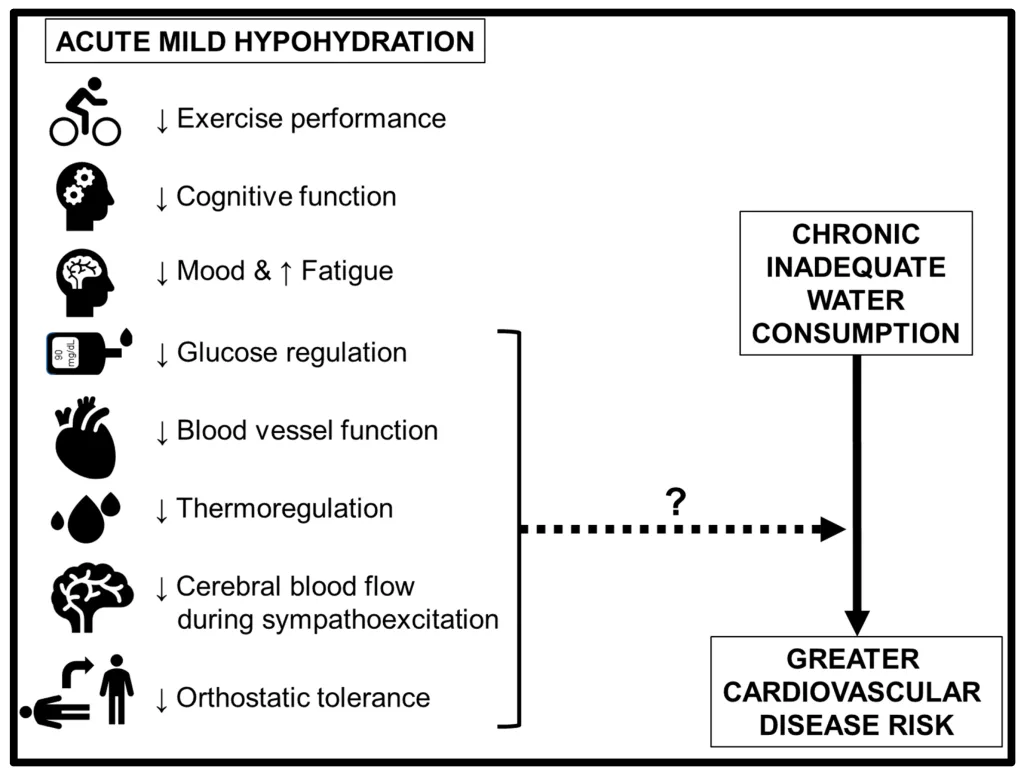
Physiological effects of acute dehydration in otherwise healthy individuals. The figure summarizes short-term changes associated with reduced fluid intake, including alterations in cardiovascular and metabolic parameters. (Image Courtesy: Watso, J. C., Farquhar, W. B., Watso, J. C., & Farquhar, W. B. (2019). Hydration Status and Cardiovascular Function. Nutrients, 11(8). Available fromMDPIand licensed under CC by 4.0)
Dehydration Symptoms That You Shouldn’t Ignore
Since the body is fighting to restore the fluid balance on its own, dehydration is often initially silent; early signs can be so subtle that they are easily dismissed.
- Feeling of thirst and a dry mouth
- Dark urine or reduced (sometimes even nil) urine output
- General fatigue and dizziness
- Headache and vision disturbances
- Palpitations
Dehydration Shaking
Dehydration can also trigger noticeable tremors in some cases; this is called dehydration shaking. It’s a physical sign to show that the body’s emergency systems are active. The cause is a combined effect of electrolyte imbalance, release of stress hormone, and the body’s attempt to maintain vital functions. These tremors can also be accompanied by rapid heartbeat, anxiety, and fluctuations in blood pressure.[3]
For a person who already has chronic hypertension issues, this should be a warning: your body is not just dehydrated, but is actively in a stress response that is very likely elevating your blood pressure at that moment. It should prompt a clinician to go for immediate rehydration and careful monitoring.
Diarrhoea and High Blood Pressure
Diarrhoea and high blood pressure make for a particularly dangerous combination. Acute diarrhoea leads to rapid fluid and electrolyte loss, which can:
- Reduce circulating blood volume
- Activate compensatory vasoconstriction (constriction of blood vessels)
- Interfere with the absorption and effect of blood pressure medications
In hypertensive patients, especially when they enter their old age, frequent diarrheal episodes can destabilize blood pressure control measures. They may also cause an acute kidney injury and increase the overall cardiovascular risk. Immediate, timely fluid replacement and full medical assessment are crucial in these situations.
Blood Pressure Medications and Dehydration
Dehydration can, interestingly, also affect how blood pressure medications behave in the body.
The best example would be diuretics, commonly prescribed for hypertension, which increase urine output to lower blood pressure. When dehydration occurs, diuretics make the fluid and electrolyte loss worse, which increases the risk of dizziness, kidney injury, and feedback blood pressure changes.[4]
Not just diuretics, though, ACE inhibitors and angiotensin receptor blockers (ARBs) can also prove to be risky during dehydration by reducing renal blood flow, particularly in people who already have a pre-existing kidney disease (that affects renal function/blood flow).
This explains why patients taking antihypertensives are advised to be especially cautious during episodes of vomiting, diarrhoea, fever, etc.
Consequences of Untreated High Blood Pressure
Even though the dangers of untreated hypertension are more commonly known now, the quiet, gradual damage it can have for vital organs over time is still somewhat under-scored. These long-term consequences can include:
- Coronary artery disease and heart failure
- Stroke and transient ischemic attacks
- Chronic kidney disease
- Vision loss/damage due to retinal damage[5]
- Cognitive decline
Dehydration does not directly cause these outcomes, but when it worsens blood pressure control, it can accelerate existing damage.
[Image: Diagram showing the main complications of chronic high blood pressure, including heart disease, stroke, kidney damage, vision loss, and vascular disease.]
Major complications associated with long-standing high blood pressure: Persistent hypertension can damage multiple organ systems over time, including the heart, brain, kidneys, eyes, and blood vessels, increasing the risk of serious cardiovascular and systemic disease. (Image Courtesy: Mikael Häggström (25 July 2014). Medical gallery of Mikael Häggström 2014. WikiJournal of Medicine 1 (2). Available fromWikipediaand licensed under CC by 1.0)
How Long Can You Live With Hypertension?
Hypertension itself is not a death sentence. Many people live long, healthy lives with high blood pressure if it is well managed. What can shorten lifespan, though, is when it is not controlled properly, be it because of a lack of compliance to medication, or a lack of commitment to lifestyle changes.
Outcomes depend largely on how early it is diagnosed and how consistently it is controlled. Also, whether contributing factors such as dehydration, diet, and lifestyle are addressed properly.
Practical Ways to Manage Blood Pressure:
Evidence-based, sustainable habits are proven to work long-term:
- Monitoring hydration and salt intake
- Regular physical activity and maintaining a healthy weight
- Ensuring good sleep and meditation to reduce stress
- Taking prescribed medications consistently
Best Drinks for Hydration
You should drink enough fluid every day to stay healthy. But some fluids can be more or less helpful than others, especially for someone with high blood pressure.[6] Appropriate options include:
- Plain water
- Oral rehydration solutions (ORS) in case of vomiting, sweating, or diarrhea (since sodium retention is seen as a contributor to hypertension, and ORS contains sodium, it’s important to understand that the immediate need to correct fluid volume and prevent kidney injury usually outweighs the salt risk during acute illness)
- Coconut water (in moderation if you have kidney disease or take potassium-retaining meds, as it is high in potassium)
At the same time, it’s important to limit sugary drinks, excessive caffeine, and alcohol.
When High Blood Pressure Becomes a Medical Emergency
Yes, dehydration-related high blood pressure is often temporary, but with or without dehydration, it’s important to seek immediate care if a high blood pressure is accompanied by one of these:
- Severe headache or visual disturbances
- Chest pain or shortness of breath
- Confusion or altered consciousness
- Persistent vomiting or inability to retain fluids
- Repeated blood pressure readings above emergency thresholds
These symptoms may indicate a hypertensive emergency or acute organ damage and should never be ignored.[7]
Final Word
Dehydration does indeed lead to high blood pressure, not in the form of some actual disease state, but simply as a physical response to the fact that your body has lost fluids, and while it can be in some aspects temporary or ultimately reversible, the consequences can be significant in those with a predisposition, and underlying condition, or disease, such as hypertension or kidney disease.
But doing your part to help to stay hydrated represents an easy way to assist your body with blood pressure control, to protect your body’s important organs, and decrease your chances of developing serious health consequences down the road from developed cardiovascular issues. Sometimes this small measure can make the biggest difference.
References
[1] Mohammedin, A. S., AlSaid, A. H., Almalki, A. M., Alsaiari, A. R., Alghamdi, F. N., Jalalah, A. A., Alghamdi, A. F., & Jatoi, A. (2022). Assessment of Hydration Status and Blood Pressure in a Tertiary Care Hospital at Al-Khobar. Cureus, 14(8), e27706.
[2] Lote, C. (2006). The renin-angiotensin system and regulation of fluid volume. Surgery (Oxford), 24(5), 154-159. https://doi.org/10.1383/surg.2006.24.5.154
[3] Watso, J. C., & Farquhar, W. B. (2019). Hydration Status and Cardiovascular Function. Nutrients, 11(8), 1866.
[4] Blebea, N.-M., Pușcașu, C., Ștefănescu, E., & Stăniguț, A. M. (2025). Diuretic Therapy: Mechanisms, Clinical Applications, and Management. Journal of Mind and Medical Sciences, 12(1), 26. https://doi.org/10.3390/jmms12010026
[5] Dziedziak, J., Zaleska-Żmijewska, A., Szaflik, J. P., & Cudnoch-Jędrzejewska, A. (2022). Impact of Arterial Hypertension on the Eye: A Review of the Pathogenesis, Diagnostic Methods, and Treatment of Hypertensive Retinopathy. Medical Science Monitor : International Medical Journal of Experimental and Clinical Research, 28, e935135-1.
[6] Li, S., Xiao, X., & Zhang, X. (2024). Association between plain water intake and risk of hypertension: Longitudinal analyses from the China Health and Nutrition Survey. Frontiers in Public Health, 11, 1280653.
[7] Alley WD, Schick MA. Hypertensive Emergency. [Updated 2023 Jul 24]. In: StatPearls [Internet]. Treasure Island (FL): StatPearls Publishing; 2025 Jan-. Available from: https://www.ncbi.nlm.nih.gov/books/NBK470371/