

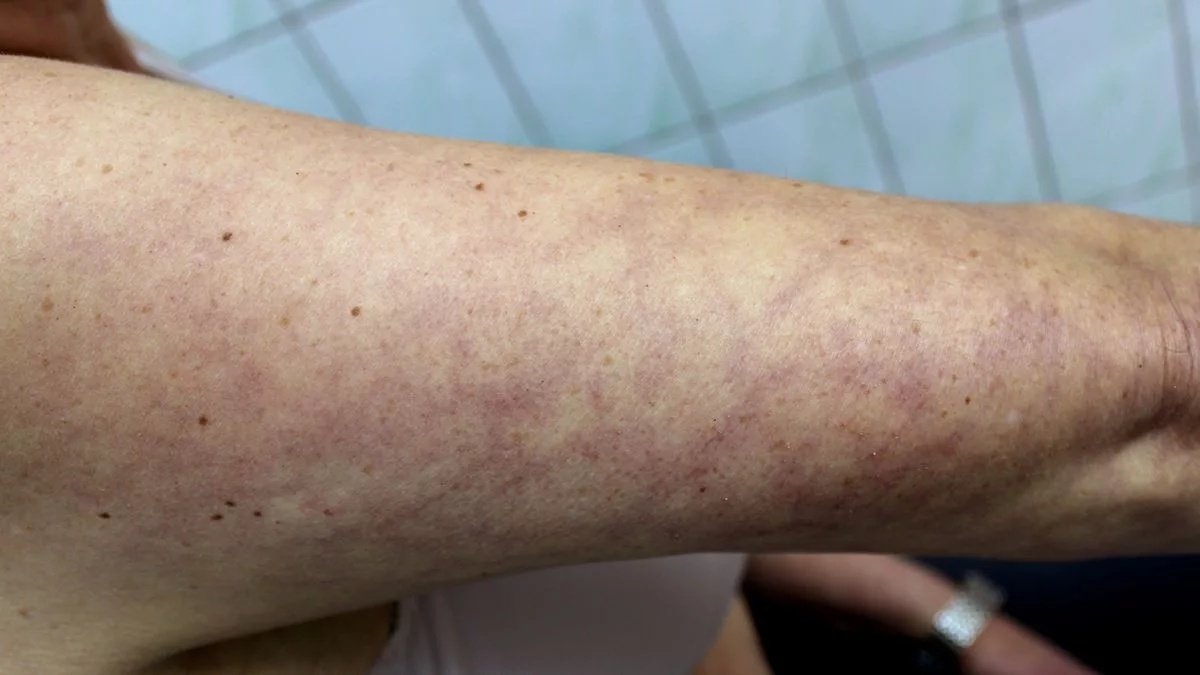
Cutis Marmorata This Cutis Marmorata is a benign skin condition highly common in infants, which is characterized by the appearance of blue, mottled/marbled patterns on the skin. Marmorata in Latin means “mottled,” while cutis refers to “skin”, so it literally translates to marbled or mottled appearance of the skin. In most cases, it is a transient skin response to cold. It is estimated that around 50% of children/infants have cutis marmorata at some point in life. It does not require any treatment as it is a temporary condition that resolves on its own. Rewarming the skin restores it to its normal appearance. In adults, a similar mottled appearance may occur secondary to decompression sickness rather than true cutis marmorata. In such cases, doctors perform recompression therapy in a hyperbaric oxygen chamber to alleviate symptoms, not “recompression of the skin.
Note: Cutis marmorata is different from cutis marmorata telangiectatica congenita (CTMC), which is a rare congenital vascular disorder.
The term “cutis marmorata” is sometimes loosely used alongside “livedo reticularis,” which describes a similar but generally benign net-like skin pattern. “Livedo racemosa,” however, refers to a pathologic and irregular pattern often linked to systemic disease. While some older literature uses these terms interchangeably, they are not identical conditions.
Cutis Marmorata Symptoms: Cutis Marmorata This
Infants:
In infants, cutis marmorata merely displays discoloration of the skin. Exposure to cold changes the color of the infant’s skin to a pink, bluish-pink color. This discoloration appears in the form of a marbled or lacy pattern. In individuals with darker skin tones, cutis marmorata can appear as dark brown or purple-colored laces/marbles. The most common site of marmorata is the limbs, i.e., arms and legs. However, the skin deformity can appear on the infant’s torso (trunk) as well.
The unique discoloration appears somewhat dull, and there are no shiny skin presentations. Moreover, there are no associated symptoms with the marmorata. There is no itching, pain, or burning present in infants and children. Hence, it is a benign and innocuous infant condition that arises only as a response to external cold.
Adults:
In adult individuals, the skin mottling usually develops secondary to decompression sickness and can be accompanied by various symptoms. Commonly known as bends (in scuba diving professionals), decompression sickness (DCS) is a problem frequently encountered by scuba divers (especially those who go to greater depths).
Livedo racemosa (also called “skin bends”) may appear in divers with cutaneous decompression sickness. As per studies, the skin condition is seen in about 10% of DCS cases..[1]
Even low decompression stress can present with cutaneous manifestations. In a clinical study, a 30-year-old female developed cutis marmorata on three different occasions. The study concluded that cutaneous decompression sickness is a serious event as it is neurologically mediated through the brainstem, which regulates skin blood flow.[2]
Itching & Rash:
Divers ascending rapidly after a prolonged stay under the water are known to present with decompression sickness. Such patients usually have a livedoid or marbled skin pattern resembling cutis marmorata. In one such case, a 52-year-old male patient stayed underwater (18 meters of seawater) for about 1.5 hours. After a rapid rescue ascent, he was brought to the ER with confusion and circulatory collapse. In the emergency room, the patient showed a marble skin, typical of cutis marmorata. The skin discoloration pattern was present on the torso, thighs, and knees. He also reported having developed macular rash on the upper extremities. As he didn’t recall any fish bite, the rash was believed to be associated with decompression sickness rather than cutis marmorata alone.[3]
Erythematous lesions and cutis are common features of DCS’s skin manifestations. The rash typically develops in conjunction with mottling of the skin. However, these manifestations are only temporary.
Modern studies found reticular violaceous macular eruptions in the cutaneous manifestations of decompression sickness. Such violet-colored macules may appear in a satellite pattern and are often accompanied by mottling of the skin.[4]
Joint Pain:
Generally, decompression sickness is characterized by different types of aches in the body. The most common problems include arthralgias (bone/joint pains) and myalgias (muscle pains). These aches may be accompanied by parasthesis.
Decompression issues are not only seen in scuba divers but can also be present in individuals working under pressurized chambers. According to a reported case, a 32-year-old male presented to the ER with a mottled rash, weakness, vision changes, arthralgias, and myalgias. These symptoms were attributed to occupational exposure in a factory-based pressurized chamber. The patient reported complete resolution of symptoms after two hyperbaric chamber sessions.[5]
Other severe symptoms of decompression sickness, like fatigue and paralysis, may also be present in conjunction with the marbled skin appearance. It can rarely lead to unique complications like venous thrombosis of the intestines (mesenteric venous thrombosis). Patients presenting with cutaneous symptoms, joint pain, and cardiopulmonary dysfunction can fall prey to mesenteric venous thrombosis due to the presence of intravascular gas bubbles.[6]
Cutis Marmorata Causes
The exact cause of the condition is unknown.
Infants:
The condition of marbled skin is pretty common in infants. As mentioned, the majority of newborns, and up to 50% of children, experience cutis marmorata. However, the temporary skin condition is more frequently seen in premature babies.
Child experts consider this a normal, physiological response of the infant’s skin to the outer cold environment. Many experts believe that the temporary dermatological symptoms arise primarily due to the immature nervous system and vascular system of newborns. The cold environment causes alternating constriction and dilation of the superficial blood vessels of the infant. This leads to the formation of mottling on the skin, which is otherwise symptomless.
Adults:
According to common belief, the marbled skin pattern seen in decompression sickness is not true cutis marmorata but a similar livedoid reaction. When an individual undergoes rapid decompression, for example, a scuba diver rapidly ascends to the surface, the abrupt changes in external pressure induce the formation of nitrogen bubbles in the bloodstream and the tissues. These bubbles lead to different manifestations, like skin mottling, etc. In rare instances, these moving bubbles in the blood circulation lead to serious issues like cerebral dysfunction and visual distortions.

Decompression sickness in adults causes cutis marmorata
The appearance of cerebral symptoms indicates a more serious phenomenon, i.e., bubble embolization in the brainstem. The brainstem is the site of the autonomic nervous system regulation of the skin’s blood vessels. Thus, modern-day experts believe that the brainstem bubble embolization (created in decompression) negatively affects the activity of the brainstem. Therefore, clinicians now advise health professionals to cautiously treat cutis marmorata secondary to decompression sickness, as it is linked to brain embolization.[7]
When it is secondary to decompression sickness, there is a high prevalence of patent foramen ovale (PFO) of the heart.
Risk Factors:
Infants with the following underlying health disorders are at a higher risk of developing cutis marmorata at the time of birth:
- Congenital hypothyroidism: Studies show that individuals with hypothyroidism often have cold and mottled skin. [8]
- Systemic lupus erythematosus: Patients suffering from this autoimmune disorder may develop mottled purple reticular vessels in the arms and legs at some point in life. [9]
- Down syndrome: Cutis marmorata occurs in 8-13% of babies with Down syndrome. [10]
- Familial dysautonomia: Individuals suffering from this nervous system disorder are prone to developing racelike purple discolorations of the skin, i.e., livedo racemosa. [11]
Cutis Marmorata Diagnosis
A healthcare provider diagnoses cutis marmorata by performing a physical examination. In infants, the mottling/marbling disappears on warming. If the presentations persist even after warming, doctors perform other tests such as X-rays, CT scans, MRI scans, etc. These tests help diagnose the underlying pathology that is causing secondary skin mottling.
Differential Diagnosis:
Cutis Marmorata’s differential diagnosis includes:
Cutis Marmorata Vs Cutis Marmorata Telangiectatica Congenita
Both diseases sound the same. However, cutis marmorata is a temporary disorder seen in infants and decompression sickness patients. In infants, it arises due to cold exposure, while rapid decompression causes mottling in adults. Thus, symptoms of cutis marmorata subside after warming (in infants) and hyperbaric oxygen therapy (in adults). On the other hand, cutis marmorata telangiectatica congenita is a persistent blood vessel disorder characterized by a purple, mottled/marbled appearance of the skin. The dilated blood vessels form a purple, net-like pattern, which is associated with other problems like ocular problems and musculoskeletal abnormalities.
Cutis Marmorata Treatment
Infants/Newborns:
In the vast majority of cases, doctors do not provide any treatment as it resolves itself. In newborns, warming makes the skin mottling disappear. Even when warming doesn’t improve the skin discoloration, cutis marmorata symptoms in infants disappear within a few months (to a year). For most patients, the mottling resolves within the first 2 years of life.
Adults:
For adults displaying the typical skin mottling due to compression sickness are mostly treated with recompression in a hyperbaric oxygen chamber. The chambers increase the concentration and pressure of oxygen being delivered into the body. This shrinks the gas bubbles in the bloodstream and leads to the resolution of cutaneous symptoms.
Cutis Marmorata Prevention
In infants, cutis marmorata can not be prevented. However, you can minimize the chances of decompression sickness-induced cutis marmorata. For this, you need to follow an appropriate ascent rate and take safety stops if ascending from a deep dive. You must adhere to the decompression schedules and follow conservative dive planning.
Final Word
Cutis marmorata is a benign skin condition that usually develops temporarily in newborns due to cold exposure. It is characterized by mottled, marbled bluish-purple discoloration of the skin of the torso and limbs. The skin presentation usually disappears on warming the newborn. Even if warming doesn’t work, it resolves without intervention within 2 years. Immature vascular and neurological development of the infant causes constriction and dilation of the skin blood vessels, leading to skin mottling.
In adults, the condition mostly arises secondary to decompression sickness (often seen in scuba divers). Rapid ascent to the surface produces air bubbles in the blood. These bubbles cause brainstem bubble embolization that interferes with the normal functioning of the brainstem, i.e., controlling constriction/dilation of skin blood vessels.
Cutis marmorata is different from cutis marmorata telangiectatica congenita, which is a permanent, congenital deformity of the skin blood vessels. Doctors do not treat infant cutis marmorata as it resolves itself. For cutaneous decompression sickness symptoms, doctors put the patient on recompression therapy with hyperbaric oxygen chambers.
References
[1] Shadiack, A. (2025). Cutaneous Decompression Sickness in a SCUBA Diver.Current Sports Medicine Reports,24(4), 85-87.
[2] Kemper, T. C., Rienks, R., van Ooij, P. J., & van Hulst, R. A. (2015). Cutis marmorata in decompression illness may be cerebrally mediated: a novel hypothesis on the aetiology of cutis marmorata.Diving Hyperb Med,45(2), 84-8.
[3] Tasios, K., Sidiras, G. G., Kalentzos, V., & Pyrpasopoulou, A. (2014). Cutaneous decompression sickness.Diving Hyperb Med,44(1), 45-47.
[4] Breen, I. D., Stepanek, J., Marks, L., Yale, K., Mesinkovska, N., & Swanson, D. (2024). Clinical significance of mottling rashes in diving decompression sickness.Aerospace Medicine and Human Performance,95(9), 695-702.
[5] Diederich, T., Briggs, A. M., Malik, A., & Beaver, B. (2024). Occupational decompression sickness: A case report.JACEP Open,5(2), e13144.
[6] Toyota, S., Nagata, S., Yoshino, S., Kono, S., Kawanami, S., Maeda, S., … & Korenaga, D. (2020). Mesenteric venous thrombosis as a rare complication of decompression sickness.Surgical Case Reports,6(1), 24.
[7] Germonpre, P., Balestra, C., Obeid, G., & Caers, D. (2015). Cutis Marmorata skin decompression sickness is a manifestation of brainstem bubble embolization, not of local skin bubbles.Medical hypotheses,85(6), 863-869.
[8] Cammisa, I., Zona, M., Guerriero, C., Cipolla, C., & Rigante, D. (2024). Skin Sceneries of Thyroid Disorders and Impact of Thyroid on Different Skin Diseases: A Scoping Review Focused on Pediatric Patients.Children,11(12), 1488.
[9] Ghosh, A. (2007). Cutaneous manifestations of systemic lupus erythematosus.Indian Journal of Rheumatology,2(4), 156-164.
[10] Hunter, A. G. (2001). Down syndrome.Management of genetic syndromes, 103-129.
[11] Varner, C. A. (2020). Dysautonomia: Getting a handle on POTS.Nursing Made Incredibly Easy,18(4), 16-20.