

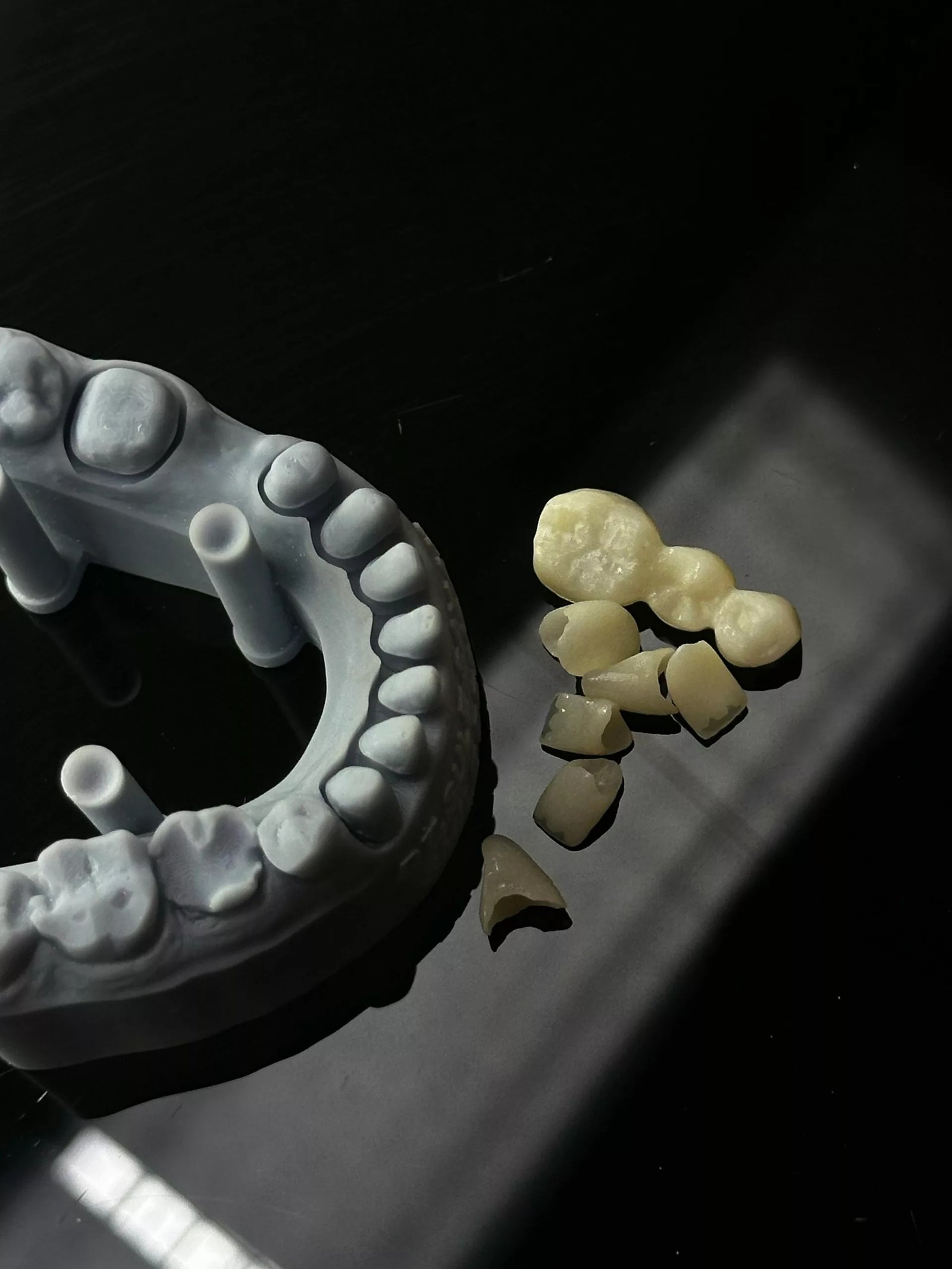
Dental Bridge Procedure A dental bridge is a type of artificial teeth that replace your missing teeth. These prostheses help restore function, enhance appearance, and prevent oral complications arising from missing a tooth. It is a fixed type of prosthesis that is preferred by patients worldwide. According to a study, the vast majority of patients are highly satisfied with the chewing (masticatory function), aesthetics, and phonetics of dental bridges.[1] A dental bridge can replace one or multiple teeth successfully. However, you will need to have healthy teeth on either side of the space for a traditional dental bridge to work. Dentists advise on different types of bridges and different materials, depending on your condition.
What Is A Dental Bridge?
A dental bridge belongs to the group of fixed partial dental prostheses. It means that these artificial teeth are fixed in your mouth and you can not remove them at will. This type is called a bridge because it bridges the gap between teeth (due to lost tooth/teeth). Moreover, it mimics a bridge design as it also has two parts that take support from the base, like posts/pillars of a bridge, and a part that connects these support pillars.

Illustrations of a Dental bridge based on two supporting teeth (abutments)
Design Of A Dental Bridge
Every dental bridge has several distinct parts. You get a variety of bridge types based on the modifications in these parts, but the basic principle is the same for all prostheses.
Abutments
In dentistry, abutment refers to structures that provide support to fixed artificial teeth. In the case of a dental bridge, abutment refers to the natural teeth present on the neighboring sides of the space or tiny connectors (in case of implant-supported bridges).
Pontics
The artificial teeth that replace your missing teeth (gap) are called pontics. Depending on the number of missing teeth, the gingival health, and the ridge quality, you might have one or more abutments and one or more pontics.
Why Is A Dental Bridge Necessary?
Getting a dental prosthetic is important because there are numerous consequences of a missing tooth. The physical changes that take place in your oral cavity due to prolonged edentulism (a state of lacking teeth) present with issues like difficulty in chewing (mastication), collapse of the face, and derangement of the bite (due to movement of the teeth).[2]
According to studies, losing teeth and not getting them replaced on time can lead to multiple complications, including temporomandibular disorder and negative emotional effects (mostly in the case of front teeth). Moreover, the lack of an opposition causes supra-eruption (protrusion of the tooth in the oral cavity) of the opposing and drifting of neighboring teeth. These effects lead to speech distortion, poor aesthetics, and low chewing ability.[3] Hence, you should not delay getting a dental bridge.
Types Of Dental Bridges
Different types of dental bridges exist in clinical dentistry. The choice of a bridge depends on different factors, including oral factors (oral health, ridge height, bridge location, etc.) and patient preferences. Most commonly, we see the following types:
Traditional Bridge
A traditional bridge is the most commonly sought-after fixed dental prosthesis. It comprises two parts, i.e., dental crowns and the pontics. A dental crown refers to the cap that is bonded to the abutment (natural teeth) on both sides of the space. The pontics (artificial teeth part) is attached to the crowns and covers the space, i.e., the bone (ridge) missing the teeth. A traditional bridge is the preferred type of bridge if the patients’ abutments are healthy. However, the choice of a fixed dental partial prosthesis comes second to an implant-supported crown.[4]
Cantilever Bridge
A cantilever bridge has a design similar to a traditional bridge. The only difference is that in this type cap covers the abutment on only one end and not both. This type of bridge hangs over the ridge. Medical literature shows that a cantilever bridge requires a proper oral health status, and there are multiple factors that lead to its failure. Hence, doctors should minimize the size of the pontics and increase abutment teeth for enhanced outcomes.[5] Cantilever bridges are not as strong as traditional bridges. Thus, their use is not that common.
Maryland Bridge
In a Maryland bridge, there are no caps (crowns) but metal wings that secure the bridge in place. Unlike traditional and cantilever bridges, this type doesn’t require the dentist to prepare abutments. The dentist bonds the wings to the neighboring teeth using resin. Therefore, dentists also call it a resin-bonded bridge. A Maryland bridge is weak because of the limited support from neighboring teeth.
Maryland bridges offer some advantages over conventional and cantilever bridges. A major advantage of Maryland is that it requires minimal to no tooth preparation, thereby preserving the healthy tooth structure of abutments. As this type rests above your bone and gums (supragingivally), you can achieve better periodontal health. Moreover, dentists can easily fix debonded bridges. However, this type of prosthesis is ideal only for short periods and in patients who demand minimal tooth preparation and less chair time.[6]
Implant-Supported Bridge
An implant-supported bridge rests atop two implants instead of natural teeth. A dental implant is an advanced dental prosthesis that comprises a post (placed inside the jaw, which replaces the tooth root). An abutment (small connector) attaches to the post to which the dentist can fix a crown. When more implants are placed to replace a larger number of teeth (three or more missing teeth in a row), the dentist may opt for an implant-supported bridge. This is usually done to lower the cost of the treatment. Studies note that implant-supported bridges have success rates similar to natural tooth-supported bridges.[7]
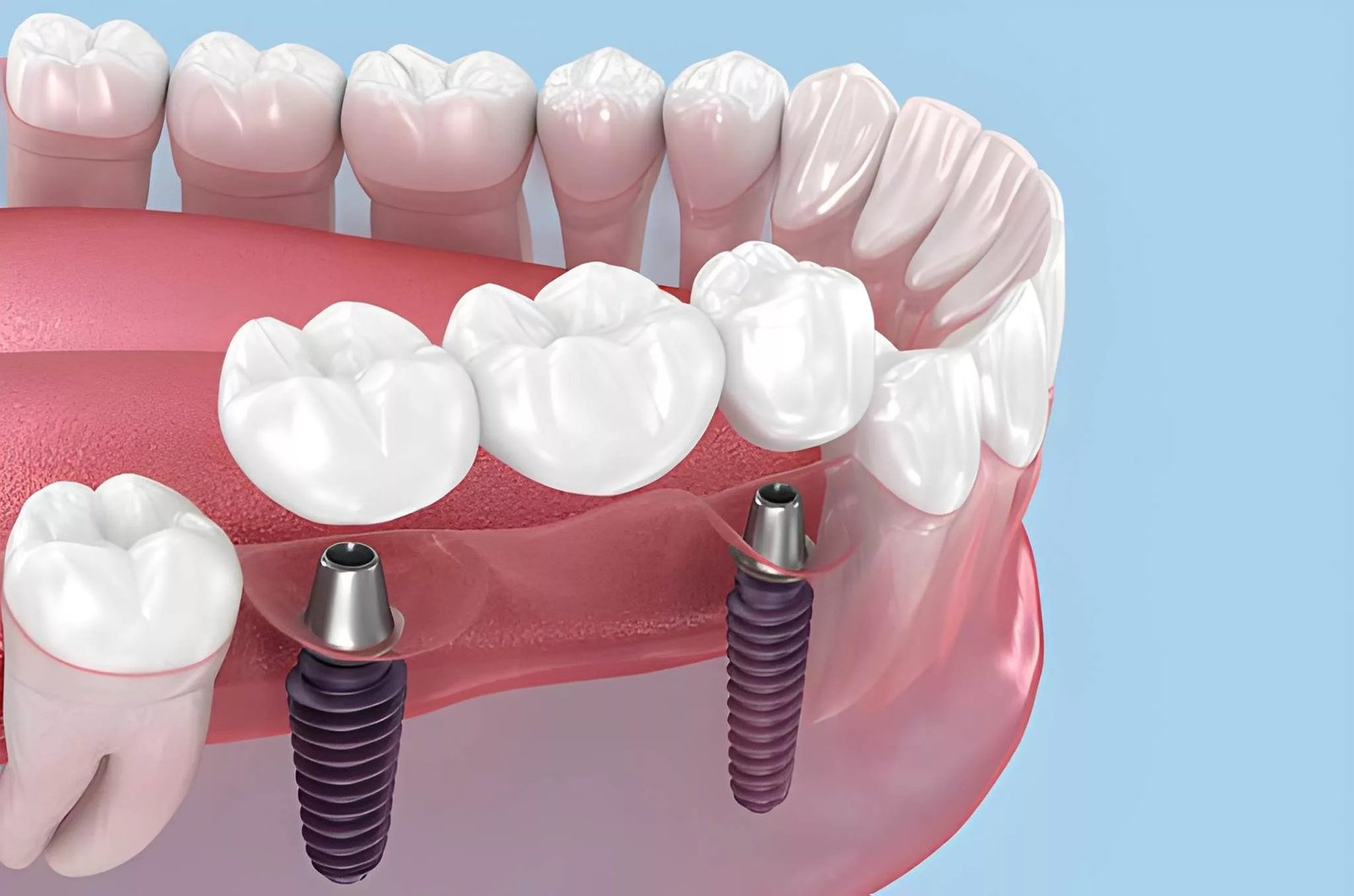
Implant-supported dental bridge
Factors Affecting The Choice Of The Bridge Type
Dentists consider multiple factors when determining the type of bridge ideal for a patient, including:
- Number of missing teeth
- Size of the gap (edentulous area)
- Quality/condition of the abutment teeth
- Periodontal health of the patient
Dental Bridge Procedure
The process of making a dental bridge involves several different steps. Preparation of the tooth and impression taking are done at a dental clinic, and the manufacturing process of the bridge takes place at a dental laboratory. There are differences in the preparation of different bridge types.
Anesthesia
The first step in the preparation of a fixed bridge is the administration of local anesthesia to keep you comfortable during the procedure. Dentists usually do not give anesthesia for Maryland bridges, as they require minimal to no tooth preparation.
Preparation
The next step is teeth preparation. For traditional and cantilever bridges, the dentist reshapes the natural teeth neighboring the space. He grinds the tooth enamel to make space for the bridge crowns. Your tooth gets shortened in all dimensions. The loss of enamel induced by the grinding is irreversible. In the conventional bridge, teeth on both sides are trimmed/prepared, while in the cantilever type, only one-sided abutment is prepared.

The image shows the prepared (cut) teeth of a patient for a 3-unit traditional dental bridge. You can appreciate the cutting of teeth on both ends.
In most Maryland bridge cases, dentists do not prepare the abutments. However, there may be a minimal amount of preparation on the lingual (back) side of the adjacent teeth.
In the case of an implant-supported bridge, a bridge is fixed to the implant post fixed inside your jaw. The preparation of this type of bridge is different and involves attaching special copings to the dental implants for impression. These copings are tiny connector posts that project out of the gum/bone for impression recording.
Dental Impression
After the dentist has carefully cut your tooth, he will take an impression of your upper and lower jaws. For implant bridges, an impression of the ridge with copings is taken.
There are multiple ways to record an impression of the oral structures. A physical impression requires filling up dental trays with impression materials like silicone (putty-based) and sodium alginate, etc. The dentist fills up the tray with either of these materials and records the prepared teeth or copings.
In modern times, dentists prefer using an intraoral scanner to take an impression. An intraoral scanner is an advanced, handheld device that recreates the details of the patient’s mouth (gums, teeth, bone, and implant with copings, etc). It creates real-time 3D images that are highly accurate. According to studies, these modernized devices show good accuracy in recording impressions for three-unit implant-supported bridges.[8] After this, the dentist sends this impression to the lab to create the bridge.
For implant-supported prostheses, the dentist will remove the abutments (copings) after the impression is taken.
Temporary Bridge
Your dentist will place a temporary bridge (crown) over the prepared teeth till the time the lab prepares your final bridge.
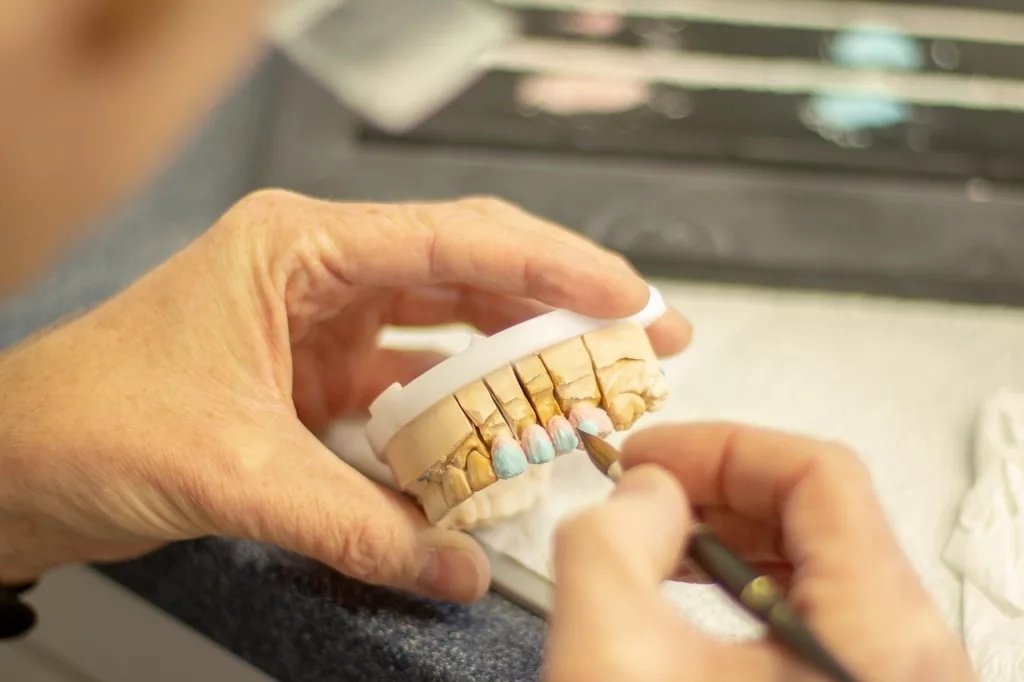
A dental lab technician is preparing a traditional dental bridge.
Bridge Insertion/Fixation
You will have to schedule your next appointment when the bridge is ready. A bridge usually takes 2-4 weeks to make. At your second visit, your dentist will remove the temporary bridge and try on the final bridge first. He will check for fit and occlusion (bite). If needed, he might slightly grind it before fixing it. Once everything is checked, the dentist adds bonding (dental cement) to the crowns and places them on the abutments.
In the case of a Maryland bridge, your dentist will apply acid etch to the back (lingual) surfaces of the abutments. The wings (extensions) of the bridge are then bonded to the abutments using dental resin cement.
For an implant-supported bridge, the dentist will place the implant abutments and the attached bridge onto the threaded post (implant) in your bone. The dentist first checks the fit and occlusion and then secures the bridge in place with the help of tiny screws or dental cement.
Types Of Dental Bridge Materials
Scientists have tested different biocompatible materials that have proven to be beneficial as crown/bridge materials. The most commonly used materials include:
- Metal alloys like Chromium-Cobalt, Nickel-Chromium, and Gold have conventionally been used for the purpose due to their toughness. However, these alloys don’t offer a natural look.
- Porcelain-Fused-to-Metal (PFM) bridges have a base of metal alloys to which high-quality, tough ceramic, i.e., porcelain, is fused. This type offers the strength of the metal alloy while imparting a natural look, thanks to the white, tooth-colored porcelain. When compared with all-ceramic crowns/bridges, PFM bridges have better survival.[9]

The image shows a zirconia bridge that looks aesthetic and is robust.
- Glass-ceramics like Lithium disilicate (E. max) and Zirconia are strong and durable materials used to make dental bridges. Monolithic zirconia crowns/bridges are derived from zircon sand and have been shown to exhibit positive results in dentistry.[10]
Alternatives To A Dental Bridge
If you don’t want to get a dental bridge, you can opt for the following options. Cast partial dentures are removable teeth, while a dental implant is fixed and screwed into your bone.
Dental Bridge Vs Cast Denture
A removable partial denture is a type of artificial tooth that replaces your missing teeth. It consists of a denture base (that rests on your bone), artificial teeth, connectors, and retainers. You can choose between flexible, acrylic, and cast partial dentures. Dentists don’t prepare neighboring teeth for a denture.
Dental Bridge Vs Dental Implant
An implant is the most advanced type of artificial tooth that consists of a post surgically placed in the jawbone to which a crown is attached. This type of artificial tooth spares your neighboring teeth from being cut/ground.
How To Care For Your Dental Bridge?
You must care for your bridge to ensure its longevity. There are certain steps that you can adopt to increase the life of your artificial teeth:
- Avoid extremely hard foods.
- Avoid sticky and chewy foods.
- Maintain good oral hygiene by brushing and flossing daily.
- Regularly visit your dentist for checkups and cleanings.
Frequently Asked Questions
How Much Does a Dental Bridge Cost?
The cost of a dental bridge depends on the type of bridge used, the number of missing teeth, the material chosen, and the complexity of the procedure. Prices can vary significantly based on location and the dentist’s expertise, so an in-person evaluation is usually needed for an accurate estimate.
How Long Do Dental Bridges Typically Last?
With good oral hygiene and regular dental checkups, a dental bridge can last many years. Its lifespan largely depends on how well the supporting teeth and gums are maintained. Studies show that the estimated survival rate for dental bridges is quite high in the short term; around 94% at 3 years, about 89–91% at 5 years, and roughly 79–82% at 10 years.[11]
Final Word
A dental bridge is a fixed type of artificial teeth that takes support from neighboring teeth. There are several different types of bridges. A Maryland bridge has an artificial tooth part with metal extensions that are bonded to unprepared inner surfaces of neighboring teeth. This type is mostly used in the replacement of front teeth. In a cantilever bridge, the doctor trims one of the neighboring teeth of the space. The crown (to which the artificial tooth is attached) is fixed to the prepared tooth, i.e., the abutment.
A traditional bridge has crowns on both ends of the artificial teeth, which are fixed to the abutment teeth. Traditional bridges offer the greatest strength, resilience, and retention. Another type is an implant-supported bridge, in which the bridge is fixed to implants present in your jaw.
Materials like glass-ceramics (lithium disilicate and zirconia) and porcelain-fused-to-metal (PFM) offer superb strength and superior aesthetics, which make them a natural choice for the patients.
A dental bridge requires two visits in general. In the first visit, the dentist gives anesthesia, grinds the abutment teeth, takes an impression, and sends you home with a temporary crown. It takes 2-4 weeks to prepare a permanent bridge, which the dentist fixes during the 2nd visit. Avoiding very hard/chewy food and maintaining oral hygiene can ensure the longevity of the bridge without complications.
References
[1] Astuti, T. H., Kusumadewi, A. N., & Pramudita, S. (2024). The Level of Satisfaction Among Patients with Dental Bridges.Insisiva Dental Journal: Majalah Kedokteran Gigi Insisiva,13(1), 23-31.
[2] Dosumu, O. O., Ogunrinde, J. T., & Bamigboye, S. A. (2014). Knowledge of consequences of missing teeth in patients attending prosthetic clinic in uCh Ibadan.Annals of Ibadan postgraduate medicine,12(1), 42-48.
[3] Jaber, A. A., Alshame, A. M., Abdalla, K. O., & Natarajan, P. M. (2021). The association between teeth loss and oral health problems.Indian journal of forensic medicine & toxicology,15(1), 1892-1902.
[4] Augusti, D., Augusti, G., & Re, D. (2014). Prosthetic restoration in the single‐tooth gap: patient preferences and analysis of the WTP index.Clinical Oral Implants Research,25(11), 1257-1264.
[5] Bukhari, M., Fatani, O., Alrifai, J. A., Kabli, S. W., Alhomood, M. A., Alnomani, M. H., … & Alshaikh, A. B. (2022). Advantages and disadvantages of cantilever bridges. International Journal of Community Medicine and Public Health, 9(1), 359-63.
[6] Bukhari, M., Alhowig, M., Al Farhah, A., Ibrahim, M., Alsahafi, R., Ali, S., … & Alghamdi, A. (2022). An Overview of Maryland Bridges and their Clinical Applications.
[7] Cristea, I., Agop-Forna, D., Martu, M. A., Dascălu, C., Topoliceanu, C., Török, R., … & Forna, N. (2023). Oral and Periodontal Risk Factors of Prosthetic Success for 3-Unit Natural Tooth-Supported Bridges versus Implant-Supported Fixed Dental Prostheses.Diagnostics,13(5), 852.
[8] Fang, S., Xingjian, Z., Xueying, W., Yuyin, S., & Zhicheng, G. (2025). Assessment Of Intraoral Scanning For Three-Unit Implant-Supported Bridges.International Dental Journal,75, 105280.
[9] Newaskar, P. S., Sonkesriya, S., Singh, R., Palekar, U., Bagde, H., Dhopte, A., … & Sonkesariya, S. (2022). Evaluation and comparison of five-year survival of tooth-supported porcelain fused to metal and all-ceramic multiple unit fixed prostheses: a systematic review.Cureus,14(10).
[10] Jabber, H. N., Ali, R., & Al-Delfi, M. N. (2023). Monolithic zirconia in dentistry: Evolving aesthetics, durability, and cementation techniques–an in-depth review.Future Dental Research,1(1), 26-36.
[11] Hill S, Bailey S, Hamson A; Authors. Dental Bridges for Partial Tooth Loss: CADTH Health Technology Review [Internet]. Ottawa (ON): Canadian Agency for Drugs and Technologies in Health; 2023 Mar. Available from: https://www.ncbi.nlm.nih.gov/books/NBK596304/?utm_source=chatgpt.com