

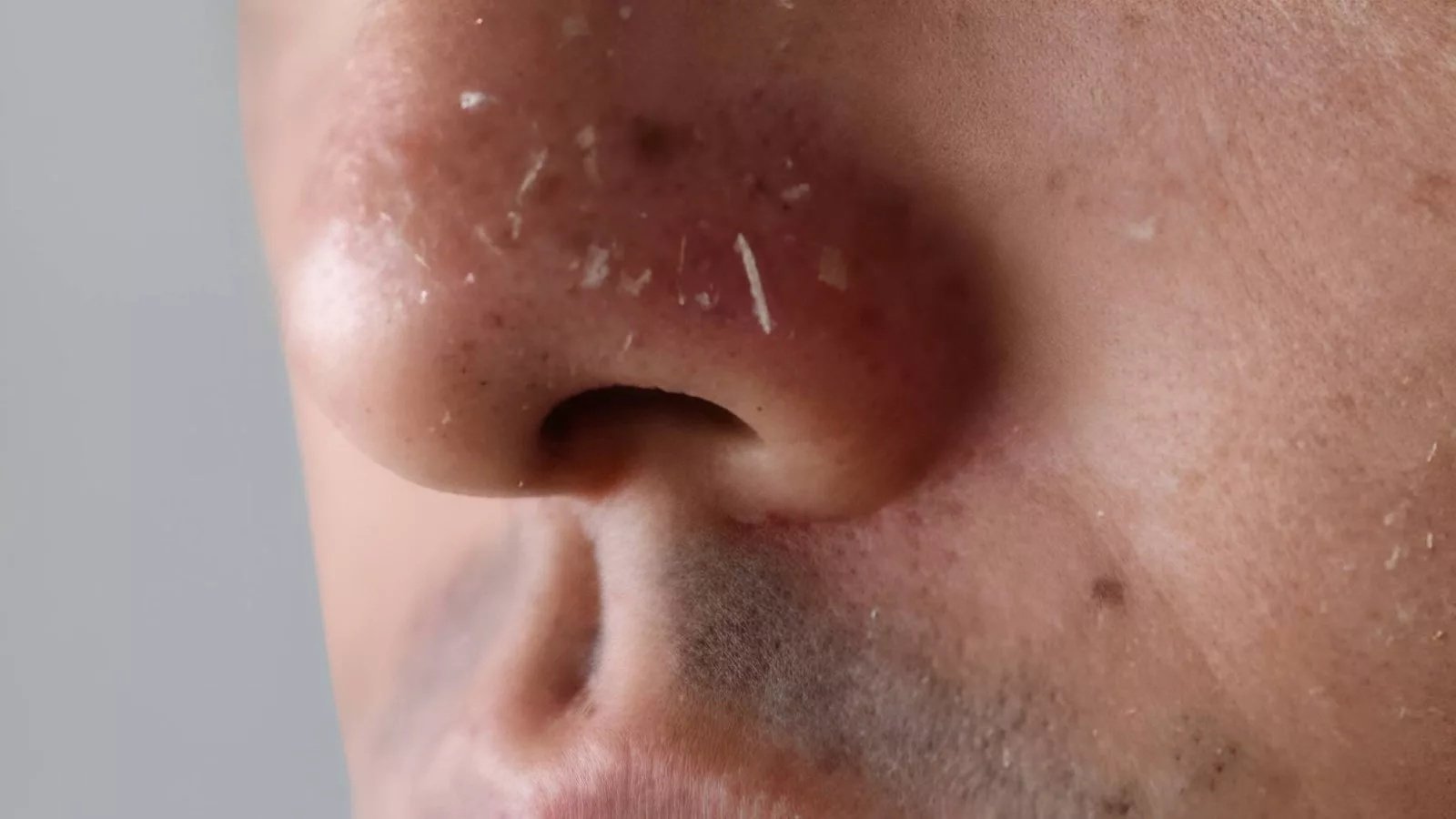
Flaky skin around the nose is a common clinical symptom that refers to visible scaling and dryness in the nasolabial folds, often associated with an underlying disruption of the skin barrier or inflammatory skin conditions. It is most frequently linked to seborrheic dermatitis, although other conditions such as irritant dermatitis, allergic contact dermatitis, and psoriasis may present in a similar way.[1]
Skin Barrier Function and Why Flaking Occurs
The skin’s outermost layer, the stratum corneum, forms the main protective and permeability barrier of the skin. This barrier maintains hydration and protects against environmental irritants through the coordinated function of natural moisturizing factors, lipids, antimicrobial peptides, and corneocytes. When this barrier is disrupted, increased water loss and inflammation can result in dryness and visible flaking of the skin.[2]
Common Causes of Flaky Skin Around the Nose
Flaking around the nose is multifactorial. The most common causes include inflammatory skin conditions and external irritants.
Seborrheic Dermatitis (Most Common Cause)
Seborrheic dermatitis is a chronic inflammatory skin condition and the most frequent cause of flaky skin around the nose. It typically affects areas such as the nose, scalp, eyebrows, and upper chest. These areas are rich in sebaceous glands.
It is associated with abnormal immune response to Malassezia species, a lipophilic yeast that naturally exists on the skin. In susceptible individuals, this interaction leads to inflammation, increased skin turnover, and greasy or yellowish scaling.
Other Possible Causes
- Irritant contact dermatitis due to harsh skincare products or over-cleansing
- Allergic contact dermatitis due to cosmetic or topical product sensitivity
- Dry skin (xerosis), especially in cold or low-humidity environments
- Psoriasis, which may cause well-defined scaling plaques
How Seborrheic Dermatitis Causes Flaking Around the Nose?
In seborrheic dermatitis, increased sebum production and altered skin microbiome create an environment where Malassezia yeast proliferates. The breakdown of skin lipids produces inflammatory byproducts that trigger an immune response.
This leads to:
- Mild to moderate inflammation
- Increased epidermal turnover
- Formation of greasy or flaky scales
- Red or erythematous patches around the nose
Clinical Features and Appearance
The clinical presentation of dry, patchy skin around the nose and other body parts varies across skin types and age groups. Around the nose, patches of salmon colour can be observed with fine scales. In people with lighter skin tone, symptoms include raised, red patches, whereas in darker skin tones, erythema may be less visible and scaling may be the predominant feature, sometimes without obvious redness.[3]
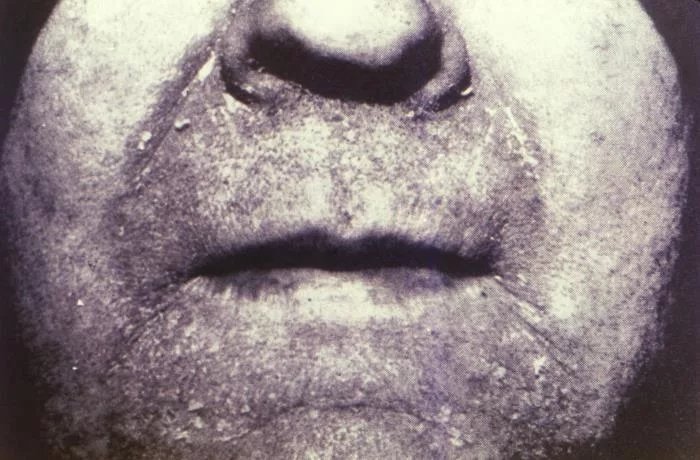
A frontal view of the lower half of a patient’s face, which exhibited a condition diagnosed as seborrheic dermatitis. Image ID#21287, Image Courtesy: PHIL CDC.
When To See a Dermatologist?
If the skin is only slightly dry and flaky, it may improve with basic skin care measures. However, if the condition does not improve and certain signs appear, it is better to talk to a professional.
A person should pay attention to the following signs:
- The condition does not improve after 2 to 4 weeks of appropriate topical care.[4]
- An infection starts to appear with signs such as pain, increased redness, and oozing.
- The skin becomes more scaly and dry.
- Substantial impact on daily activities or quality of life.[5]
Clinical Assessment and Diagnosis
Dry and flaky skin around the nose is identified by the presence of greasy, flaky, erythematous patches on the nasolabial folds.[6] It is usually diagnosed clinically and rarely requires specific investigations.[7]
Dermatoscopy
A non-invasive diagnostic method known as dermatoscopy, or incident light microscopy, is used to detect morphological features that cannot be observed with the naked eye. This technique requires manual devices or digital systems that need a video camera with lenses and optical fibres. These instruments are used to obtain images that can be observed on a monitor. The images can also be stored on a computer to identify changes over time.[8]
Skin Biopsy (Rarely Required)
Histopathology is rarely needed and is reserved for atypical or treatment-resistant cases. These histopathological findings are non-specific and vary in acute and chronic stages. Psoriasiform hyperplasia and spongiosis can be observed during the acute stage, while the chronic stage involves the presence of parakeratosis and psoriasiform epidermal hyperplasia.[9]
Factors That Contribute to or Worsen Flaking
Several external and internal factors may worsen symptoms.
Weather
In dry weather, moisture in the skin is lost, leading to dry patches around the nose.
Seasonal Habits
When a person is battling the flu, constant nose-rubbing can also worsen this problem.
Skincare Products
Overuse of certain skincare products can also contribute to dryness around the nose and other facial areas.
Overproduction of Sebum
Another leading cause is the overproduction of sebum due to excessive activity of the sebaceous gland. In seborrheic dermatitis, increased sebum production supports the growth of Malassezia yeast. This triggers the release of inflammatory mediators that lead to scaling and redness.[10]

Factors that contribute to the condition.
Management of Flaky Skin Around the Nose
Treatment depends on the underlying cause and severity. In the absence of seborrheic dermatitis, common practices can help to resolve the issue. A facial oil or a good moisturiser helps to hydrate the skin. Consuming enough water makes a person hydrated from the inside out. Using a face mask helps to protect the nose from cold weather and wind. Harmful chemical products should be avoided. A sunscreen can help prevent further skin irritation.
But, if the dryness is due to seborrheic dermatitis, medications or other approaches should be used to treat the condition. For this purpose, different strategies are combined, as a single approach cannot solve all the problems.
Treatment When Seborrheic Dermatitis Is Involved
Management is typically anti-inflammatory and antifungal.
Antifungal Treatments
Using antifungal agents is the most fundamental treatment, as they target Malassezia yeast, the root cause of seborrheic dermatitis. As the yeast population decreases, the flaking and redness caused by the inflammatory cascade also diminish. Antifungal agents can be topical or oral. The most commonly used topical agent for the face is ketoconazole.[11] Oral antifungals are required when the patient fails to respond to the topical ones. Itraconazole is commonly prescribed in such cases with careful monitoring for drug interaction and liver function.[12]
Calcineurin Inhibitors and Topical Corticosteroids
Topical corticosteroids are effective for short-term management of flaky skin caused by seborrheic dermatitis. However, these cannot be used for a prolonged period because rebound flares and skin thinning can occur. For long-term treatment, calcineurin inhibitors are a safer alternative. The improvements can be observed within two weeks, and the relapse rate is lower than with corticosteroids. These inhibitors do not result in skin atrophy, making them appropriate for maintenance therapy.
Supportive Care and Prevention
Supportive measures include:
- Using sunscreen to reduce irritation in sensitive skin
- Maintaining regular skin hydration
- Avoiding known irritants
- Protecting skin from cold and wind exposure
Good skincare habits can help to lower the risk of facial dryness. Keeping the skin clean and balancing out oil are helpful in this regard.
Conclusion
Flaky skin around the nose is a problem caused by skin issues. There are several reasons for this, but the most prominent one is an inflammatory condition known as seborrheic dermatitis. In this condition, the skin of the affected area becomes patchy and dry. For the diagnosis of seborrheic dermatitis, two common practices include dermatoscopy and histological examination. A person should take care of their skin and protect it from harsh weather and chemicals to lower the risk of developing this condition. The treatment is employed based on the actual cause of this problem. If seborrheic dermatitis is the cause of flaky skin around the nose, the most common approach is antifungal agents, calcineurin inhibitors, and topical corticosteroids.
References
[1] Turchin, I., Albrecht, L., Hanna, S., Kyritsis, D., Loo, W. J., Lynde, C. W., … & Gooderham, M. (2025). Current understanding of seborrheic dermatitis: presentation, diagnosis, and special populations.Journal of Cutaneous Medicine and Surgery,29(4_suppl), 16S-23S.
[2] Fluhr, J. W., Moore, D. J., Lane, M. E., Lachmann, N., & Rawlings, A. V. (2024). Epidermal barrier function in dry, flaky and sensitive skin: A narrative review.Journal of the European Academy of Dermatology and Venereology,38(5), 812-820.
[3] Arenas, J. Seborrheic Dermatitis: Causes, Symptoms, and Proven Treatments.
[4] Arenas, J. Seborrheic Dermatitis: Causes, Symptoms, and Proven Treatments.
[5] Arenas, J. Seborrheic Dermatitis: Causes, Symptoms, and Proven Treatments.
[6] Clark, G. W., Pope, S. M., & Jaboori, K. A. (2015). Diagnosis and treatment of seborrheic dermatitis.American family physician,91(3), 185-190.
[7] Dall’Oglio, F., Nasca, M. R., Gerbino, C., & Micali, G. (2022). An overview of the diagnosis and management of seborrheic dermatitis.Clinical, cosmetic and investigational dermatology, 1537-1548.
[8] Golińska, J., Sar-Pomian, M., & Rudnicka, L. (2022). Diagnostic accuracy of trichoscopy in inflammatory scalp diseases: a systematic review.Dermatology,238(3), 412-421.
[9] Borda, L. J., & Wikramanayake, T. C. (2015). Seborrheic dermatitis and dandruff: a comprehensive review.Journal of clinical and investigative dermatology,3(2), 10-13188.
[10] Leung, A. K., & Barankin, B. (2015). Seborrheic dermatitis.Int J Pediat Health Care Adv,2(1), 7-9.
[11] Piérard-Franchimont, C., Goffin, V., Decroix, J., & Piérard, G. E. (2002). A multicenter randomized trial of ketoconazole 2% and zinc pyrithione 1% shampoos in severe dandruff and seborrheic dermatitis.Skin Pharmacology and Physiology,15(6), 434-441.
[12] Vidal, S. I., Menta, N., & Green, L. (2025). Child and adult seborrheic dermatitis: a narrative review of the current treatment landscape.Dermatology and therapy,15(3), 599-613.