
, is a condition in which there is more than the...)

Gummy Smile Too A gummy smile, clinically known as excessive gingival display (EGD), is a condition in which there is more than the esthetically acceptable display of the maxillary gingiva during smiling. The abnormality is known to have an impact on the quality of life primarily due to its psychosocial rather than functional effects. In young female adults, a gummy smile is associated with smile avoidance. In a study analyzing 385 students, the prevalence of a gummy smile was found to be 52%. However, this figure reflects perceived excessive gingival display within a specific young population and does not represent true clinical prevalence in the general population.[1] In addition to the actual deviation from natural gums, esthetic self-perception plays a major role. Many women believe that their smiles show too much of their gumline. Thus, people seeking treatment for it are sometimes more than the actual patients. Doctors adopt different techniques to lessen the gum display, including Botox and surgical options.
What Is A Gummy Smile?: Gummy Smile Too
There is no exact definition for a gummy smile. However, doctors consider a smile a gummy smile if the gum display is more than 3–4 mm during a full smile. Therefore, dentists focus on treating smiles with having 4-5 mm gum display. Multiple factors contribute to excessive display of the gingiva (gums):
- Height of the teeth
- Shape of the teeth
- Lip length and mobility
- Jaw position and facial proportions
Comprehensive smile analysis also includes evaluation of incisor display at rest, lip length, smile line, and facial symmetry.
Gummy Smile Classification
Clinicians divide a gummy smile into the following categories:
- Mild: 3-4 mm of gum display
- Moderate: 4-8 mm of display
- Severe: More than 8 mm of gum display
In the vast majority of cases (around 88%), there is a continuous band of gingival display which extends in the front-to-back (anteroposterior) direction. However, it may be localized to the anterior (front) or posterior (back) regions in specific cases.
Impact Of A Gummy Smile On Life Quality
There is no significant impact on the functionality of a gummy smile. However, the major reason why young adults seek treatment is to counter the psychological impact of the disorder. The following psychosocial effects are seen in the majority of young individuals:
Self Consciousness
Individuals with a gummy smile tend to be more self-conscious. Youngsters feel a lack in their smile and gums. This makes them more conscious of their activities, like talking and smiling in public. The increased self-consciousness prompts them to make amendments to their smile and the way they eat.
Smile Avoidance
Numerous studies have demonstrated how a gummy smile negatively impacts the psychological health of individuals. Several patients avoid smiling in public to minimize their gum exposure. When researchers investigated the psychological impact of a gummy smile in 320 individuals, 32 participants refused to participate (despite meeting the criteria) out of embarrassment at smiling. Some even refused to get their gummy smiles photographed.[2]
Lowered Self-Esteem
Health providers have noted a direct relation between a gummy smile and lowered self-esteem. Orthodontists provide personalized treatment options to patients encountering reduced self-esteem and social withdrawal due to excessive gingival display. Some may even fall prey to social anxiety, and early intervention can prevent related psychological impacts in some patients.[3]
What Causes A Gummy Smile?
Generally, a gummy smile is a multifactorial abnormality, and the origins of the excessive display are complex. Excessive gingival display is mostly the result of a combination of different causative factors. These factors are classified into skeletal, dental, and soft tissue abnormalities.[4]
1- Skeletal Discrepancies
Various skeletal growth abnormalities can contribute to excessive gum display.
Vertical Maxillary Excess (VME):
Disproportionate growth of the jaw leading to augmented lower facial height is known as vertical maxillary excess. The increased growth leads to more display of front teeth and gingiva, which contributes to a gummy smile. Clinicians find VME to be one of the most common causes of a gummy smile.[5]
Skeletal Cant:
Another skeletal condition that can cause a gummy smile is a skeletal cant. In this deformity, your occlusal plane (biting surface of the teeth) is tilted vertically due to abnormal growth of the jaw bones. This creates an uneven smile that can display more gumline.
2- Dental Causes
In some cases, the position and growth of the bones are optimal. However, discrepancies in the teeth and soft tissue positioning cause a gummy smile.
Excessive Eruption Of Front Teeth:
Hypereruption of your upper front teeth (maxillary incisors) leads to a greater display of front teeth and overexposure of the associated gingival tissue. This passive eruption of anterior (front) teeth tends to modify the curvature of your biting plane (occlusal plane).
Dental Cant:
Vertical tilt in the upper jaw caused by irregular development of the teeth is called dental cant without skeletal asymmetry. The abnormal positioning of the teeth leads to more than normal gum display in certain teeth (and lesser than normal gingival display in others). Doctors have found dental cant in about 4% of gummy smile cases.[6]
Disproportionate Crown Length And Width Ratio:
According to nature’s rules, there is a specific crown length-to-width ratio. This means the width of a normal tooth’s crown is proportional to its height. However, sometimes, there is a disparity in this ratio. Very small teeth can contribute to excessive display of gums.
Proclination Of Upper Front Teeth:
Patients suffering from severe outward projection (proclination) of the upper front teeth (anteriors) may present with a gummy smile. This is because in the majority of such cases (bi-dental protrusion smiles), the lips tend to retract, revealing a greater amount of gingiva when the person smiles.
3- Soft Tissue Causes
Your soft tissues play an integral role in shaping your smile. Therefore, different anomalies in the soft tissue lay the foundation for a gummy smile.
Gingival Enlargment:
Severe overgrowth of the gingiva is a major cause of a gummy smile. Your gums can grow to ga reat size due to multiple underlying pathologies. Infections (bacterial infections) of the gums can cause enlargement. Poor oral hygiene serves as the basis for gum infections.
On the other hand, individuals taking medicines like phenytoin (for seizures), calcium channel blockers (for hypertension), and cyclosporin (for autoimmune disorders) have a higher tendency to develop overgrown/overdisplaying gums.
Lip Abnormalities:
A hyperactive upper lip muscle can cause retraction of the upper lip while smiling, giving way for an enhanced display of the upper gingiva. Moreover, a short upper lip with normal musculature can have similar presentations.
Altered Passive Eruption
Before eruption, your tooth is covered by gums (gingiva), and as the tooth erupts into the oral cavity, the gums over and around it recede. However, sometimes, the gingiva fails to recede during the passive eruption phase in a condition called altered passive eruption. This results in excessive gingival coverage of the crown, shortened clinical crowns, and increased gingival display.
How To Diagnose A Gummy Smile?
Dentists diagnose the condition by physically examining the patient. After recognizing the abnormal display of gums, your doctor will evaluate the gingival display. He will measure how much of your gingiva is visible during smiling and will allocate it to a category (mild, moderate, or severe). Then your dentist will try to investigate the underlying cause of the gummy smile. To check whether the excessive gingival display is due to soft tissue abnormalities or hard tissue discrepancies, your doctor may perform some tests and order some radiographic images.
Probing Depth Measurement
Your dentist will insert a specialized probe called a periodontal probe into the space between your gum and tooth to measure the depth of the gingival sulcus. This measurement of the probing depth gives an idea about the health of your gums and if a gummy smile is caused by gum swelling conditions (gingivitis/periodontitis).

Periodontal probe for measuring pocket depths
Lateral Cephalogram
A lateral cephalogram X-ray provides a sideways picture of your jaws. This radiograph, paired with orthodontic cephalometric analysis, helps orthodontists in identifying bone growth abnormalities and jaw discrepancies leading to a gummy smile. Measurements of the angles allow professionals to design the ideal treatment plan for the patient.
How to Fix A Gummy Smile: Gummy Smile Treatment
Your doctor may offer you a number of treatment plans based on your specific condition. Treatment modalities employed in the management of a gummy smile range from minimally invasive injections to surgical interventions. Several different types of non-invasive and minimally invasive treatments target the underlying causes of your excessive gingival display.

Orthodontic treatment fixes malpositioned teeth, causing a gummy smile.
Orthodontic Treatment
Your general dentist might refer you to an orthodontist for your gummy smile. Orthodontic treatment works best in cases of overeruption of upper incisors or when occlusal cant is leading to more gum display. With the help of comprehensive orthodontic treatment, your orthodontist will intrude (move into the bone) your overerupted teeth and balance the display of all teeth (in dental cant cases).[7]
While orthodontic treatment with the help of mini-screw implants for maximum anchorage can be an effective strategy, it is usually the combination of orthodontics and orthognathic (jaw surgery)that yields the maximum results.
Facial Injections
Advancements in the field of healthcare now provide doctors and patients with newer options for treatments.
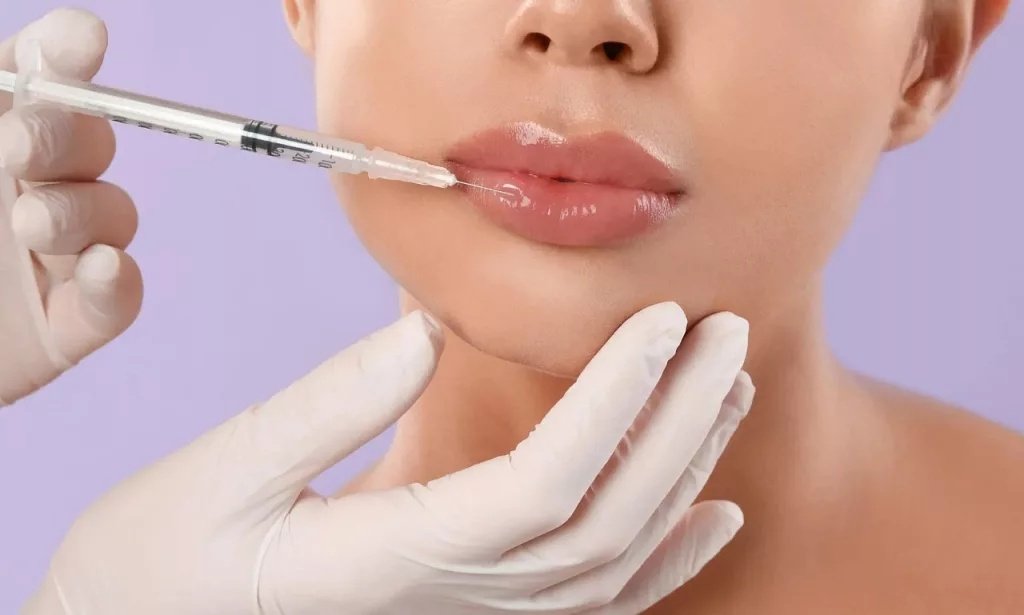
Filler and Botox injections can help improve a gummy smile.
Botox:
Botulinum toxin (Botox) injections are widely used to provide a younger-looking skin. These injections are now being used in managing gummy smiles caused by a hyperactive lip muscle. Studies show that Botox effectively improves the smile, has quick results, and rarely causes complications. However, the only drawback with Botox is the limited effect of the procedure (up to 6 months).[8]
Fillers:
Poor bone support in the premaxilla (upper lip region) paired with a hyperactive lip muscle can contribute to excessive gum display. To fix this, doctors are using filler injections such as hyaluronic acid. A recent clinical study showed that hyaluronic acid induces changes in the activity of the lip muscle, i.e., myomodulation, which resolves a gummy smile.[9]
Microautologous fat grafts can also serve as fillers for the upper lip. These new, minimally invasive techniques are fast, safe, and have minimal sequelae.[10]
Surgical Management of Gummy Smile
Different types of surgery target the multitude of underlying causes leading to excessive gingival display.
Periodontal Surgery:
One of the most commonly adopted surgeries is gum surgery (periodontal surgery). Gingivoplasty or gum contouring is a procedure in which the surgeon cuts/slices parts of the anterior gums to reshape them. It is frequently done to fix a gummy smile. In cases of excessive gingival covering, doctors may also perform surgical crown lengthening. In this, the oral surgeon/periodontist removes the excess gingiva covering the tooth (one or more) and thereby exposes the underlying tooth crown. This effectively fixes the gummy smile. Crown lengthening can be performed with the help of medical lasers.
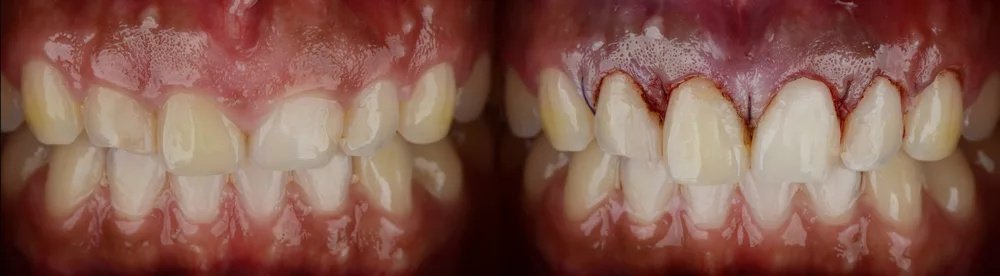
The image shows before and after a patient with a gummy smile treated with gum contouring (periodontal surgery).
Modern surgeons prefer pairing gum contouring surgery with lip muscle modification surgery (containment of the elevator muscle of the upper lip and wing of the nose) for most esthetic results.[11]
Orthognathic Surgery:
Corrective jaw surgery or orthognathic surgery is adopted in cases where a gummy smile is the result of misaligned jaws. Le Fort osteotomy is a type of orthognathic surgery done to fix excessive gingival display.
Lip Repositioning:
A frequently adopted surgical procedure for treating a gummy smile is lip repositioning surgery. The goal of this surgery is to reduce the muscle tension caused by a hyperactive upper lip muscle. A case series concluded that lip surgery enhanced smiles, reduced gum display with minimal postoperative complications. The procedure yielded the best results when paired with laser-assisted crown lengthening.[12]
The latest systematic reviews advocated the use of lip repositioning surgery for gummy smile treatment, thanks to its high clinical efficacy and good patient satisfaction.[13]
Wrapping Up
A gummy smile is a condition in which there is more than normal display of gums when smiling. Generally, a gum display of more than 3 mm when smiling is considered a gummy smile. The excessive gingival display can be attributed to multiple factors. Skeletal growth abnormalities (VME, cant), malpositioning of teeth (dental cant, hypereruption of front teeth), soft tissue pathologies (gingival enlargement), and lip abnormalities (short lip, hyperactive muscle) can cause a gummy smile.
Most patients suffer from the psychosocial impacts of a crooked smile, which makes them avoid smiling (and even interacting) in public. Doctors fix this with multiple treatment options. Orthodontic treatment can help correct improperly positioned teeth and arches and reduce overerupted front teeth. Botox injections lower the activity of the upper lip muscle, thereby providing quick but short-lasting results. Similarly, filler injections of hyaluronic acid modulate the upper lip muscle activity and enhance smile esthetics.
Surgery is the most effective and potent treatment strategy. Periodontists perform periodontal surgeries like gum recontouring and crown lengthening surgeries to reshape your gingiva, responsible for imparting a gummy look. Orthognathic surgeries are carried out to align and fix jaw discrepancies. Lip repositioning surgeries are very effective in resolving a gummy smile by altering the lip muscle activity and positioning. For best outcomes, most doctors pair lip repositioning with gum contouring. These surgical procedures have minimal side effects.
References
[1] Al Sayed, A. A., Alshammari, B. Z., Alshammari, A. R., Aldajani, M. B., Alshammari, F. R., Aldajani, M., & Alshammari, F. (2023). Gummy smile prevalence among ha’il city female young adults and its impact on quality of life: a cross-sectional study.Cureus,15(12).
[2] Amro, L. A., Abdalwahab, M. M., Zazou, N., & Amr, A. E. H. (2025). The Psychological Effect of Excessive Gingival Display on Egyptian Females.The Scientific World Journal,2025(1), 9996803.
[3] Faraj, S. H., & Zardawi, F. M. (2024). Excessive Gingival Display, Prevalence, and Its Impact on Patient’s Psychological Status and Quality of Life: A Questionnaire-Based Survey.Frontiers in Health Informatics,13(6).
[4] Hayder, S. B. (2024). Extravagant gingival display: A review of the literature.Journal of Dental Research and Treatment. The Geek Chronicles,1(1), 1-6.
[5] Pavone, A. F., Ghassemian, M., & Verardi, S. (2016). Gummy smile and short tooth syndrome-Part 1: etiopathogenesis, classification, and diagnostic guidelines.Compend Contin Educ Dent,37(2), 102-7.
[6] Alshammery, D., Alqhtani, N., Alajmi, A., Dagriri, L., Alrukban, N., Alshahrani, R., & Alghamdi, S. (2021). Non-surgical correction of gummy smile using temporary skeletal mini-screw anchorage devices: A systematic review.Journal of clinical and experimental dentistry,13(7), e717.
[7] LIP, T. O. A. S. U. An evidence-based treatment planning guide for a gummy smile
[8] Fatani, B. (2023). An approach for gummy smile treatment using botulinum toxin A: a narrative review of the literature. Cureus, 15(1).
[9] Vieira, M. G., Rogerio, V., Roschel, P., Rabelo, V., Teixeira, T., & Muñoz-Lora, V. R. M. (2022). Myomodulation using hyaluronic acid fillers as an efficient and innovative treatment for gummy smile: A case report. Journal of Oral Biology and Craniofacial Research, 12(3), 376-380.
[10] Sharif, H., & Aghayan, S. (2023). New Approaches for Gummy Smile Treatment: A Review. Journal of Research in Dental and Maxillofacial Sciences, 8(2), 154-161.
[11] Storrer, C. L. M., Valverde, F. K. B., Santos, F. R., & Deliberador, T. M. (2014). Treatment of gummy smile: Gingival recontouring with the containment of the elevator muscle of the upper lip and wing of nose. A surgery innovation technique.Journal of Indian Society of Periodontology,18(5), 656-660.
[12] Ramesh, A., Vellayappan, R., Ravi, S., & Gurumoorthy, K. (2019). Esthetic lip repositioning: A cosmetic approach for correction of gummy smile–A case series.Journal of Indian Society of Periodontology,23(3), 290-294.
[13] Mendoza-Geng, A., Gonzales-Medina, K., Meza-Mauricio, J., Muniz, F. W. M. G., & Vergara-Buenaventura, A. (2022). Clinical efficacy of lip repositioning technique and its modifications for the treatment of gummy smile: systematic review and meta-analysis.Clinical oral investigations,26(6), 4243-4261.