


Heimlich Maneuver Save The Heimlich maneuver, now referred to as abdominal thrusts, is a life-saving procedure used to relieve choking in adults and children over one year of age. It involves delivering quick inward and upward thrusts to the upper abdomen, forcing air from the lungs to expel the obstructing object. This quick and safe life-saving procedure is very easy to perform and must be learnt by all. The procedure is performed on conscious people who have compromised breathing due to choking.
This technique is taught in Basic Life Support (BLS) training and First Aid Classes, but many people are still unfamiliar with how to perform it correctly. People who do not know the technique are reluctant to perform it on a choking individual. However, individuals properly trained in the Heimlich maneuver are highly likely to perform the abdominal thrust technique and save a life.[1]
What Is Choking?: Heimlich Maneuver Save
Accidental choking is a condition in which the patient is unable to breathe properly due to the lodging of any foreign object in the trachea (windpipe). In most cases, food objects get stuck above the glottis (supraglottic region) or the throat and block the flow of air, which compromises breathing. However, in some cases, tiny objects like toys can also block the airways. Every year, thousands of patients succumb to choking. In 2023, more than 5500 US individuals lost their lives due to choking.[2]
Choking is an unfortunate way of death that can be easily avoided by a simple procedure called the Heimlich maneuver. The exact numbers are not known, but sources estimate that more than 100,000 US individuals have been saved with the Heimlich maneuver since its invention by Dr. Henry Heimlich in 1974.
How does the Heimlich Maneuver work?
The sharp inward and upward thrusts on the abdomen help expel the foreign object by increasing the intrathoracic pressure. The increase in pressure has an impact on the airways, stomach, and esophagus. The high pressure (achieved with every thrust) pushes out objects lodged in the supra-laryngeal area.[3]
Heimlich Maneuver Instructions
Before going on to explain the procedure, it is imperative to know the instructions regarding abdominal thrusts. You must take these into account before deciding to perform the maneuver.
On Conscious Individuals:
The first requirement for a Heimlich is that the person is conscious and choking. Identifying choking isn’t hard. People with foreign body lodgement cough or present signs of breathing insufficiency. If you suspect a choking episode, don’t waste any time and ask the person, “Are you choking?” In the majority of times, people will indicate that they can’t breathe and are trying to cough out the stuck object. If you are late to the scene, you may find an individual with weak breathing and only gasping sounds because of the airway blockage and exhaustion.
Some people who are aware of it may indicate their condition using the universal choking symbol. It is done by both hands, clutching the throat as shown in the picture below.

The illustration shows a man doing the universal choking sign.
In Severe Occasions:
As already mentioned, Heimlich should be reserved only for cases where breathing is compromised significantly and life is in danger. If the person can cough, breathe, and speak, abdominal thrusts should not be performed. Instead, encourage the person to continue coughing, and if needed, provide back blows as recommended by the American Red Cross. To do this, you need to stand on the side of the choking adult and place your arm across his chest to support the body. Bend the choking person over (at the waist) with his face towards the ground. Target the person’s back between the shoulder blades and strike five times with the heel of your hand.
Healthcare providers suggest that the Heimlich maneuver should only be performed on children older than 1 year. They don’t recommend the use of abdominal thrusts on infants 12 months or younger. So, in such cases, choking relief is managed with back blows and chest thrusts.
Note: Healthcare professionals advise performing the Heimlich maneuver with utmost care and precaution in elderly patients with underlying health complications such as aortic aneurysms, clotting disorders, and cerebral palsy. You should avoid too much pressure as it may lead to serious complications. Such patients should always be transferred to a hospital for further evaluation. Excessive force of abdominal thrusts can induce injuries as rib fractures, abdominal injury, and artery dissections, etc.[4]
Heimlich Maneuver Procedure
The Heimlich maneuver in adults has proven to be effective in relieving foreign body airway obstructions. Nowadays, mechanical devices like LifeVac are also available that can help relieve choking in infants and children. A study comparing Heimlich and LifeVac found that both strategies are effective, but Heimlich generates higher positive gradients.[5]
Heimlich Maneuver on Adults:
To perform, you need to follow these simple steps:
- Stand behind the choking person and wrap your arm around his abdomen (belly).
- Form a fist with your crossed-over hands and clasp one hand with your other hand tightly (around the person’s body).
- Navigate to the ribcage and place your fist’s thumbside just below it (approximately two inches above the belly button).
- Thrust your fist (hands) inward and upwards five times. DO THIS STEP SHARPLY AND QUICKLY!
- Continue repeating this set of 5 abdominal thrusts until the dislodged object (in the windpipe) is removed.
- Repeat until the object is expelled or the person becomes unresponsive.
If the person becomes unresponsive, immediately call for emergency help and begin CPR, starting with chest compressions. CPR is a Cardio-Pulmonary Resuscitation procedure performed on a person by laying the person flat on the floor. Place your one hand (heel part) on the center of the person’s chest (in the midpoint between the nipples). Place your other hand over the top of your first hand while interlacing your fingers. Keep the fingers slightly lifted off the chest.
While keeping your arms straight (with shoulders directly over your hands) and elbows locked, use your body weight to push down on the chest, pushing at least 2 inches deep. Give 100-120 compressions/minute while giving time to the chest for recoil after each compression. Continue until there are signs of movement or until help arrives.[6]
Heimlich Maneuver On Children (Over 1 Year Old)
You will need to modify the maneuver when performing on children. Due to the smaller body size and lesser weight, the force required to expel the lodged item is less. In general, less pressure should be used in children under 5 years old or weighing less than 20 kilograms (45 pounds).
Management Of Choking Infants (Under 1 Year Old)
Life-saving management of infants differs from that of adults. While the aim of the maneuver is the same, the activity is different. Infants under 1 year should never receive abdominal thrusts (Heimlich maneuver). Instead, the recommended approach is a combination of back blows and chest thrusts.
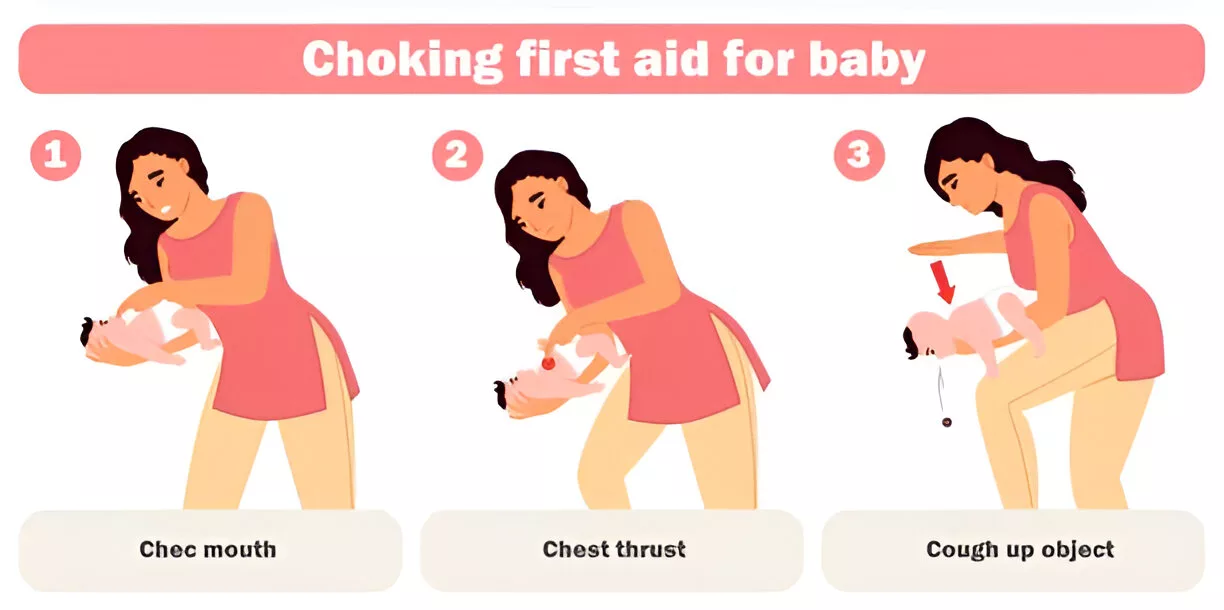
The illustration shows how to perform the Heimlich maneuver on an infant
Back Blows:
The sequence of steps in the management of a choking infant is as follows:
- Properly position the child by placing it face down on your arm with its chest resting on your forearm (or thigh if sitting). An important thing to note here is to ensure that the infant’s head is lower than his body so the stuck object can be expelled without hindrance.
- Strike the infant’s upper back (between shoulder blades) using the heel of your hand 5 times. Make sure that the strikes are firm but not hard enough to cause injury to the little one.
- After every 5 strikes, thoroughly check the infant’s mouth for any visible objects and remove them. Never perform blind finger sweeps.
Chest Thrusts:
If the airway remains blocked after back blows, you can shift to Chest thrusts. It is done in the following way:
- Turn the infant face up from the face-down lying position. Keep its head down while keeping the body straight.
- Place your one hand below the child’s sternum (chestbone) at approximately half to one inch below.
- Use your 2nd and 3rd fingers to give five chest thrusts, pressing about 1.5 inches (4 cm) deep. Ensure that the thrusts are directed inwards and upwards.
- After every 5 thrusts, check the infant’s mouth for an object.
- Alternate between five back blows and five chest thrusts until the object is expelled or the infant becomes unresponsive.
- If the infant becomes unresponsive, immediately begin CPR and call for emergency help.
Heimlich Maneuver On Special Cases
Well, as Heimlich requires you to deliver strong, sharp forces to the abdomen for object expulsion, a normal abdomen is a prerequisite. So, you will need to make alterations to the conventional method in cases with abnormal abdomens, such as obese individuals and pregnant women.
Pregnant Women & Obese Individuals:
For pregnant women, you are supposed to place your hands slightly above, i.e., on the sternum (breastbone). This is to avoid harming the fetus. You can place your hands higher for obese individuals as well, where abdominal fat hinders proper delivery of force. Chest thrusts are safer for pregnant women.[7]
Heimlich Maneuver On Your Ownself
Most people believe that the Heimlich maneuver can only be performed by another person. You can try Heimlich on your own if you are choking when alone. However, you have to make an early decision, as shortness of breath will reduce your capabilities very quickly. For a self-Heimlich maneuver, you need to follow these steps:
- Form a fist with your one hand and grip (clasp) your other hand tightly around it.
- Place your fist’s thumb side about 2 inches below the ribcage, i.e., above the belly button.
- Give yourself 5 hard, sharp, and quick abdominal thrusts that are directed inwards and upwards.
- Repeat the procedure until you have freed your airways of the lodged object.

The illustration shows how you can perform the Hemilich maneuver on yourself.
Management of accidental choking requires adopting ways to help remove the object. You can also try leaning over a nearby chair or table edge while thrusting your abdomen. Studies show that the intrathoracic pressure increased by self-abdominal thrusts is similar to that when done by another person. The highest pressure rise is seen when the upper abdomen is pushed against a chair back.[8]
Heimlich Maneuver Success Rate
Abdominal thrusts are effective as a first-aid procedure. Studies on the efficacy of the Heimlich maneuver are limited. However, one study published in 2024 found the Heimlich maneuver success rate to be good. In 46.6% of patients with foreign body airway obstruction, Heimlich was able to remove the lodged foreign object. The highest success rate was seen in children below 15 years of age, i.e., 60.2%.[9]
Moreover, the forceful abdominal thrusting in the Heimlich maneuver can help you get rid of any supraglottic (above glottis) blockage, not just foreign bodies. In a clinical case, the Heimlich maneuver and chest compressions helped retrieve a normal (patent) airway in a patient who suffered from supraglottic mass-induced upper airway obstruction.[10]
Heimlich Maneuver Complications
Improperly done Heimlich maneuver can lead to harm and serious complications. Therefore, doctors advise limiting the number of thrusts given as more thrusts are linked to complications. Too many forces and abrupt location of thrusting can lead to the following problems:
Broken Ribs:
Injuries to the thoracic region are common after resuscitation procedures like CPR and Heimlich. There have been reports of patients suffering from rib and sternal fractures after receiving the Heimlich maneuver and CPR following accidental choking.[11]
Abdominal Injuries:
Despite the Heimlich maneuver being safe and the best intervention for relieving upper airway obstructions, the increased abdominal pressure can lead to abdominal injuries like traumatic dissection and rupture of the aorta.[12] Excessive, abruptly delivered forces during the Heimlich maneuver can also cause gastric and oesophageal perforation.[13]
Wrapping Up
The Heimlich maneuver is a first-aid procedure done to save a choking person. It requires you to give abdominal thrusts to the choking person who is conscious but has seriously impaired breathing pathways. It works by increasing the intra-thoracic pressure, which expels the lodged foreign object. All you have to do is wrap your arms around the choking person, make a fist just under his chestbone, and give sharp inward+upward thrusts (five). If the patient is unconscious after object removal, lay him flat and do CPR. In children, the force is reduced, while in infants, back blows are given.
It is generally not advised to perform abdominal thrusts in people who are conscious and speaking. Encourage them to cough (and give backslaps if needed). The Heimlich maneuver should be done properly and with concentration, as it can lead to complications like abdominal aorta dissection and rib fracture, especially in elderly adults(with comorbidities).
References
[1] Kim, J. M., Cho, G. C., Na, Y. H., Cho, J. H., & Kim, O. H. (2010). The effect of CPR and abdominal thrust education on teachers in child care centers.Journal of the Korean Society of Emergency Medicine, 757-762.
[2] National Safety Council. (2023).Choking. InInjury facts. National Safety Council. https://www.nsc.org/community-safety/safety-topics/choking
[3] Godet, M., & Chevillotte, J. (2015). Nursing care of airway obstruction caused by food.Revue de l’infirmiere, (211), 47-48.
[4] Moradians, V., & Gholamlou, A. (2024). Is Heimlich maneuver safe? A literature review and case report.J Gastroenterol Res Pract,4(7), 1209.
[5] Hristonof, M. L. S., Amantéa, M. C., Lazzaretti, F. J., Bernardes, M. M., Xavier, L. F., & Amantéa, S. L. (2025). Comparative efficacy of LifeVac® and Heimlich maneuver in simulated airway obstruction.Jornal de Pediatria,101(3), 473-478.
[6] American Heart Association. (2020).Highlights of the 2020 American Heart Association guidelines for CPR and ECC. American Heart Association. https://cpr.heart.org/en/resuscitation-science/cpr-and-ecc-guidelines
[7] Whitty, J. E. (2002). Maternal cardiac arrest in pregnancy.Clinical obstetrics and gynecology,45(2), 377-392.
[8] Pavitt, M. J., Swanton, L. L., Hind, M., Apps, M., Polkey, M. I., Green, M., & Hopkinson, N. S. (2017). Choking on a foreign body: a physiological study of the effectiveness of abdominal thrust manoeuvres to increase thoracic pressure.Thorax,72(6), 576-578.
[9] Suga, R., Igarashi, Y., Kitano, S., Suzuki, K., Yokobori, S., Ogawa, S., & Yokota, H. (2024). Effectiveness of the Abdominal Thrust Maneuver for Airway Obstruction Removal: Analysis of Data from the National Emergency Medical Services Information System.Journal of Nippon Medical School,91(3), 270-276.
[10] Zhou, X., Wang, L., Zhang, Y., Wu, Q., & Cao, Y. (2023). The Heimlich maneuver and chest compression relieve mask ventilation difficulties caused by asymptomatic laryngeal mass: A case report and review of literature.Medicine,102(48), e36362.
[11] Drinka, P. (2009). Broken ribs following CPR or the Heimlich maneuver.Journal of the American Medical Directors Association,10(4), 283-284.
[12] Desai, S. C., Chute, D. J., Desai, B. C., & Koloski, E. R. (2008). Traumatic dissection and rupture of the abdominal aorta as a complication of the Heimlich maneuver.Journal of vascular surgery,48(5), 1325-1327.
[13] Koss, S. L., Karle, W. E., Dibelius, G., Kamat, A., & Berzofsky, C. (2018). Esophageal perforation as a complication of the Heimlich maneuver in a pediatric patient: A case report.ENT: Ear, Nose & Throat Journal,97(7).
For more information about Heimlich Maneuver Save, refer to the latest medical literature.