

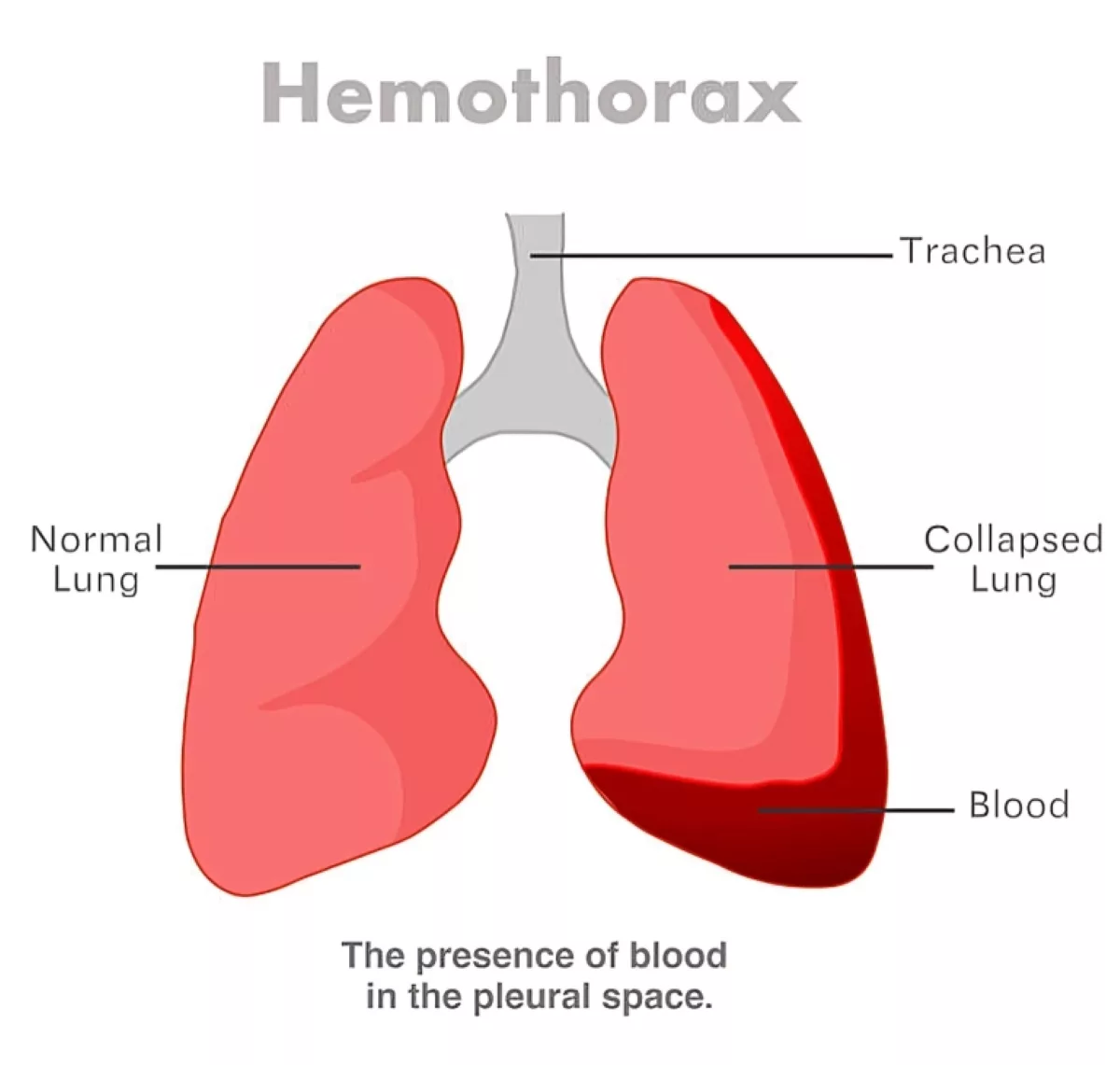
Hemothorax Symptoms Treatment Hemothorax refers to the accumulation of blood in the pleural cavity, the space between the visceral and parietal pleura that surrounds the lungs. It most commonly occurs secondary to trauma or injury to the chest. The trauma or injury damages the thorax’s internal structures, leading to blood collection. The source of bleeding may arise from injured intercostal vessels, internal mammary arteries, pulmonary vessels, the diaphragm, or even from abdominal organs such as the liver or spleen. The best investigation to rule out hemothorax is a CT scan. In an unstable patient, a CT scan is not easy to carry out. For this reason, a recent investigation called a point-of-care ultrasound (POCUS) has been introduced. In severely ill patients, it helps to do the ultrasound at the bedside. POCUS allows rapid bedside evaluation without radiation exposure, helping to identify fluid in critically ill or unstable patients.[1]
Causes of Hemothorax: Hemothorax Symptoms Treatment
The primary and most frequent cause of hemothorax is any injury to your thoracic structures. Traumatic injury is of two types: blunt and penetrating. The blunt injury is the leading cause of hemothorax, and it has a mortality rate of almost 9.4%. Some patients may develop hemothorax as a result of other non-traumatic causes, such as iatrogenic (due to any examination or treatment), neoplasia (tumor), any infection,lung sequestration (presence of abnormal lung tissue), tuberculosis, or any blood-clotting disease.[2]
Incidence of Hemothorax
In the United States, traumatic injuries cause 14000 deaths per year. The thoracic injuries account for 60% cases in the trauma unit. The mortality rate of thoracic injuries is high, as it is responsible for almost 20-25% deaths. The frequent (70 to 80%) cause of blunt thoracic injuries is motor vehicle accidents in the US.
Among patients with blunt chest trauma, 30–50% develop hemothorax or pneumothorax (air in the thorax). Common associated findings include rib fractures, lung contusion, and diaphragmatic injuries.
Pathophysiology of Hemothorax
Bleeding into the hemithorax (right or left) can develop from different sites, like injury to the diaphragm, to the mediastinum, to the pulmonary structure or the chest wall, and even due to injury to the abdominal structures, such as the liver or spleen. Half of your thorax contains at least 40% of your blood volume.
The significant bleeding into the thoracic cavity results when there is a substantial injury to the intercostal vessels present between your ribs. These intercostal vessels include the internal mammary, carotid, and pulmonary vessels.
The body’s response after developing hemothorax depends upon the location of the injury, the patient’s condition, the volume of blood present, and the rate at which blood is accumulated in the thorax.
When hemothorax develops, the body’s early response is hypovolemia, a decrease in blood volume. Hypovolemia affects the heart, reducing its preload (the stretch of the heart’s muscles at the end of ventricular filling). A decrease in preload ultimately impacts left ventricular function, and all of this eventually decreases cardiac output.
Hemothorax also affects the pulmonary system by causing alveolar hypoventilation and anatomic shunting. It then leads to abnormal functional vital capacity of the lung. If the hemithorax is large in volume, it leads to an increased hydrostatic pressure in the thorax, and due to this pressure, the preload of the heart is dysfunctional.
All of these mechanisms make a patient unstable and can cause their death.[3]
Types of Hemothorax
Depending upon the cause, hemothorax is categorized into the following types:
Traumatic Hemothorax:
As the name suggests, traumatic hemothorax develops as a result of penetrating or blunt chest injury.
Iatrogenic Hemothorax:
This type of hemothorax does not develop from trauma. Instead, it develops during any surgical intervention, such as thoracic surgery or lung biopsy.
Spontaneous Hemothorax:
There is no significant history of trauma behind spontaneous hemothorax. It develops when you have any underlying disease or a medication history. For example: tumor, vascular disorders, history of anticoagulant therapy, or metastasis.
Signs & Symptoms of Hemothorax
The signs and symptoms of hemothorax are very varied, and they usually overlap with the symptoms of pneumothorax ( air in the thoracic cavity ). The common signs and symptoms in patients with hemothorax are:
- Respiratory distress
- Tachypnea
- Changes in breath sounds (decreased or absent)
- Hypotension
- Hypoxia (decrease in oxygen levels)
- Presence of contusions or abrasions on the chest due to injury
- Tenderness
- Abnormal movements of the chest wall
- Distended neck veins
How to diagnose Hemothorax?
The diagnosis of hemothorax should be rapid, as it can be life-threatening for the patient. The complete diagnosis of hemothorax involves various steps, such as proper history, physical examination, and specific imaging techniques, before finally calling it a hemothorax.[4]
History:
In history, it is crucial to ask about the cause and mechanism of injury, as it could be penetrating or blunt trauma. Doctors also ask about the direction and speed of vehicles in the accident. Other essential questions in the history of hemothorax are:
- Any surgical history
- Use of toxic drugs
- Alcohol use
- Any underlying disease
- Use of any medications such as anticoagulants
There is a strong prediction of thoracic injury if the speed of the vehicle is more than 35mph, a fall from a height of more than 15 feet, a pedestrian ejection of more than 10 feet, or there is visible trauma and the patient has a decreased level of consciousness.
Examination:
The next important step after taking a rapid history is the physical examination, which involves four steps: inspection, palpation, percussion, and auscultation.
The inspection and palpation of the chest wall show any contusion, abrasions, deformity, penetrating injury, deviation of the trachea, and tenderness. Doctors may see distended neck veins and seat belt signs (a bruise on the abdomen in the shape of a seat belt). Hemothorax also causes abnormalities in the chest and abdominal movements if the cause is chest wall injury. The resulting compression of the superior vena cava due to hemothorax leads to facial or neck swelling, and in some cases, it can cause cyanosis too.
The percussion and auscultation of the chest cavity show a dullness as the cavity is filled with blood, and on auscultation, the frequency of breath sounds decreases.
Imaging:
The best investigation to diagnose hemothorax is imaging modalities.
When a patient comes with a traumatic chest injury, the initial step is a chest X-ray, but it has some drawbacks, as it cannot clearly diagnose the presence of blood in the thoracic cavity. Many studies have shown that ultrasound yields better results than chest X-rays, as it is 67% more sensitive. Another benefit of ultrasound in patients with hemothorax is that it can detect even 20ml of fluid in the pleural cavity. At the same time, the radiographs can only detect the fluid up to 175ml.

A chest X-ray film of a patient with multiple left rib fractures with a large hemothorax and an intrathoracic drainage tube (ICD). Chest radiology image in trauma and accident. Flail chest.
FAST (Focused Assessment with Sonography in Trauma):
Recent use of the FAST exam (focused assessment with sonography in trauma) is very effective in detecting minor traumas, small fluid or air in several areas, such as the pericardium, perihepatic, perisplenic, and pelvis. FAST can also diagnose pneumothorax and lung contusion in addition to hemothorax. FAST is a protocol for POCUS (point-of-care ultrasound). POCUS has been proven to effectively treat patients, especially in emergencies and the ICU, as doctors can easily move it from one place to another. Furthermore, POCUS does not use harmful radiation, saving the patients from unwanted rays.[5]
In addition to that, another important benefit of FAST is that, in addition to four views of the chest cavity, it can also take the oblique view of the diaphragm and the anterior view of the chest cavity, which helps to detect pneumothorax and hemothorax. The doctors put the machine’s transducer in the patient’s midaxillary line in the fifth to sixth intercostal space. In a healthy person, there is the presence of air in the cavity, and it is impossible to see the deeper structures. However, in patients with hemothorax, a black (anechoic) area appears between the diaphragm and pleura, known as the “spine sign.”[6]
Laboratory Tests:
Some laboratory tests also play a vital role in the diagnosis of hemothorax. These includes;
- CBC to see the levels of hemoglobin in the body.
- Creatinine and troponin are used to evaluate the presence of cardiac injury in patients with trauma.
- Coagulation profile
- Lactate. Some studies show that lactate defines the rate of mortality in many patients with traumatic chest injury. If the levels of lactate are more than 4mg/dl, there is a higher chance of death in the patients.
Treatment of Hemothorax
The initial step when a patient comes in an emergency with a traumatic chest injury is his resuscitation according to the ATLS (American Traumatic Life Support) protocol. The ATLS protocol emphasizes managing breathing, airway, circulation, disability, and the patient’s environment.[7]
The staff should immediately insert IV cannulas into the patient to maintain circulation and perform 12 12-lead EKG to rule out cardiac issues.
Further management of the patient depends upon his condition. If the amount of blood in the pleural cavity is less than 300ml, then the patient does not require any treatment as this small amount of blood reabsorbs after some weeks. Patients with minimal symptoms also do not need any surgical treatment. These patients are put on a follow-up list for observation along with the imaging at 4 to 6 hours and 24 hours after the traumatic chest injury.
Thoracostomy:
Patients with extensive blood collections in their pleural cavity and severe symptoms undergo thoracostomy. After consulting with a cardiothoracic surgeon, the surgeon places a 36-40 French chest tube between the anterior and midaxillary lines, ideally in the fourth or fifth intercostal space. The tube is then used to drain the blood, and in addition to drainage, it also helps identify the blood quantity.[8]
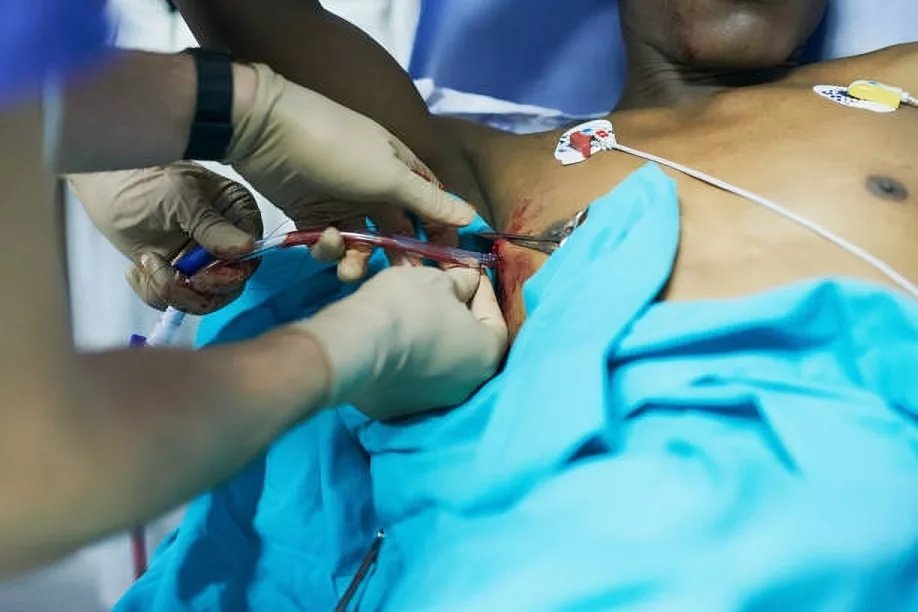
A doctor inserting a tube into a patient’s chest in an emergency room for the treatment of hemothorax
Surgical intervention (thoracotomy) is done in the following cases:[9]
- Chest tube drains 1500ml of blood in 24 hours
- After 2-4 hours of chest tube insertion, there is 300-500ml/hr of blood
- Injury of a great vessel or chest wall injury
- Pericardial tamponade
Some surgeons prefer video-assisted thoracoscopy ( VATS ) as it helps to clearly see the pleural cavity, chest tube placement, removal of remaining blood and clot, and evaluate any other issue, such as diaphragmatic or mediastinal injury.[10]
Complications of Hemothorax
The complications related to hemothorax are hemodynamic instability, shock, a decrease in oxygen levels, and death. Improper use of a thoracic ultrasound can lead to pain and tenderness at the site.
When chest tube placement is improper, it can damage the solid organs. Insufficient blood drainage causes the formation of empyema and fibrothorax, which prevents the lung from expanding fully. This is called lung entrapment.[11]
Differentials of Hemothorax
Some medical conditions mimic the signs and symptoms of hemothorax. Some important ones are:
- Pneumothorax
- Cardiac tamponade
- Hemopneumothorax
- Pleural effusions
Difference between Hemothorax & Pneumothorax
Both hemothorax and pneumothorax are abnormal conditions of the pleural space, and most of the time, both develop when you have a traumatic chest injury. Treatment of both conditions involves inserting a chest tube to drain blood and air. However, there are some differences.
Hemothorax is related to the accumulation of blood, while pneumothorax means air collection in the pleural cavity. During percussion of your chest wall, pneumothorax sounds hyperresonant, but hemothorax is dull to percussion due to the blood.[12]

Illustration of complications after a chest injury – Pneumothorax, Hemothorax, and Hemopneumothorax
Prognosis of Hemothorax
The prognosis of hemothorax entirely depends upon the type and severity of the patient’s injury. If there is insufficient blood drainage through thoracostomy, there is a risk of developing empyema or fibrothorax, which leads to a poor prognosis for hemothorax.
Conclusion
Hemothorax is a serious condition that happens when blood builds up in the space around your lungs, usually after an injury to the chest. Recognizing the signs early and getting the proper treatment can make a big difference in recovery. Depending on how much blood is present, treatment can range from simply keeping an eye on the condition to placing a chest tube or even doing surgery. If not treated properly, it can lead to complications like lung collapse or infection. That’s why acting quickly and taking your symptoms seriously is so important.
References
[1] Zeiler, J., Idell, S., Norwood, S., & Cook, A. (2020). Hemothorax: A Review of the Literature.Clinical pulmonary medicine,27(1), 1–12. https://doi.org/10.1097/CPM.0000000000000343
[2] Patrini, D., Panagiotopoulos, N., Pararajasingham, J., Gvinianidze, L., Iqbal, Y., & Lawrence, D. R. (2015). Etiology and management of spontaneous haemothorax.Journal of thoracic disease,7(3), 520–526. https://doi.org/10.3978/j.issn.2072-1439.2014.12.50
[3] Pumarejo Gomez, L., & Tran, V. H. (2023). Hemothorax. InStatPearls. StatPearls Publishing.
[4] Yang, L., Zhang, C., Liu, W., Wang, H., Xia, J., Liu, B., Shi, X., Dong, X., Fu, F., & Dai, M. (2020). Real-Time Detection of Hemothorax and Monitoring its Progression in a Piglet Model by Electrical Impedance Tomography: A Feasibility Study.BioMed Research International,2020, 1357160. https://doi.org/10.1155/2020/1357160
[5] McEwan, K., & Thompson, P. (2007). Ultrasound to detect haemothorax after chest injury.Emergency medicine journal: EMJ,24(8), 581–582. https://doi.org/10.1136/emj.2007.051334
[6] Kithinji, S. M., Lule, H., Acan, M., Kyomukama, L., Muhumuza, J., & Kyamanywa, P. (2022). Efficacy of extended focused assessment with sonography for trauma using a portable handheld device for detecting hemothorax in a low-resource setting; a multicenter longitudinal study. BMC Medical Imaging,22(1), 211. https://doi.org/10.1186/s12880-022-00942-y
[7] Boersma, W. G., Stigt, J. A., & Smit, H. J. (2010). Treatment of haemothorax.Respiratory medicine,104(11), 1583–1587. https://doi.org/10.1016/j.rmed.2010.08.006
[8] Lyons, N. B., Abdelhamid, M. O., Collie, B. L., Ramsey, W. A., O’Neil, C. F., Delamater, J. M., Cobler-Lichter, M. D., Shagabayeva, L., Proctor, K. G., Namias, N., & Meizoso, J. P. (2024). Small versus large-bore thoracostomy for traumatic hemothorax: A systematic review and meta-analysis.The journal of trauma and acute care surgery,97(4), 631–638. https://doi.org/10.1097/TA.0000000000004412
[9] Bertoglio, P., Guerrera, F., Viti, A., Terzi, A. C., Ruffini, E., Lyberis, P., & Filosso, P. L. (2019). Chest drain and thoracotomy for chest trauma.Journal of thoracic disease,11(Suppl 2), S186–S191. https://doi.org/10.21037/jtd.2019.01.53
[10] Carrillo, E. H., & Richardson, J. D. (1998). Thoracoscopy in the management of hemothorax and retained blood after trauma.Current opinion in pulmonary medicine,4(4), 243–246. https://doi.org/10.1097/00063198-199807000-00012
[11] Drummond D. S. (1967). Traumatic hemothorax: complications and management.The American surgeon,33(5), 403–408.
[12] Blank, J. J., & de Moya, M. A. (2025). Traumatic pneumothorax and hemothorax: What you need to know.The journal of trauma and acute care surgery, 10.1097/TA.0000000000004692. Advance online publication. https://doi.org/10.1097/TA.0000000000004692