


Eat Calorie Deficit In 2026, we know better that crash diets and miracle supplements aren’t the most effective ways to lose weight. Sustainable, long-term weight loss is based on a simple fact of mathematics and thermodynamics: the calorie deficit. This is the approach that medical professionals advocate for because it prioritizes metabolic health over quick fixes.
What is a Calorie Deficit?: Eat Calorie Deficit
The human body needs energy, which we usually provide through food. Calories from food are burned to sustain metabolic activities in the body. The excess calories get deposited as fat. This is the basis of weight gain.
A calorie deficit simply occurs when you burn more calories than you consume. This is the only way you can lose body mass. When this gap exists, the body is forced to tap into stored energy, mainly in the form of adipose tissue (fat). Hence, even a minor calorie deficit leads to gradual, but long-term, weight loss.
How to Calculate Your Calorie Deficit?
This isn’t arbitrary. Before you change what you eat, you must understand your body’s unique energy requirements. A qualified nutritionist will look at your routine, calculate your energy requirements, and then suggest a balanced plan for you.
1. Find Your Basal Metabolic Rate (BMR)
Your BMR is the number of calories your body burns at rest to maintain vital functions like breathing and cell production or repair. The Mifflin-St Jeer Equation is considered the most accurate[1]:
- For men, it is calculated as: 10 x weight (kg) + 6.25 x height (cm) – 5 x age (y) + 5
- And for women: 10 x weight (kg) + 6.25 x height (cm) – 5 x age (y) – 161
2. Determine Your TDEE
The next important calculation is the Total Daily Energy Expenditure (TDEE), which includes BMR plus physical activity. Someone who walks 10k steps daily can eat more calories while maintaining the same deficit compared to someone with a sedentary job. To calculate, multiply your BMR by the activity factor:
- Sedentary (little to no exercise): 1.2
- Lightly Active (1-3 days/week): 1.375
- Moderately Active (3-5 days/week): 1.55
- Very Active (6-7 days/week): 1.725
3. Set a Sustainable Target
According to nutritionists, the standard for healthy weight loss is a 300 to 500 calorie deficit. If maintained, there is a safe weight loss of 0.5 to 1 pound (0.25 to 0.5 kg) per week, preserving lean muscle mass while targeting fat.[2]
Crash diets that claim more than 2 kg loss per week are not just unrealistic, but also extremely dangerous for the body. Weight lost this way also includes significant muscle mass, a phenomenon we also see in people who use GLP-1 drugs, the Ozempic face.
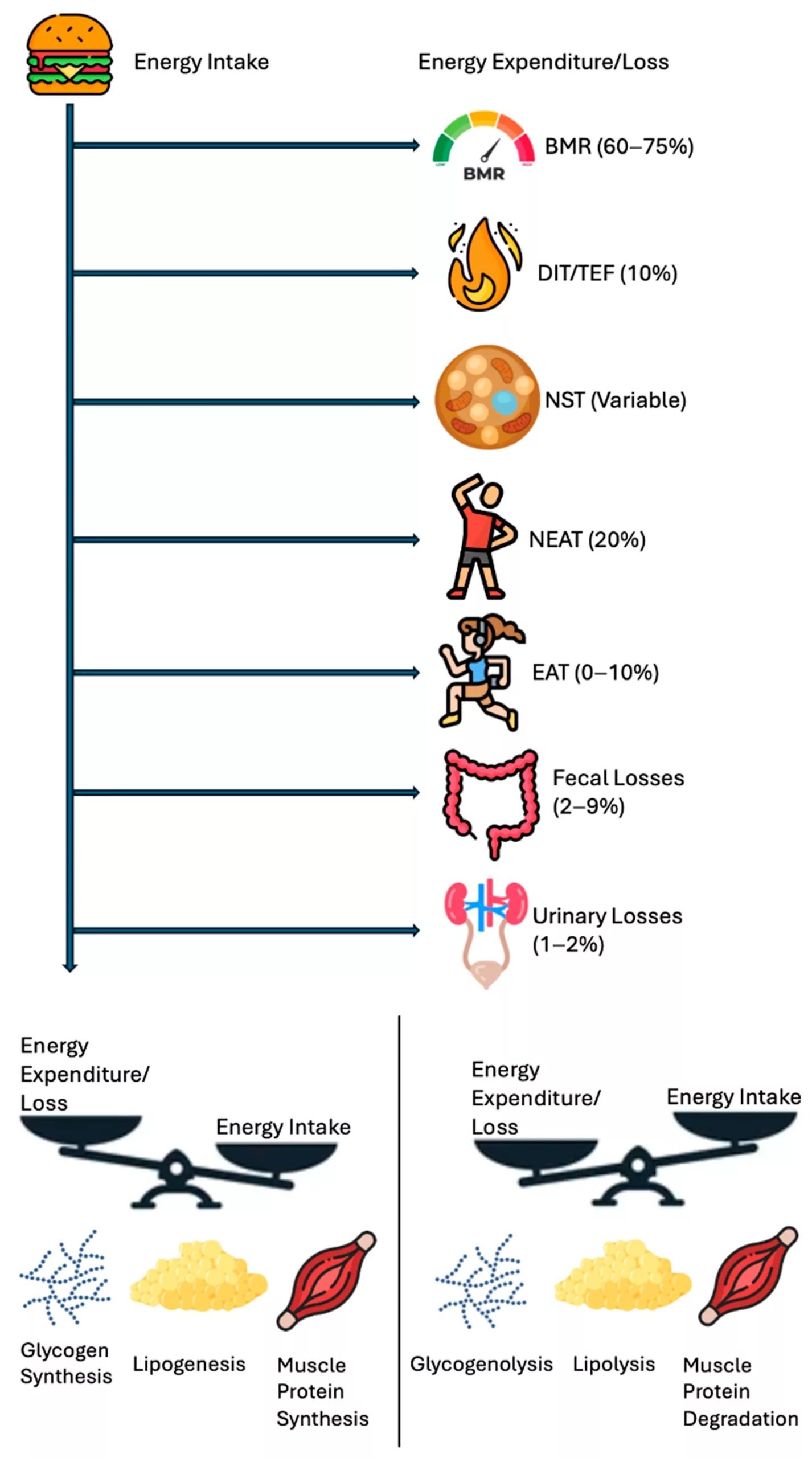
The Pathways of Human Energy Expenditure: Total Daily Energy Expenditure (TDEE) is comprised of BMR, NEAT, EAT, and the thermic effect of food (Image Courtesy: Theodorakis, N., & Nikolaou, M. (2025). The Human Energy Balance: Uncovering the Hidden Variables of Obesity. Diseases, 13(2), 55. Available fromMDPIand licensed under CC by 4.0)
Why Weight Loss Journeys Fail?
A lot of people start their weight loss journeys, but give up a couple of weeks later. We call this the ‘3-week wall’. It’s because hunger is a survival mechanism. When you drop calories, the brain signals a starvation alert, which spikes ghrelin and makes high-calorie food look irresistible.
How can you beat this? Not with motivation alone, but with a habit shift. You must trick the stomach stretch receptors by volume eating. For example, if you eat 500g of spinach, it’ll only be 115 calories. But your stomach will feel physically full and signal the same to the brain.
Low-Calorie Foods That Are Filling
There are several foods that are low-calorie and can be consumed in larger volumes to make the stomach feel fuller, so the weight loss process isn’t miserable.
- Non-Starchy Vegetables: Broccoli, cauliflower, and other leafy vegetables. These bulk up the stomach, triggering stretch receptors.
- Lean Proteins: Chicken breast, fish, Greek yogurt, and tofu. Protein has the highest thermic effect, meaning it burns more calories digesting it than it does fats or carbs.
- Complex carbs like berries, oatmeal, and beans. These release glucose steadily into the blood rather than a spike (like refined sugars). This helps reduce cravings caused by a sugar spike.
How to Do a Calorie Deficit
Successfully maintaining a deficit is difficult, but it gets easier once you make it a habit. Here are three strategies that are known to help:
1. Prioritize Protein
The daily recommended percentage is 1.6 to 2.2 grams of protein per kg of body weight.[3] Protein stays in the stomach longer and slows down gastric emptying. Also, a protein-heavy diet suppresses ghrelin (the hunger hormone) and boosts peptide YY (the satiety hormone).
If you make it a habit to incorporate more protein in your diet, it will help you eat fewer calories.
2. A Balanced Plate
Obviously, you cannot weigh every grain of rice; just use your plate as a visual guide. It’s also better to use a smaller plate to trick your brain. Your plate should consist of:
- 50% non-starchy vegetables,
- 25% lean protein,
- and 25% complex carbohydrates or healthy fats.
3. Mindful Eating
It takes approximately 20 minutes for the brain to register fullness.[4] When you eat too fast, you end up eating more calories within these 20 minutes. Eating slowly, on the other hand, means you’ll start feeling full, and you’ll have consumed fewer calories.
How to Maintain a Calorie Deficit?
Don’t aim for daily perfection. A long-term good average is what will help along your weight loss journey. Here are a few quick tips:
- Track everything you eat, even if it’s an apple. Hidden calories in oils, liquid calories in coffee or soda are common ones people tend to ignore.
- For the first two weeks, weigh your food. It’ll help you recalibrate your eye for portion sizes.
- As you lose weight, your TDEE drops. A deficit that worked at 80kg won’t work at 65kg. In fact, you should recalculate after every 5kg you lose.
- Take the stairs. Pace while talking. These small movements burn more fat over time than an hour spent at the gym. We call this Non-Exercise Activity Thermogenesis or NEAT[5].
- Weekends aren’t cheat days. A strict 500-calorie daily deficit during the week does not mean you can eat 2500 calories on Saturday.
- A strategy that works for most people is to calculate the whole week’s calorie deficit and manage it so that you are still in a deficit even if you indulge a little over the weekend.
- Less than seven hours of sleep triggers ghrelin; not only will you be hungrier, you’ll also crave fast energy (sugars).
- Not losing weight despite a significant calorie deficit? The problem might be completely different. Cortisol is notorious for signalling the body to preserve fat around the midsection and also to hold water. A state of constant stress means your body is triggering the release of cortisol.
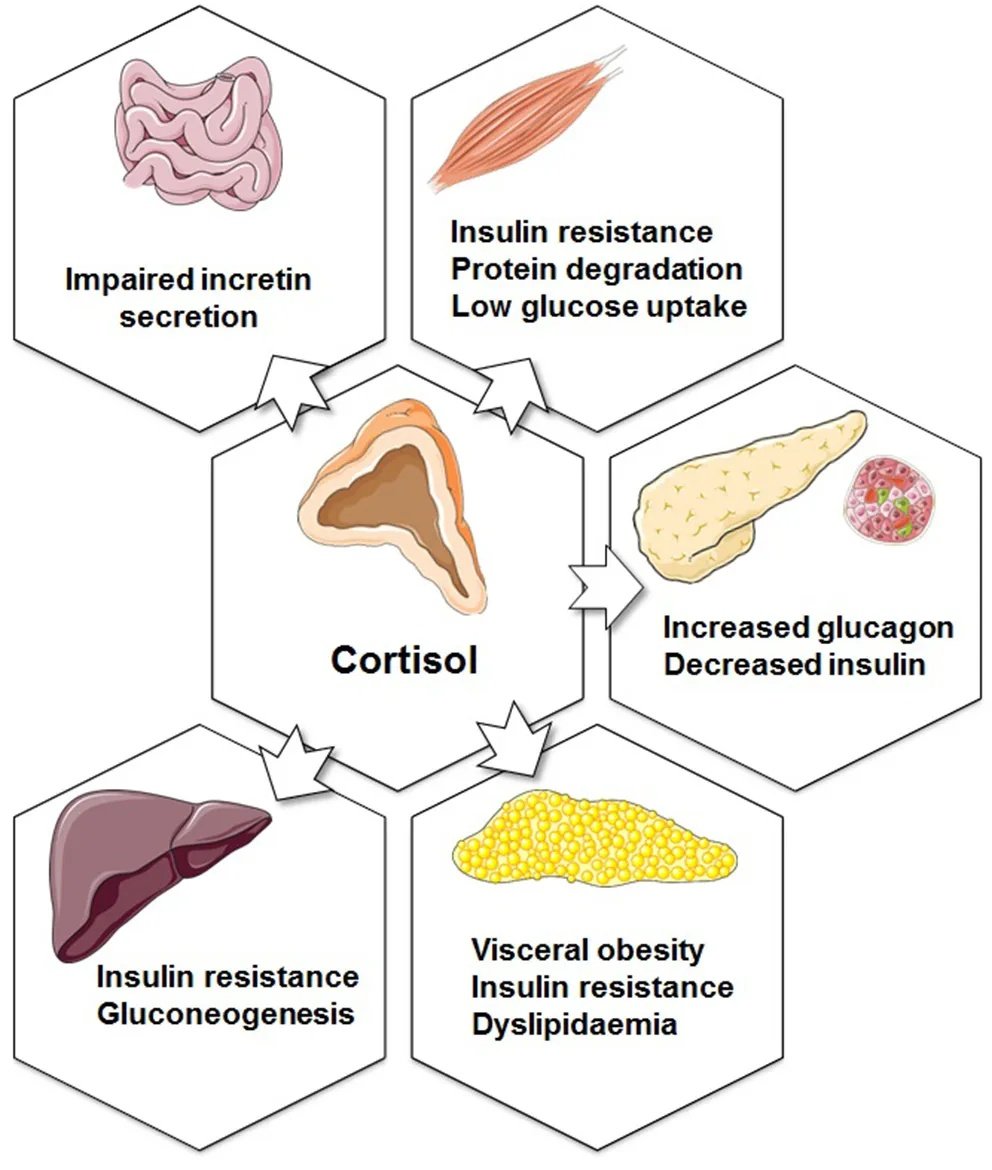
The systemic impact of chronic cortisol elevation: Increased glucocorticoid secretion alters nutrient metabolism across the liver, adipose tissue, and skeletal muscle, often counteracting weight loss efforts (Image Courtesy: Akalestou E, Genser L and Rutter GA (2020) Glucocorticoid Metabolism in Obesity and Following Weight Loss. Front. Endocrinol. 11:59. Available fromFrontiersand licensed under CC by 4.0)
Takeaway
A calorie deficit is a tool for weight loss, but when we deprive ourselves of food, it becomes a punishment. A lot of people underestimate the damage done by crash diets since they show quicker results, but these not only damage the body, but the weight comes right back as soon as you start eating normally again. And since their bodies haven’t gotten used to healthy eating habits, calorie deficits are harder for them to maintain. If you instead focus on nutrient density and maintaining a modest gap, you can achieve your weight loss goals without feeling miserable all day.
References
[1] Van Dessel, K., Verrijken, A., De Block, C., Verhaegen, A., Peiffer, F., Van Gaal, L., De Wachter, C., & Dirinck, E. (2024). Basal metabolic rate using indirect calorimetry among individuals living with overweight or obesity: The accuracy of predictive equations for basal metabolic rate. Clinical nutrition ESPEN, 59, 422–435.
[2] Institute of Medicine (US) Subcommittee on Military Weight Management. Weight Management: State of the Science and Opportunities for Military Programs. Washington (DC): National Academies Press (US); 2004. 4, Weight-Loss and Maintenance Strategies. Available from: https://www.ncbi.nlm.nih.gov/books/NBK221839/
[3] Schoenfeld, B. J., & Aragon, A. A. (2018). How much protein can the body use in a single meal for muscle-building? Implications for daily protein distribution. Journal of the International Society of Sports Nutrition, 15, 10.
[4] I Martens, M. J., T Lemmens, S. G., Born, J. M., & Westerterp-Plantenga, M. S. (2012). Satiating Capacity and Post-Prandial Relationships between Appetite Parameters and Gut-Peptide Concentrations with Solid and Liquefied Carbohydrate. PLoS ONE, 7(7), e42110.
[5] von Loeffelholz C, Birkenfeld AL. Non-Exercise Activity Thermogenesis in Human Energy Homeostasis. In: Feingold KR, Adler RA, Ahmed SF, et al., editors. Endotext. South Dartmouth (MA): MDText.com, Inc.; 2000-. Available from: https://www.ncbi.nlm.nih.gov/books/NBK279077/