

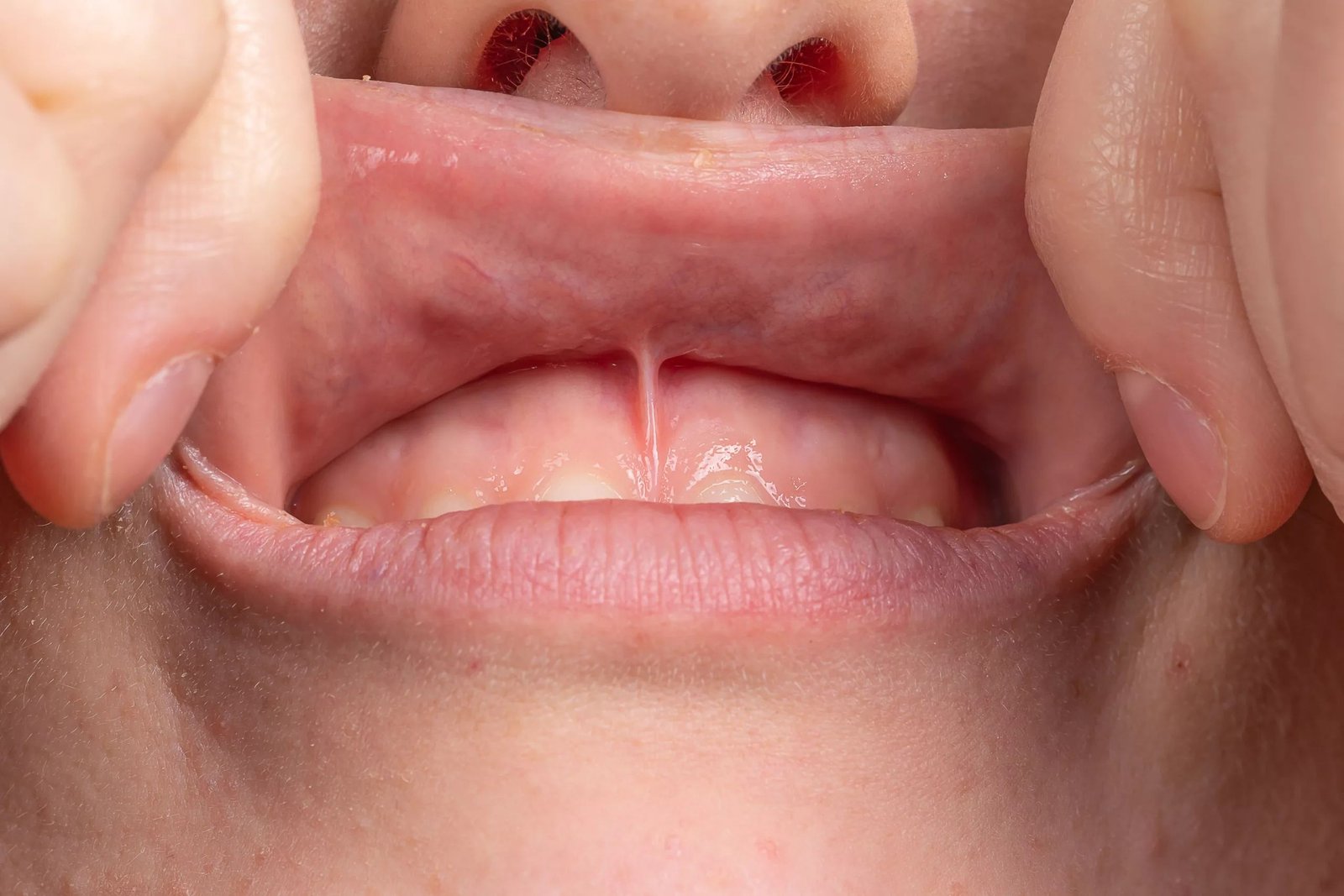
Lip tie release, also known as frenotomy or frenectomy, is a surgical procedure to correct a tight maxillary frenum (soft tissue connecting the upper lip to the gums above the upper front teeth). This condition is typically diagnosed in infants, often when feeding difficulties arise, and usually corrected in early life. The superior labial frenum, or median labial frenum, is devoid of muscles. But it can become problematic when it is attached too tightly or extends too far down the gum line. A significant restriction in lip movement due to this tight attachment is what defines a lip tie.
The occurrence of a lip tie is significantly less common than a tongue tie, which is why the former is less well-documented than the latter. Lip tie release is a simple and safe procedure that is easily performed after lip tie diagnosis. Lip tie release is not a dangerous procedure. However, some parents receive their information from nonmedical resources, which may lead to misconceptions and a delay in diagnosis.[1]
Lip Tie Levels
It is important to distinguish between a normal labial frenum from a tight one. A healthy labial frenum connecting your child’s lip to the gums is perfectly normal. Some people are born with a prominent labial frenulum, but that does not indicate surgery until there are symptoms. You need a lip tie release only if your infant faces restricted upper lip movement.
Doctors classify lip ties into 4 levels.[2]
- Level 1 or Mucosal level: The attachment is present only on the inner lining of the lip and the oral mucosa (gums).
- Level 2 or Gingival level: The attachment exists (extends into) the gingiva.
- Level 3 or Papillary level: At this level, the attachment extends into the area between the front teeth and appears as a papilla.
- Level 4 or Papilla penetrating level: The attachment is present between the anterior teeth and may even extend to the palate.
Pediatric surgeons do not intervene in cases with levels 1 or 2. Most of the time, a lip tie release is done for levels 3 and 4, where breastfeeding issues arise.
Indications for a Lip Tie Release
Doctors advise a lip tie release surgery in the following cases:
Speech Difficulties:
Restricted movement of the upper lip can offer challenges in speech. There is limited evidence for serious speech impediments with lip tie. However, speech difficulty can be an indication for the release surgery.
Breastfeeding Issues:
The role of the maxillary labial frenum or lip tie in breastfeeding is controversial. However, many believe that it can serve to impede breastfeeding.[3] Several times, doctors combine maxillary frenum release with lingual frenum release for successful feeding. While tongue ties directly hinder feeding, performing a lip tie release with tongue tie release improves infant latching to the mother.[4] Lip tie and tongue tie release surgeries become crucial if infants can’t gain weight due to improper nutrition (and feeding).
Moreover, improper feeding might lead to issues like mastitis (swelling of the mammary glands) and painful feeding.
Benefits of Lip Tie Release
A lip tie release surgery is a safe procedure. Therefore, there are more pros than cons for a lip tie release. You can expect to see the following benefits of maxillary frenum release surgery:
Improves Feeding:
Neonates can latch properly and initiate breastfeeding after a lip tie release. Suckling milk by the infant requires a good latch and uninterrupted movement of the infant’s lips. With clear lip movements (following a lip tie release), parents notice easier feeding in infants. An adequate supply of milk allows the baby to grow and gain healthy weight. Studies show that combined treatment of tongue-tie and lip-tie leads to significant improvement in breastfeeding outcomes. Parents can notice improvements within the first week (after surgery), which continue until 1 month.[5]
Averts Lip Tie Complications:
Babies with severe lip ties in conjunction with tongue tie have trouble gaining weight because of the poor latching to the mother. This can lead to further health consequences. Early diagnosis and treatment improve feeding and allow the infant to gain healthy weight.
Enhances Speech:
While ankyloglossia (tongue tie) is the primary cause of speech impediment in adults, a severe lip tie can also pose problems in speech. Thus, a lip tie release surgery can enhance the pronunciation of certain words.
Improves Dental Hygiene:
Early diagnosis and treatment of a lip tie can allow better management of oral hygiene. Numerous adult patients report better cleaning and brushing after a lip tie procedure. With proper cleaning, there is a reduced risk of dental caries, decay, and gum disease. Thus, addressing the disorder earlier in life saves you from dental complications later in life.
Lip Tie Release Procedure
This is a minimally invasive procedure that is complete within a short time (around 10 minutes). It is performed by a pediatric dental surgeon.
Anesthesia
The surgery is mostly performed in infants. Surgeons do it quickly. Therefore, the procedure is often performed under topical anesthesia.
Incision & Release:
The next step is to cut the tight frenum and release the upper lip. Conventionally, doctors have used surgical scissors for this purpose. However, modern surgeons now use medical lasers for tongue and lip tie releases. A laser lip tie release has several advantages over conventional methods. With high-tech lasers, there is faster healing, less bleeding, and almost no pain during the procedure. The cutting is quicker and neater as compared to the traditional approach. This is why lasers are being used in different oral surgical procedures, like periodontal surgeriesand orthognathic surgeries,etc.
The vast majority of patients report better tolerance and fewer complications with carbon dioxide or diode lasers (for tongue and lip ties). Therefore, it is the natural choice for most patients.[6] The wound heals quickly without any negative consequences. The discomfort associated with the procedure is also minimal.[7]
There is no (or minimal) bleeding, and the area does not need any stitches.
Lip Tie Release Recovery:
The recovery after a lip tie release is generally quick because of the minimal invasion. It can also be attributed to the strong healing potential of an infant. It generally takes about 2 to 4 weeks for the wound site to completely heal. However, patients can notice improvements in symptoms within the first week.
What to expect after a Lip Tie Release?
Your infant might experience some discomfort during the procedure. A potential burning feeling in the mouth after the surgery makes the child irritated and anxious. You may also find some swelling at the surgical site, which subsides quickly. While healing generally takes 2-4 weeks, you might need to wait for 6 weeks before things get back to normal.
Lip Tie Release Post-Op Care:
A good way to pacify and calm the child is by immediately giving him/her a pacifier or bottle/breastfeed. An Ibuprofen or Tylenol syrup can provide pain relief. You can give these medicines as prescribed by your doctor.
In most cases, doctors advise mothers to carry out lip tie release exercises or stretches throughout the healing period to maintain the mobility of the upper lip. In this technique, a parent gently slides a finger along the top of the baby’s lip and practices loosening the gap between the gums and the lips. This gentle stretching ensures ample mobility of the lips. However, you should do this step only if your doctor allows.[8]
Though it is a minor procedure, you should still regularly follow up on appointments with your pediatric dentist.
Wrapping Up
A lip tie release is a minimally invasive oral surgical procedure to restore lip mobility in patients with a lip tie (level 3 or 4). Completed within 10 minutes, it is a safe procedure performed in infants who have trouble breastfeeding. A laser lip tie release is superior to conventional methods. A lip tie is diagnosed in infants, and early surgery improves latching, enhances speech, and prevents potential complications like tooth decay and gum disease. With proper feeding, infants are able to gain healthy weight. Complete recovery takes two to four weeks. However, improvements can be seen within the first week.
References
[1] Bacon, B. R., & Carr, M. M. (2023). Maxillary frenulum and “lip tie”: what parents understand.OTO open,7(3), e71.
[2] American Academy of Pediatric Dentistry. (2024).Policy on management of the frenulum in pediatric patients. InThe Reference Manual of Pediatric Dentistry(pp. 73–78). American Academy of Pediatric Dentistry.
[3] Kotlow, L. A. (2013). Diagnosing and understanding the maxillary lip-tie (superior labial, the maxillary labial frenum) as it relates to breastfeeding.Journal of Human Lactation,29(4), 458-464.
[4] Towfighi, P., Johng, S. Y., Lally, M. M., & Harley, E. H. (2022). A retrospective cohort study of the impact of upper lip tie release on breastfeeding in infants.Breastfeeding Medicine,17(5), 446-452.
[5] Ghaheri, B. A., Cole, M., Fausel, S. C., Chuop, M., & Mace, J. C. (2017). Breastfeeding improvement following tongue‐tie and lip‐tie release: a prospective cohort study.The Laryngoscope,127(5), 1217-1223.
[6] Dare, S., Shirbhate, U., & Bajaj, P. (2023). Management of tongue-tie using diode laser for speech clarity: a case report.Cureus,15(10).
[7] Demir, T., Uraz, A., Uslu, S., & Bilgili, M. (2004). Maxillary labial frenectomy with a diode laser versus scalpel: A randomized controlled study.Journal of Oral and Maxillofacial Surgery,62(5), 613–617.
[8] Miller, J. E., Chung, H. R., Marshall, C. R., Wilhalme, H. M., & West, A. N. (2025). Outcomes of stretching exercises after lingual frenotomy in infants: A prospective, interventional study.International Journal of Pediatric Otorhinolaryngology,191, 112280. https://doi.org/10.1016/j.ijporl.2025.112280