

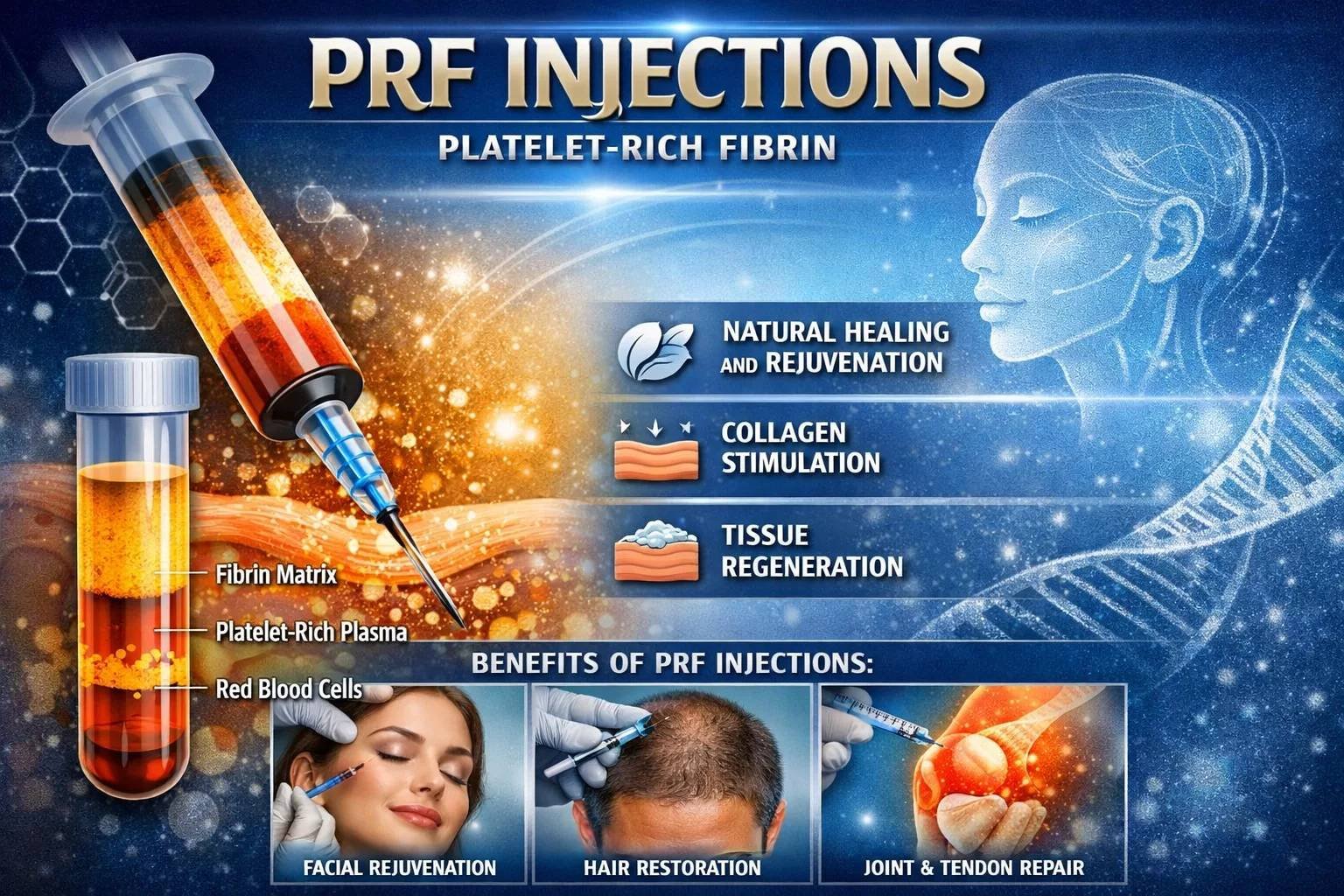
PRF Injections Modern PRF injections are part of regenerative medicine that are widely used in skin rejuvenation and hair regrowth. This minimally invasive modality is adopted frequently to help slow visible signs of aging and improve certain conditions associated with aging skin. PRF injections safely and effectively help reduce facial wrinkles, fine lines, and dark circles under the eye. Moreover, PRF injections have applications in recovery, aesthetic care, and dentistry.Platelet-rich fibrin (PRF) and its application in dentistry: A literature review.Journal of Pharmacy and Bioallied Sciences,16(Suppl 1), S5-S7.” style=”position:relative;color:#309b65;cursor:help;border-bottom:1px dotted #309b65;font-weight:bold”>[1] Regenerative therapies like PRF and PRP also promote hair growth. PRF stimulates regeneration and healing by enhancing your body’s natural healing potential. It has a favorable safety profile with minimal side effects, which makes it an increasingly popular choice of treatment.
What Are PRF Injections?: PRF Injections Modern
Platelet-rich fibrin contains a mesh (matrix) of fibrin (a protein essential for blood clotting) to which platelets and growth factors are attached. Your blood (plasma) is filled with growth factors and chemicals (cytokines) that play a crucial role in healing and tissue regeneration. Owing to their immense healing potential, health experts retrieve them from your blood and make a concentrated solution. Doctors then inject this solution into the desired site to promote healing and regeneration.
When compared to a similar modality, i.e., platelet-rich plasma (PRP), PRF offered a more sustained release of growth factors. Thus, PRF is better-suited for long-term release.[2]
Common forms of PRF include leukocyte-rich PRF (L-PRF), injectable PRF (I-PRF), and advanced PRF (A-PRF), which differ slightly in preparation and clinical application.
The most frequently targeted areas for PRF injections include:
- Under the eyes
- Face
- Neck
- Scalp (and hair)
- Oral region
How Does PRF Work?
The introduction of platelet-rich fibrin induces multiple changes that are beneficial.
Tissue Regeneration
It directly impacts the different steps of cell growth/regeneration, i.e., cell proliferation, migration, adhesion, and differentiation. Studies show that PRF supports wound healing and bone regeneration by enhancing cell proliferation, migration, and differentiation. We see these effects because PRF serves as a reservoir of bioactive materials (growth factors). Moreover, it has an anti-inflammatory effect, which makes it an ideal candidate for regenerative medicine (especially regenerative dentistry).[3]
Collagen Production
Collagen is a structural protein that plays an important role in the healing and regeneration of cells. It acts as a building block for various structures, including soft tissues (tendons, ligaments, and connective tissues), bone, and skin. The amount of collagen in the body declines with age, contributing to the aging process. Fluid-PRF administration promotes collagen synthesis. Some studies conclude that a greater regenerative effect is seen in PRF injections than in PRP.[4]
Angiogenesis
The matrix from platelet-rich fibrin acts as a bioscaffold. Another effect attained from this property of fibrin is the production of new blood vessels, i.e., angiogenesis. PRF slowly releases chemicals for vessel growth, i.e., vascular endothelial growth factors (VEGF), and induces the development of vascular cells (endothelial cells).[5]
Benefits/Uses Of PRF Injections
Doctors across the globe are using PRF injections to achieve different therapeutic advantages. Most medical benefits are seen in the following aspects:
Skin
Dermatologists employ PRF injections to reverse facial aging. You can see evident aesthetic improvement, thanks to the skin rejuvenation achieved with the non-invasive fibrin-rich injections. Patients report improvements for various skin problems.
Wrinkles And Fine Lines:
This new generation of platelet aggregate products does a fine job in helping you retrieve your youthful look. The most noticeable facial feature of aging is wrinkles, which PRF can effectively reverse. In a clinical study done on 15 volunteers, it was concluded that PRF injections brought about the following observable improvements:[6]
- Reduction of small wrinkles and deep, fine lines
- Overall skin freshness
- Reduction of periocular hyperpigmentation(dark circles around the eyes)

PRF injections under the eyes improve skin texture, appearance, and elasticity.
Patients and doctors admire the facial rejuvenation effect of PRF injections. It shows subtle improvement when administered in the skin around the corners of the eye. Many individuals notice significant reductions in canthal wrinkles with platelet-rich fibrin therapy. In addition to wrinkle reduction, PRF also induced skin smoothness.[7]
Dark Circles:
The skin under the eyes is prone to developing darker pigmentation than the surrounding skin. This periorbital hyperpigmentation is commonly referred to as dark circles, which can compromise your aesthetics. Many women seek treatment or cosmetic help to conceal these darkened areas of skin. Injecting PRF under the eyes may help improve the appearance of dark circles in some patients. Regenerative medicine (using PRP and PRF) is considered a viable option in eliminating periorbital dark circles. However, current evidence does not clearly establish the superiority of PRP over PRF, and both are used based on clinical preference and patient factors.Platelet-Rich Plasma and Platelet-Rich Fibrin.Cuestiones de Fisioterapia,53(03), 5871-5882.” style=”position:relative;color:#309b65;cursor:help;border-bottom:1px dotted #309b65;font-weight:bold”>[8]
Skin Texture And Tone:
Another perk of skin rejuvenation with platelet-rich fibrin is improvement of skin texture and tone. Skin revitalization with injectable PRF results in notable improvements in skin texture and tone. Thus, it serves as a promising modality for aging skin.[9]
Sagging Cheeks:
This therapy helps you regain the lost elasticity of the skin by promoting collagen production. Aging causes a loss of collagen, which impacts the firmness of the skin. It was concluded in a systematic review that platelet-rich plasma and fibrin yield the best results in countering facial aging parameters. Thus, you can see significant improvements in skin elasticity and thickness.[10]
Hair
Many dermatologists use PRF injections to combat hair loss in men and women. The introduction of platelet-rich fibrin leads to the regrowth of hair. Injectable PRF (I-PRF) has proven to be a safe and effective modality in treating female pattern baldness. It significantly improves hair regrowth, hair density, and quality of life.[11]
These injections have proven to be worthy tools against hairfall disorders like androgenetic alopecia (AGA). This disease is characterized by progressive thinning of hair, mainly due to hormonal changes.
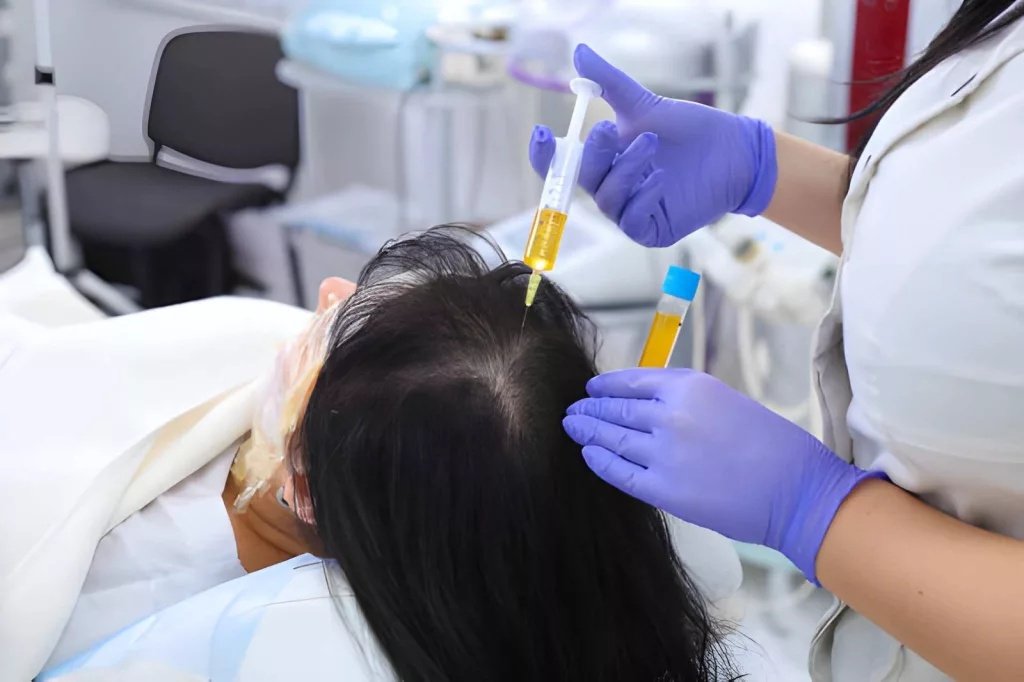
The yellow matrix of PRF can be seen in the injection. Administering PRF in the scalp (on bald patches) promotes hair regrowth.
A 2022 study concluded that I-PRF is a safe, effective, easy, and cost-effective modality for treating AGA.[12] Another study found it to be a well-tolerated and effective method for enhancing the growth of hair and reducing scalp manifestations of the disease.[13]
Recovery/Healing
Your healthcare provider may advise you to inject PRF for faster healing. Regenerative medicine works by boosting the body’s innate ability to heal itself. Therefore, you can find the PRF application in injuries and surgeries as well. Multiple animal studies have revealed that PRF injections accelerate wound healing.[14]
This novel biomaterial yielded promising results in improving healing among patients with spinal cord injury.[15] Therefore, it can be used in soft tissue and joint repair.
Dentistry
Another field where PRF injections are being praised is dentistry. Modern dentists across the globe are using this battery of growth factors for superior clinical results. Injections of platelet-rich fibrin not only accelerate healing but also reduce post-operative pain in procedures like gum surgery (periodontal procedures) and implantology.
Conventional PRP has been used for different dental procedures. However, in modern times, dentists use PRF (in the form of a membrane) in the following procedures:[16]
- Third molar extractions
- Alveolar osteitis (dry socket)
- Trismus (lockjaw)
- Implant surgery
- Sinus lift procedure
- Osteonecrosis (cell death) of the jaw
Clinical evidence supports the use of PRF therapy in oral surgery owing to its positive post-operative patient-related outcomes.[17]
Leucocyte and platelet-rich fibrin (in the form of a membrane) to donor wounds after gum grafting surgery led to lesser postoperative pain, decreased bleeding, and quicker healing.[18] Thus, it has appreciable benefits in dentistry as well.
Procedure for PRF
The procedure for retrieving platelet-rich fibrin is simple. After proper diagnosis and treatment planning, the procedure is done in the following steps:
- A healthcare provider withdraws a small amount of blood from a vein in your arm.
- The blood vial is then placed into a centrifuge machine and spun. The vial is spun at speeds lower than a traditional PRP. This low-speed spinning separates growth factors, platelets, and white blood cells from red blood cells. This step usually takes 8 to 16 minutes to complete.
- The centrifuge leads to the formation of three layers, i.e., a base of red blood cells, a middle layer of fibrin, and an upper layer of plasma.
- A lab technician then collects the yellowish PRF mixture from the vial in a syringe.
- The injection is then given in the target area (face, skin, etc.)
PRF is prepared using low-speed centrifugation and does not require an ultracentrifuge or anticoagulants, which differentiates it from PRP.

Centrifuge machine used for extracting PRP and PRF
Are There Any Side Effects Of PRF Injections?
As PRF is taken from your own blood, the autologous treatment doesn’t cause any significant side effects. However, you may experience some mild issues due to the procedure of injecting the fluid. Temporary side effects associated with PRF injections include redness, swelling, bruising, and soreness at the injection site. These effects subside within a few days.
Very rarely, you can see serious complications of under-the-eye injections. In rare instances, health workers can inadvertently inject the platelet-rich fibrin into a blood vessel, leading to the formation of a blood clot (embolism). Other rare risks include infection, nodules, and vascular complications, particularly with facial injections.
PRF Vs PRP Injections
Platelet-rich plasma (PRP) and platelet-rich fibrin work by stimulating your own healing potential. Both injections are prepared by centrifuging blood and extracting growth factor concentrations from the mix. While PRP is the pioneer technology in regenerative medicine, PRF is a second-generation product that is believed to be more potent than PRP in some cases. Moreover, PRF provides longer-lasting results than PRP.
Home Care After PRF Injections
Patients can return home and resume their daily activities on the same day after getting a PRF injection. You can follow these post-care instructions for better results:
- Be gentle and do not rub or press the injection site for the next 24 hours.
- You may use cold packs. Apply for about 20 minutes, multiple times a day.
- Wait for at least 4 hours before taking a bath. Generally, it is advised to avoid washing the treated area for some time.
- Do not apply any makeup for one day after the injection.
- Avoid blood thinner medications as per your physician’s guidelines. Avoid anti-inflammatory agents (NSAIDs and steroids) for 7-10 days post-injection to minimize the risk of bruising.
- Take medications as prescribed by your physician.
- Minimize intake of alcohol, cigarettes, and caffeine for a couple of days and drink an adequate amount of water.
FAQs
Is the procedure painful?
Generally, PRF injections do not cause any significant pain. Patients report experiencing a slight pinch or pressure during administration of the injection. Application of a numbing agent (local anesthetic) before injection can further minimize pain.
How long before I can see results?
You can start noticing improvements in your skin texture and appearance within 1-2 weeks. However, more noticeable results can be observed 4 weeks to 3 months after the injection.
How much do PRF injections cost?
PRF injection cost varies based on the doctor’s expertise, the location of the clinic, and the standard of the healthcare facility. PRF injections in the US typically cost between $500 and $1000 (or more) per session.
How long do the results last?
Generally, the results of PRF injections last between 6 and 12 months. However, in some cases, patients have noticed results lasting up to 18 months (and even more).
What is the downtime for the procedure?
The procedure has minimal downtime. It is often described as a “lunchtime procedure” as patients are allowed to return to their normal activities almost immediately after the injections. Mild swelling and bruising from the injections typically resolve within a couple of days.
Final Word
PRF injections (platelet-rich fibrin injections) are used for multiple therapeutic benefits. This regenerative medicine works by promoting the healing response of the body. PRF is a battery of growth factors that help in imparting skin benefits like reduction of wrinkles, fine lines, dark circles under the eyes, and sagging facial skin. It also helps in hair regrowth and recovery from injury/surgery. Dentists also use PRP and PRF for quicker recovery after gum surgery, tooth extractions, and implants.
To prepare a PRF injection, a healthcare provider takes a small amount of blood from a vein in your arm and spins it in an ultracentrifuge. This separates the yellow matrix (containing fibrin) from the red blood cells. The platelet-rich fibrin is collected into a syringe and injected into the desired site. There are no significant complications/adverse effects associated with PRF. Thus, doctors across the globe continue to advocate this non-invasive therapy for superior clinical results.
References
[1] Goswami, P., Chaudhary, V., Arya, A., Verma, R., Vijayakumar, G., & Bhavani, M. (2024). Platelet-rich fibrin (PRF) and its application in dentistry: A literature review.Journal of Pharmacy and Bioallied Sciences,16(Suppl 1), S5-S7.
[2] Kobayashi, E., Flückiger, L., Fujioka-Kobayashi, M., Sawada, K., Sculean, A., Schaller, B., & Miron, R. J. (2016). Comparative release of growth factors from PRP, PRF, and advanced-PRF.Clinical oral investigations,20(9), 2353-2360.
[3] Strauss, F. J., Nasirzade, J., Kargarpoor, Z., Stähli, A., & Gruber, R. (2020). Effect of platelet-rich fibrin on cell proliferation, migration, differentiation, inflammation, and osteoclastogenesis: a systematic review of in vitro studies.Clinical oral investigations,24(2), 569-584.
[4] Wang, X., Yang, Y., Zhang, Y., & Miron, R. J. (2019). Fluid platelet‐rich fibrin stimulates greater dermal skin fibroblast cell migration, proliferation, and collagen synthesis when compared to platelet‐rich plasma.Journal of cosmetic dermatology,18(6), 2004-2010.
[5] Ratajczak, J., Vangansewinkel, T., Gervois, P., Merckx, G., Hilkens, P., Quirynen, M., … & Bronckaers, A. (2018). Angiogenic properties of ‘leukocyte-and platelet-rich fibrin’.Scientific reports,8(1), 14632.
[6] Mahmoodabadi, R. A., Golafshan, H. A., Pezeshkian, F., Shahriarirad, R., & Namazi, M. R. (2023). Evaluation of the effect of platelet-rich fibrin matrix in the correction of periorbital wrinkles: an experimental clinical trial.Dermatology Practical & Conceptual,13(1), e2023050.
[7] Atsu, N., Ekinci-Aslanoglu, C., Kantarci-Demirkiran, B., Caf, N., & Nuhoglu, F. (2023). The comparison of platelet‐rich plasma versus injectable platelet rich fibrin in facial skin rejuvenation.Dermatologic Therapy,2023(1), 3096698.
[8] Yousef, A. E., Mohamed, N. G., & Abdelshafy, A. S. (2024). Regenerative Approaches for Periorbital Dark Circles: A Review of Platelet-Rich Plasma and Platelet-Rich Fibrin.Cuestiones de Fisioterapia,53(03), 5871-5882.
[9] Majewska, L. (2023). Platelet‐rich fibrin as an effective method of skin revitalization.Dermatologic Therapy,2023(1), 9040608.
[10] Qin, N., Kochheiser, M., Akosman, I., Dugue, D., Raghunandan, A., Pavuluri, C., … & Otterburn, D. M. (2025). Systematic review of platelet-rich plasma and platelet-rich fibrin in facial rejuvenation.Annals of Plastic Surgery,94(4S), S376-S389.
[11] Sharma, S., Vhadra, B., Quinlan, D. J., Shatta, B., & Hassan, H. (2024). Injectable platelet-rich fibrin for treatment of female pattern hair loss.Journal of Cosmetic and Laser Therapy,26(1-4), 17-25.
[12] Bhoite, K. S., Chikhalkar, S. B., Mishra, S. N., & Kharkar, V. D. (2022). Injectable platelet rich fibrin therapy for androgenetic alopecia: a series of 15 cases.Int J Res Dermatol,8(4), 398-402.
[13] Farooqi, M., Sayed, J., Sayed, S., & Imran, O. (2025). Evaluating the Effectiveness of Injectable Platelet-Rich Fibrin in Androgenetic Alopecia Management.International Journal of Pharmacy Research & Technology (IJPRT),15(2), 2339-2350.
[14] Zhang, T., Wang, J., Le, K., Guo, Y., & Zhu, B. (2022). Platelet-rich fibrin accelerates skin wound healing in pressure injuries: a rat model.Journal of wound care,31(9), 800-804.
[15] Swarnakar, R., Rahman, H., & Venkataraman, S. (2022). Platelet-rich fibrin membrane-as a novel biomaterial for pressure injury healing in a person with spinal cord injury: a case report.Spinal Cord Series and Cases,8(1), 75.
[16] Egierska, D., Perszke, M., Mazur, M., & Duś-Ilnicka, I. (2023). Platelet-rich plasma and platelet-rich fibrin in oral surgery: A narrative review.Dental and Medical Problems,60(1), 177-186.
[17] Zwittnig, K., Mukaddam, K., Vegh, D., Herber, V., Jakse, N., Schlenke, P., … & Payer, M. (2023). Platelet-rich fibrin in oral surgery and implantology: a narrative review.Transfusion Medicine and Hemotherapy,50(4), 348-359.
[18] Gulsever, S., & Uckan, S. (2025). Enhanced palatal wound healing with leucocyte-and platelet-rich fibrin after free gingival graft harvesting: a prospective randomized controlled clinical trial.Journal of Clinical Medicine,14(3), 1029.