
 in the pituitary gland, but the good news is that it is not a cancer...)

Prolactinoma Pituitary Tumor Prolactinoma is an abnormal growth (tumor) in the pituitary gland, but the good news is that it is not a cancer. It causes different symptoms in males and females due to a high level of prolactin secretion and the physical effects of the tumor on the surrounding tissues.[1]
Prolactinoma can be easily diagnosed with blood tests and imaging. You can not prevent prolactinoma from occurring. However, it is a very treatable condition with medications. Sometimes it may require surgery, or rarely, radiation therapy may be needed. Early diagnosis and appropriate management play an important role in preventing complications.
What is Prolactinoma?: Prolactinoma Pituitary Tumor
Prolactinoma is a benign (non-cancerous) tumor of the pituitary gland arising from prolactin-secreting cells, leading to excessive prolactin production. Prolactin is a hormone normally responsible for the growth of mammary glands and the process of lactation (milK production) in females.
Fortunately, prolactinomas are not cancerous tumors. Before discussing more about prolactinoma, it is better to have an idea about the pituitary gland and prolactin.
What is the pituitary gland?
The pituitary gland is a small structure, about the size of a pea, located at the base of the brain. It is known as the “master gland” because it secretes important hormones, many of which control other endocrine glands such as the gonads, thyroid, and adrenal glands.
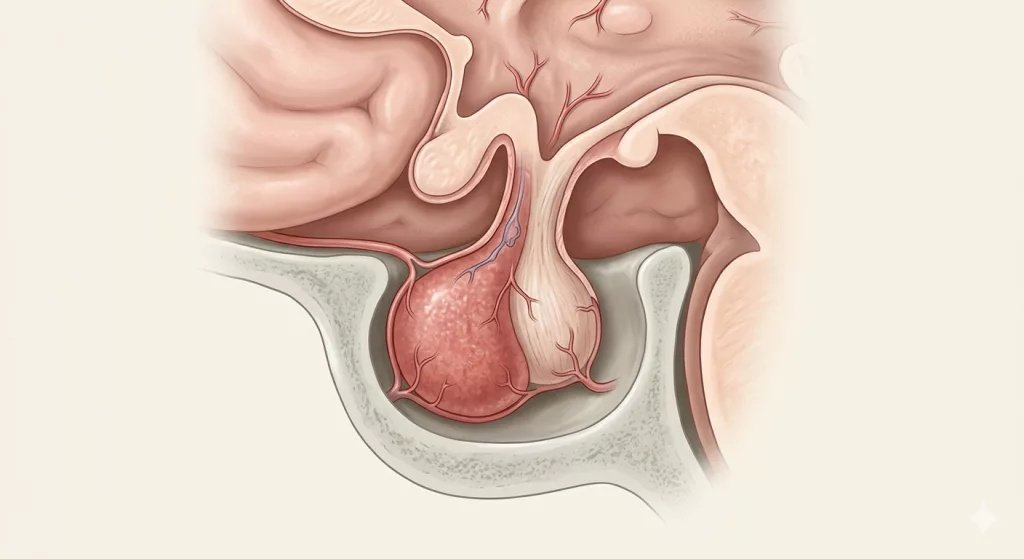
A close view of the pituitary gland, present at the base of the brain
The pituitary gland is composed of different cells that secrete different hormones. For example, growth hormone is secreted by Somatotrophs, and prolactin is secreted by Lactotrophs. Other hormones, such as ACTH, LH + FSH, and TSH, are also secreted by their own respective cells.
As the pituitary gland is so important to the normal hormone system, any disturbance in the pituitary gland function will have significant consequences.
What is prolactin?
Prolactin is a protein hormone produced by the anterior pituitary gland. It is responsible for the production of milk in the breasts as well as for the normal development of the breast tissues of females.
High prolactin levels also inhibit reproductive hormones; therefore, they can suppress ovulation and reduce fertility.[2]
Prolactin is inhibited by dopamine, which is a neurotransmitter secreted by the hypothalamus. Dopamine controls the secretion of prolactin, thus keeping its levels normal. However, prolactin levels rise in pregnancy and reach their peak during breastfeeding to stimulate milk production in the breasts of the mother.
How does prolactinoma occur?
Sometimes a growth happens in the pituitary gland, which is known as a pituitary adenoma or tumor. Most of the time, this growth occurs specifically in the prolactin-secreting cells (lactotrophs), and we call it prolactinoma.
In prolactinomas, there is more secretion of prolactin into the blood. These tumors often secrete prolactin independently of normal dopamine regulation. Higher prolactin levels interrupt the normal menstrual cycle in females, while causing erectile dysfunction and loss of sexual interest in males as well.
Types of prolactinoma
On the basis of tumor size, prolactinoma is divided into two types.
Micro-prolactinoma
They are the most common type of prolactinoma, in which the tumors are smaller, measuring less than 10 mm in diameter. Despite being small, they can cause a significant increase in the levels of prolactin in the blood.
Doctors often diagnose it in females of reproductive age due to menstrual problems or infertility, as high prolactin levels inhibit reproductive hormones.
Macro-prolactinoma
Macroprolactinomas are tumors larger than 10 mm in diameter. Doctors often diagnose it in males, because males don’t have a menstrual system; the tumor can actually grow quite large before symptoms appear.[3]
In these cases, the pituitary gland may grow large enough to compress nearby structures. In such cases, the patient may present with headache, vision problems (due to the tumor compression of the optic chiasm), and other symptoms.
What causes prolactinoma?
Prolactinoma is largely an idiopathic condition, which means no obvious factor causes it. However, in rare cases, genetic factors may play a role.
For example, in some studies, researchers find a link between prolactinoma and Multiple Endocrine Neoplasia type 1 (MEN1); a condition in which tumors occur in multiple endocrine glands due to a mutation in the MEN1 gene.[4].
Another important point to keep in mind is that dopamine secreted from the hypothalamus inhibits the secretion of prolactin. Whenever there is a problem in the normal dopamine secretion, it may lead to the production of excessive prolactin. Although reduced dopamine activity can increase prolactin levels, it does not directly cause prolactinoma.
Who is at risk of prolactinoma?
Prolactinoma can occur in individuals of any age or sex; however, certain groups are more commonly affected than others.
They include:
- Women of the age group 20-50 years (due to the more obvious symptoms of menstrual irregularity)
- Those with genetic syndromes, such as MEN1, MEN4 or Familial isolated pituitary adenomas (FIPA)
However, certain conditions or medications that alter dopamine or prolactin levels may mimic or increase the symptoms of prolactinoma.
However, no lifestyle or environmental factors are currently known to cause or increase the risk of prolactinoma. Most prolactinomas occur sporadically without any identifiable risk factor.
What are the symptoms of prolactinoma?
Prolactinoma causes its symptoms mainly due to high prolactin levels (hyperprolactinemia) or a large tumor that may press the surrounding tissues, causing pressure effects.
Prolactin inhibits the reproductive hormones, causing hypogonadism, which can cause specific symptoms that are discussed below.
The symptoms of prolactinoma differ depending on age, gender, and tumor size.
Symptoms in women
In females, the prolactinoma symptoms include:
- Irregular menstrual periods or complete absence of periods that are unrelated to the menopause (end of reproductive stage)
- Milky discharge from the breasts while she is not pregnant or breastfeeding a baby
- Infertility occurs when the normal ovulation cycle is disturbed by insufficient reproductive hormones due to high prolactin levels
- Dryness of the vagina, which may cause sexual intercourse to be painful
- Loss of interest in sexual activity (libido)
- Brittle and weak bones that easily break due to insufficient estrogen levels
Because their symptoms are easier to recognize, women with prolactinomas often seek medical attention earlier, leading to the diagnosis of microadenomas at an early stage of the tumor.
Symptoms in men
In men, a prolactinoma causes subtle symptoms initially and gradually develops. They include:
- Loss of interest in sexual activity
- Erectile dysfunction
- Reduce levels of testosterone due to high prolactin
- Fatigue and Loss of muscle mass
- Infertility may occur due to a disturbance in the formation of sperms
- Sometimes, the enlargement of male breasts (gynecomastia) may lead to milk ejection from them, although they occur very rarely.
These are mostly symptoms in smaller tumors; when the tumor grows larger, other symptoms related to the compression of normal tissue may occur.
Pressure symptoms
Sometimes the tumor increases in size quite large, especially in males, but may also occur in females, due to late diagnoses.
The pressure symptoms include:
- Vision problems (bitemporal hemianopia, due to compression of the optic chiasm)
- Headache
- Nausea and vomiting
- In advanced cases, the tumor part may compress the normal pituitary tissue, leading to hypopituitarism (which reduces the production of other pituitary hormones)
- Rarely, disordered Smell Perception (dysosmia) may occur
These symptoms may occur in advanced disease as the tumor size grows larger and compresses surrounding structures.
Prolactinoma and weight gain: is there a link?
Prolactinoma may play a minor role in central obesity and weight gain. Experts believe this may be due to a reduction in the levels of estrogen and testosterone in females and males, respectively, due to high prolactin levels.
When these hormone levels are disturbed, your body’s metabolism slows and fat storage increases, contributing to gradual weight gain. Also, prolactin plays a role in appetite regulation and insulin resistance, thus making weight gain more likely.[5]
However, weight gain is not a usual presenting symptom and occurs quite rarely in prolactinoma patients.
Can you have a safe pregnancy with a prolactinoma?
In most cases, it is shown that women who are already pregnant can give birth safely with a prolactinoma. There is no recognized risk to either fetus or mother.
However, as prolactin levels normally increase during pregnancy, there is a theoretical risk of tumor enlargement. This is why you should consult your health provider if you suspect symptoms like headaches or visual disturbances in pregnancy.[6] Management during pregnancy depends on tumor size and symptoms, and medications may be adjusted under specialist supervision.
Fertility concern
However, for a woman with high prolactin levels, it may be difficult to get pregnant, as high prolactin can inhibit reproductive hormones.
Also, in men, high prolactin may reduce sperm count and libido, making it difficult to impregnate a female.
However, prolactinoma is a treatable condition, and upon proper management, it becomes very possible to achieve fertility.
How do doctors diagnose prolactinoma?
If you have symptoms that suggest high prolactin levels or a pituitary tumor, your doctor may recommend some tests that confirm or exclude prolactinoma. This includes blood tests, imaging, and other tests that will help your doctor diagnose and manage your condition.
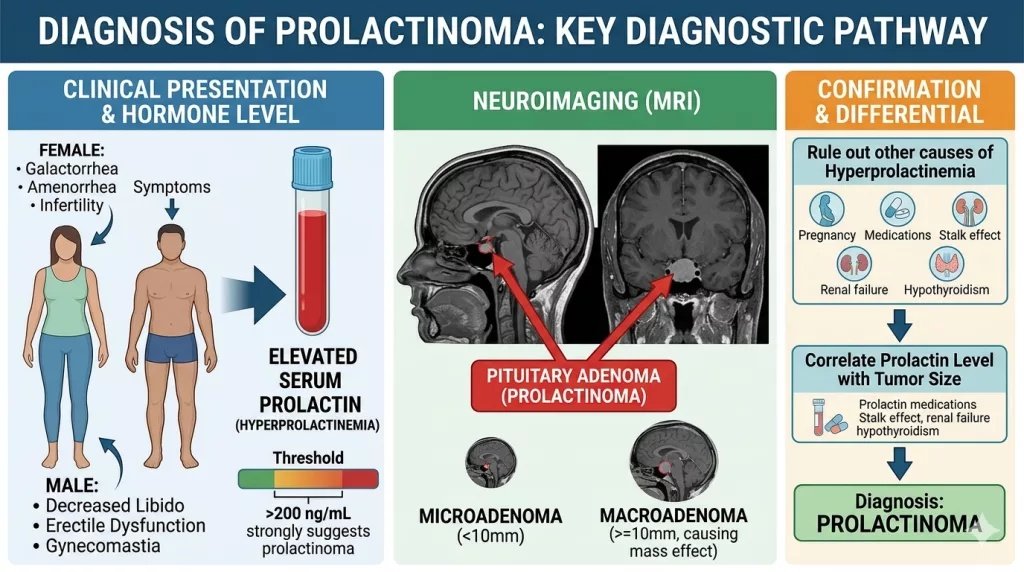
An image of the diagnostic workup for prolactinoma
Blood hormones level test
This is a very important test that shows the levels of prolactin hormone circulating in your blood.
Normal prolactin levels generally measure less than 25 ng/mL for non-pregnant women and less than 20 ng/mL for men. A high level of prolactin of over 200ng/ml strongly indicates prolactinoma.
In some cases, repeat testing or sample dilution may be required to avoid falsely low results (hook effect). Your doctor may check other hormone levels as well to find the overall picture of the hormones secreted by the pituitary gland.
Your provider may also recommend a pregnancy test that looks for the beta-HCG hormone to determine if your missed periods may be due to a normal pregnancy.
If you are a male, your doctor may advise you to check your testosterone levels as well.[7]
MRI or CT-Scan
MRI is the next test of choice as it can locate the tumor and determine its size. This also helps in planning surgical treatment if required.
Although MRI is the preferred test, if it is not appropriate for you, then doctors will recommend a CT scan.
Other conditions that may increase your prolactin levels
Your prolactin levels may rise due to other conditions as well, mimicking prolactinoma. They include:
- Reduced levels of thyroxin hormone in the blood (hypothyroidism)
- Chronic kidney disease
- Certain medications, such as anti-psychotics or anti-depressants
- Hypothalamic or pituitary stalk lesions
- Physiological causes such as pregnancy or stress
Therefore, prolactinoma requires proper differentiation from these conditions to avoid misdiagnosis and unnecessary treatment.
How do doctors treat prolactinoma?
The purpose of treating prolactinoma is to achieve normal prolactin levels, shrink the tumor, and avoid complications.
Some patients with prolactinomas but without symptoms may not need treatment. However, in other cases, the treatment of prolactinomas includes medications, surgery, or radiation therapy. In most cases, only medications may be sufficient.
Medications for prolactinoma
This is the first line of treatment for the majority of the patients. Dopamine inhibits prolactin; this is why dopamine agonists are usually very helpful in reducing the tumor size and normalizing prolactin levels.
Common options include:
- Cabergoline (generally preferred due to higher effectiveness and better tolerability)
- Bromocriptine (widely used, especially in pregnancy)
If your tumor shrinks and your prolactin levels become normal for 2-3 years, your doctor may advise you to stop taking further medication.
Their side effects may include nausea, constipation, dizziness, and Nasal stuffiness. However, they are usually mild and improve over time.
Surgical Treatment
Doctors recommend surgery for prolactinoma when:
- Medications are ineffective or not tolerated
- Tumor compressing surrounding structures
- The tumor does not shrink adequately with medical therapy
The surgical treatment of choice usually follows a minimally invasive transsphenoidal approach. In this approach, the surgeon reaches the base of the brain through the nasal passages using an endoscope (a tube with a camera). This is a relatively safe procedure and leaves no marks from the surgery.
In some cases, your surgeon may choose to access the pituitary tumor by making an opening in the skull (Transcranial surgery).[8] However, it is only reserved for large tumors.
All surgeries have an inherent risk for complications or failure. Sometimes a tumor may come back after several years of surgery. In some cases, the surgeon may only remove a partial tumor due to safety reasons and prescribe medication for the remaining tumor. Surgical success rates are higher in smaller tumors compared to larger ones.
Radiation Therapy
Your healthcare provider may recommend that you receive radiation therapy if your condition doesn’t improve with medication or surgery, or if you are not ready for a surgical procedure.
They will provide you with single or multiple radiation doses based on the tumor size and location. However, this is rarely required.
What are the complications of an untreated prolactinoma?
If left untreated, a prolactinoma can lead to several complications, such as:
- Infertility
- Osteoporosis
- Visual field defects
- Chronic headaches
- Multiple hormone deficiencies
- Rarely, acute complications such as pituitary apoplexy may occur.
Therefore, it is important to early diagnose and manage prolactinoma to prevent these outcomes.
What outcome can you expect after treatment?
Prolactinomas have an excellent outcome when properly treated. Most patients respond well to therapy and live a healthy life.
Small tumors have an especially better prognosis than larger tumors, although all are quite treatable. Most patients achieve good long-term control rather than a complete cure in all cases.
Frequently Asked Questions (FAQs)
1. Can a prolactinoma go away on its own?
It is rare for a prolactinoma to resolve on its own. Most cases require treatment, though small tumors may remain stable without progression.
2. Is prolactinoma dangerous?
Usually, a prolactinoma is not life-threatening at all; however, untreated cases can cause complications such as infertility or vision problems.
3. How long does treatment take?
Treatment is often long-term (months to years), depending on response. Some patients may eventually stop medication under medical supervision.
Conclusion
Prolactinoma is a benign condition of the pituitary gland, primarily responsible for high prolactin levels and, in some cases, mass effects due to larger size. It is often diagnosed earlier in females due to more obvious symptoms related to periods.
Females with prolactinoma usually present with amenorrhea (absent periods) or oligomenorrhea (reduced periods) and infertility. Males with prolactinoma often complain of erectile dysfunction and loss of libido (sexual interest). If you or someone you know is having these symptoms, do make an appointment with a medical specialist or endocrinologist to manage your condition.
Doctors diagnose it using blood tests (hormone levels) and Imaging. It is very hard to prevent prolactinoma from happening; however, proper treatment can be curative. Treatment includes medications (mainstay), surgery, or radiation therapy.
References
[1] Melmed S, Casanueva FF, Hoffman AR, Kleinberg DL, Montori VM, Schlechte JA, et al. Diagnosis and treatment of hyperprolactinemia: An Endocrine Society clinical practice guideline. J Clin Endocrinol Metab. 2011;96(2):273–288.
[2] Glezer A, Bronstein MD. Prolactinomas. Endocrinol Metab Clin North Am. 2015;44(1):71–78.
[3] Molitch ME. Diagnosis and treatment of pituitary adenomas: A review. JAMA. 2017;317(5):516–524.
[4] Vroonen L, Jaffrain-Rea ML, Petrossians P, Tamagno G, Chanson P, Vilar L, et al. Prolactinomas resistant to standard doses of cabergoline: a multicenter study. Eur J Endocrinol. 2012;167(5):651–662
[5] Pala NA, Laway BA. Prolactin and metabolic syndrome. Indian J Endocrinol Metab. 2012;16(Suppl 2):S195–S198.
[6] Gillam MP, Molitch ME, Lombardi G, Colao A. Advances in the treatment of prolactinomas. Endocr Rev. 2006;27(5):485–534.
[7] Cleveland Clinic. Prolactinoma: What it is, causes, symptoms & treatment. Cleveland Clinic. 2024.
[8] Mayo Clinic Staff. Prolactinoma: Symptoms and causes. Mayo Clinic. 2025.