

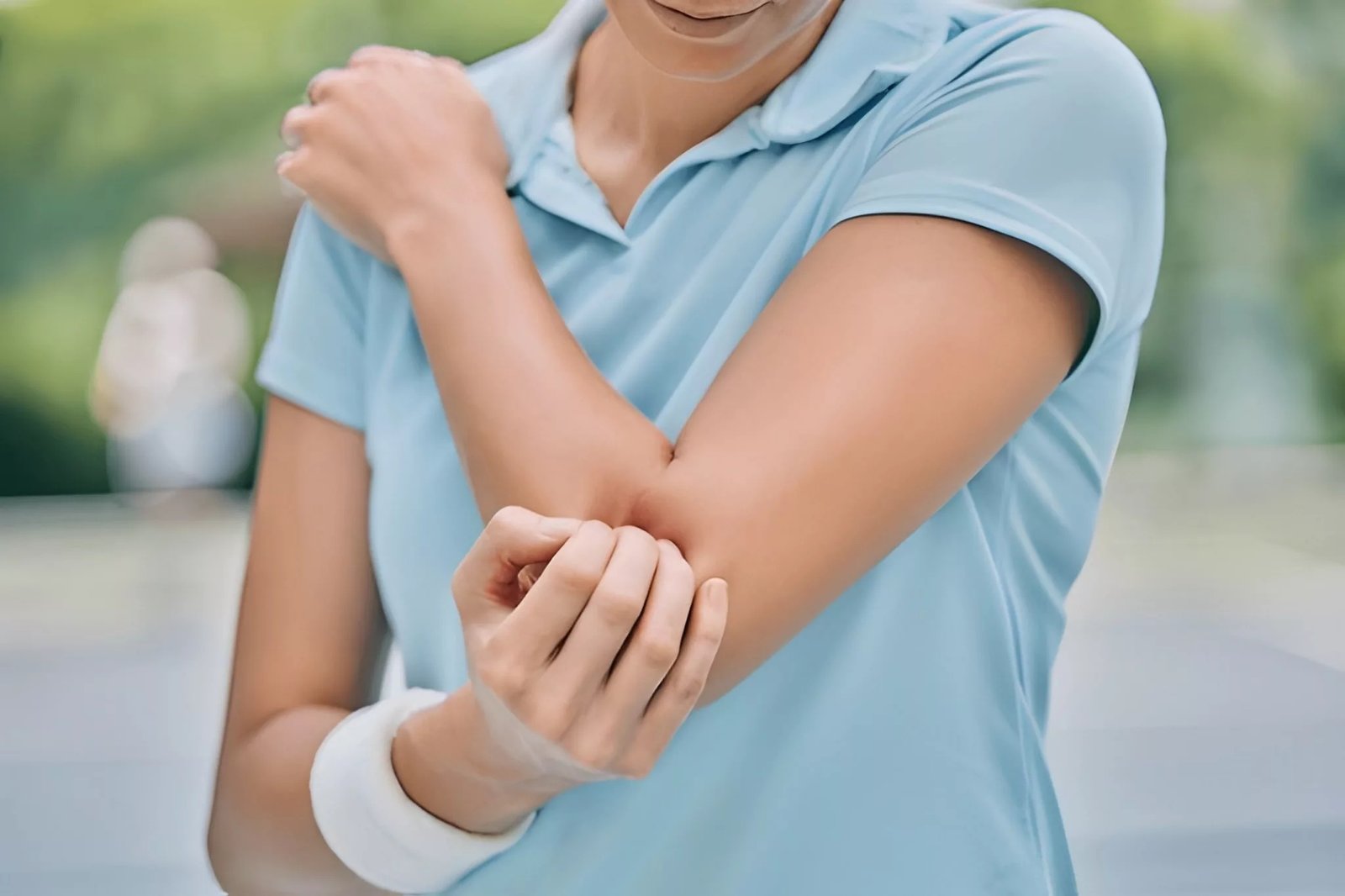
Tennis Elbow Manage Tennis elbow, or lateral epicondylitis, is a painful condition affecting the outer part of the elbow where the forearm muscles attach to the lateral epicondyle. Most people who develop tennis elbow have never actually played tennis, despite the name.[1]
The Anatomy of the Problem:
This is a disorder of the extensor carpi radialis brevis (ECRB) muscle and its tendon, which helps stabilize the wrist when the elbow is straight. During gripping, twisting, or lifting actions, this tendon is highly active. When you overuse a tendon or strain it too much, the fibers of the tendon get torn microscopically.Tendinosis of the elbow (tennis elbow): Clinical features and histological findings.The Journal of Bone and Joint Surgery. American Volume, 81(2), 259–278.” style=”position:relative;color:#309b65;cursor:help;border-bottom:1px dotted #309b65;font-weight:bold”>[2]

Tennis elbow – tear in the common extensor tendon of the arm
Tennis elbow results more from tendinosis (chronic degeneration of the tendon tissue) than from tendinitis (acute inflammation). The tendons with the disorder exhibit: [3]
- Unorganized collagenous fibers.
- Increased synthesis of pain-generating chemicals.
- Lack of inflammatory cells.
- Tried a treatment that results in weaker scar-like tissues.
This degeneration can be compared to a frayed rope from overuse rather than one that is inflamed. Understanding this distinction is important because it changes how the condition is treated.
Root Causes & Common Triggers: Who Gets It and Why?: Tennis Elbow Manage
The following are some specific causes for Tennis elbow:
Occupational Causes (The Most Common):
- Handicrafts: Plumbers, carpenters, painters.
- Culinary employees: Butchers, chefs (knife monotony)
- Office employees: Poorly ergonomic computer users.
- Workers in the manufacturing sector: Assembly line workers.
- Artists and musicians: Violinists and painters.
Recreational Activities:
Sports Beyond Tennis:
- Racket sports (tennis, squash, badminton)
- Golf (particularly, bad swing technique)
- Rock climbing
- Poorly-performed weight lifting.
- Bowling
The Tennis Connection: Only about 5–10% of tennis players develop this condition, and among them, risk factors include:[5]
- Poor backhand skills.
- Late contact with the ball (arm stretched further)
- Racket tension is too high
- Wrong grip size
Biomechanical Factors:
Tennis elbow, in most cases, is acquired as a result of biomechanical influences and age susceptibility. Biomechanically, it is noted that when the wrist remains in a grip position, especially in tasks that require maximum effort, with a straight elbow. When the blood supply to the affected tendon is relatively low, this limits its healing capacity, and if the tendon encounters the greatest stress at the site of attachment to the bone.
Also, age is a contributing factor, whereby most of the incidences are observed among people aged between 30 and 50 years, at which age the tendons start losing some elasticity and strength.[6]
Tennis Elbow Symptoms
The tennis elbow makes itself felt. With the awareness of the pattern, you can differentiate it from other conditions of the elbow.
The Hallmark Pain Pattern:
This pain starts from the lateral epicondyle (the bump of bone on the outside of the elbow) and spreads down to the forearm to the wrist. The interior elbow is usually non-painful. The quality of pain is:[7]
- Aching or burning pain.
- Pain on movement; a sore on rest, in extreme instances.
Onset: It occurs slowly, starting as slight post-activity pains. It gets better or worse in weeks or months, occasionally reaching a sharp pain when performing some motions.
The pain usually develops gradually, starting as mild post-activity soreness that worsens over weeks or months and can become sharp during gripping or lifting.
Particular Activities that Trigger:
- Holding (shaking hands, door locks).[8]
- Rising in the palm down pose.
- Rotary movements (opening jars).
- Spreading fingers (typewriting, playing the piano).
Diagnostic Hint:
A classic diagnostic clue is the “coffee cup test”; lifting a full cup with the arm extended and palm facing down reproduces pain at the elbow.
Diagnosis of Tennis Elbow
The clinical diagnosis of tennis elbow largely depends on the history and physical examination. Imaging is only needed if symptoms are atypical or do not improve with treatment.
The Medical History:
Your doctor will enquire about activities, the pattern of pain, and what makes it worse. Also medical history of past trauma, arthritis, and other diseases is important.
Physical Examination Tests:
The diagnosis can be confirmed by the use of several special maneuvers:[9]
- Cozen’s Test (Resisted Wrist Extension): Pain in the outer elbow is sharp when the wrist is extended.
- Mills’ Test: The doctor gives you a complete flexion of the wrist and straightening of the elbow, which results in stretching the tendon, resulting in pain.
- Maudsley’s Test: In this test middle finger is extended with resistance that puts particular stress on the ECRB.
- Palpation: The pain is produced with direct pressure over the lateral epicondyle. The tender point is normally slightly below and before the bony protrusion.
- Grip Strength Testing: Measured with a dynamometer. The affected side is generally half or less strong than the one that is not affected.
Imaging Studies:
- X-rays do not reveal the damage to tendons, but rule out other bone-related diseases, like arthritis, bone spurs, and loose bodies in the joint.
- If the diagnosis is not certain after 6-12 months of conservative treatment, then an MRI is used for suspected tear of the tendons or other injuries to the soft tissues.[10]
Differential Diagnosis:
- Radial tunnel syndrome
- Cervical radiculopathy
- Posterior interosseous nerve entrapment
- Osteoarthritis
- Ligament injury
Treatment of Tennis Elbow
The treatment of tennis elbow is evidence-based. Most patients (80–95%) recover with conservative therapy, though healing may take 6 months to 2 years.
Conservative Treatments:
Rest & Activity Modification
Rest doesn’t mean complete immobilization, but rest relative. Complete rest causes further weakening of the tendon. Practical strategy is to:[11]
- Recognize and correct the individual actions that are painful.
- Lessen the frequency and the duration of the aggravating activities by half at first.
- Where applicable, use your other hand.
- Rest for a short time: 30 seconds after every 10 minutes during monotonous work.
Some possible work modifications include:
- Adjust keyboard height, use an ergonomic mouse, and adjust the position of the wrist.
- Manual Workers should use power tools in place of hand tools to switch hands.
- For athletes, it is better to decrease the volume of training and also pay attention to the correction of techniques.
Ice vs. Heat: The Evidence-Based Protocol
Ice: Use ice therapy in the acute phase, i.e, the first 48-72 hours of a significant increase in pain. Apply only for 15-20 minutes for every 2-3 hours, in the form of an Ice pack in a thin towel; never apply it directly to the skin.
Heat: Warming up is better for chronic pain. For best results, you should warm the body tissues 10-15 minutes before an activity to increase their flexibility.
Medication
Over-the-Counter NSAIDs (Non-Steroidal Anti-Inflammatory Drugs): Short-term pain relief (2-4 weeks), but no effect on long-term recovery.
Topical NSAIDs: Provide local analgesia with fewer systemic side effects.
Acetaminophen (Tylenol): Non-anti-inflammatory (pure) painkiller, and it is safer over the long term. However, it is not as effective as NSAIDs.
It is important to remember that drugs only treat the symptoms but not the degeneration of tendons. There are no such things as primary treatments.[12]
Counterforce Bracing:
A counterforce strap worn just below the elbow redistributes stress from the affected tendon, allowing continued activity with less pain. It should not be overly tight to avoid nerve compression.
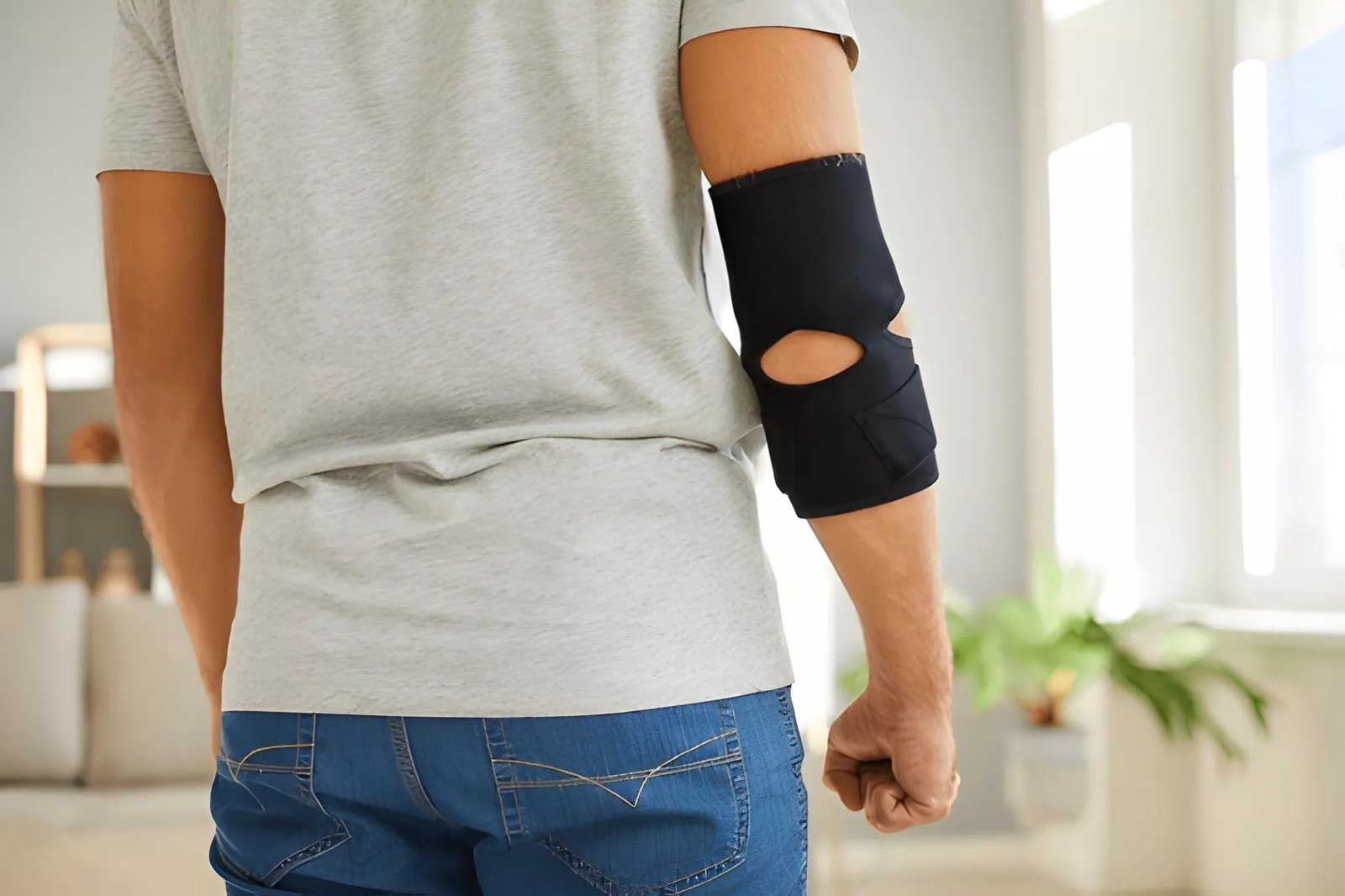
Young man wearing an adjustable orthopedic elbow support brace on his right arm for easing pain in the elbow, back view.
Physical Therapy & Exercise:
The most effective conservative treatment is physical therapy, the success rates of which are 80-90 percent, provided that it is conducted correctly. Eccentric strengthening and stretching exercises of the wrist extensors are key.[13]
Advanced/Medical Interventions:
Corticosteroid Injections
These anti-inflammatory drugs are injected into the area, which gives an effective analgesic effect for 4-6 weeks. The effects, however, disappear after 3 months and can make the tendon weak in the long run. It is applied with limitations in case of severe pain, giving a time frame to start the exercise program.[14]
Platelet-Rich Plasma (PRP) Injections
This is an injection in which concentrated growth factors of your own blood are injected to help the tendons heal. It is costly and likely not covered by most insurance, but promising in the long-term in chronic cases that otherwise did not respond to other therapies, whose effects accumulate over months.[15]
Extracorporeal Shockwave Therapy (ESWT)
This therapy uses sound waves over the elbow to aid in healing. Patients undergo several sessions, and research shows moderate evidence with about 60-65% pain and functional improvement when used to treat chronic tennis elbow.[16]
Newer/Experimental Treatments
Other methods, including prolotherapy and dry needling, aim to stimulate a healing response. The injection of Botox is regarded as experimental. They are typically used in cases where the treatment has not been effective.
Surgical Options:
Surgical intervention is considered a final option on failure of non-surgical treatment after 12 months. The main goal is excising the tissue of damaged tendons and restoring the normal function.[17] Success rates range from 80–95%, but full recovery can take 3–6 months. Infection, nerve damage, or permanent pain are the potential risks.
Open Tennis Elbow Release (Most Common)
In this technique, an opening (about 4-5 cm) is made above the outer elbow. The surgeon will excise the degenerated tendon tissue and smooth the bone surface, and perhaps reposition the healthy tendon tissue. It has the advantages of long-lasting pain relief, though it takes time to heal when compared to minimally invasive procedures.
Arthroscopic Surgery
Arthroscopic surgery is a minimally invasive surgery that consists of 2-3 small incisions and is performed with the assistance of a camera and special instruments. It enables an accurate excision of disease-infected tendon tissue and quicker recovery of normal functioning processes.[18]
Percutaneous Release
A newer, ultrasound-guided procedure using a fine needle to release scarred tendon fibers. It produces minimal pain, the scar is virtually invisible, and the recovery takes a shorter time. Although the preliminary data are encouraging, the long-term data are limited.
Prevention Strategies for Tennis Elbow
The most effective way to prevent tennis elbow is to avoid your tendon from constant stress, because it will ultimately damage the muscles in your arm. The following are some preventive measures that help you protect your elbow and arm.[19]
- To prevent micro tears, make your forearms strong and more flexible. Some exercises, like stretching and endurance exercises, help you to strengthen muscles and tendons.
- Another significant factor for the prevention of tennis elbow is a correct posture and wrist position during work. The best position for the wrist is a neutral position (without tilting up and down) with a well-supported forearm.
- The tendons require more time to heal compared to the muscles, and hence, time should be allowed to rest. Make short rests at 15-20 minute intervals during tough and repetitive activities.[20]
Final Thoughts
Tennis elbow is an irritating disorder, yet it is possible to manage it with a careful and consistent approach. Recovery and healing of an injured tendon is a process of patience, so don’t try to look for quick-fix methods. You should keep in mind, healing is a long process: it is not possible to heal in several days, but within several weeks. Working regular hours, a specialized exercise program, and professional advice in case of persistent pain can all help speed up recovery. In the long run, a gradual progressive improvement will provide permanent relief and strength of your arm without pain.[21]
References
[1] Shiri, R., & Viikari-Juntura, E. (2011). Lateral and medial epicondylitis: Role of occupational factors.Best Practice & Research Clinical Rheumatology, 25(1), 43–57.
[2] Kraushaar, B. S., & Nirschl, R. P. (1999). Tendinosis of the elbow (tennis elbow): Clinical features and histological findings.The Journal of Bone and Joint Surgery. American Volume, 81(2), 259–278.
[3] Walz, D. M., Newman, J. S., Konin, G. P., & Ross, G. (2010). Epicondylitis: Pathogenesis, imaging, and treatment.Radiographics, 30(1), 167–184.
[4] Haahr, J. P., & Andersen, J. H. (2003). Physical and psychosocial risk factors for lateral epicondylitis: A population-based study.Occupational and Environmental Medicine, 60(5), 322–329.
[5] Walker-Bone, K., Palmer, K. T., Reading, I., & Cooper, C. (2004). Soft-tissue rheumatic disorders of the upper limb: Prevalence and risk factors.Seminars in Arthritis and Rheumatism, 33(3), 185–203.
[6] Shiri, R., Viikari-Juntura, E., & Varonen, H. (2006). Prevalence and determinants of lateral and medial epicondylitis.Scandinavian Journal of Work, Environment & Health, 32(1), 43–48.
[7] Bisset, L. M., Beller, E. M., Jull, G. A., Brooks, P., Darnell, R., & Vicenzino, B. (2006). Mobilisation with movement and exercise, corticosteroid injection, or wait and see for tennis elbow: Randomised trial.BMJ, 333(7575), 939.
[8] Ciccotti, M. G., Schwartz, M. A., Ciccotti, M. C., & Nirschl, R. P. (2004). Diagnosis and treatment of lateral epicondylitis.The Physician and Sportsmedicine, 32(5), 20–25.
[9] Coombes, B. K., Bisset, L., & Vicenzino, B. (2015). Management of lateral elbow tendinopathy: One size does not fit all.Journal of Orthopaedic & Sports Physical Therapy, 45(11), 938–949.
[10] Connell, D. A., Burke, F., Coombes, P., McNealy, S., Freeman, D., & Pryde, D. (2001). Sonographic examination of lateral epicondylitis.AJR. American Journal of Roentgenology, 176(3), 777–782.
[11] Bisset, L., Paungmali, A., Vicenzino, B., & Beller, E. (2005). A systematic review and meta-analysis of physical interventions for lateral epicondylalgia.British Journal of Sports Medicine, 39(7), 411–422.
[12] Peterson, M., Butler, S., Eriksson, M., & Svärdsudd, K. (2014). A randomized controlled trial of eccentric versus concentric exercise in chronic tennis elbow.Clinical Rehabilitation, 28(9), 862–872.
[13] Smidt, N., Assendelft, W. J. J., Arola, H., Malmivaara, A., Green, S., Buchbinder, R., … & Bouter, L. M. (2003). Effectiveness of physiotherapy for lateral epicondylitis: A systematic review.Annals of Medicine, 35(1), 51–62.
[14] Coombes, B. K., Bisset, L., & Vicenzino, B. (2010). Efficacy and safety of corticosteroid injections and other injections for lateral epicondylalgia: A systematic review and meta-analysis.The Lancet, 376(9754), 1751–1767.
[15] Mishra, A., Pavelko, T., & Carmichael, J. (2014). Platelet-rich plasma significantly improves clinical outcomes in patients with chronic tennis elbow.The American Journal of Sports Medicine, 42(2), 463–471.
[16] Gerdesmeyer, L., Frey, C., Vester, J., Maier, M., Weil, L., & Weil, L. (2008). Radial extracorporeal shock wave therapy is safe and effective in the treatment of chronic lateral epicondylitis.The American Journal of Sports Medicine, 36(11), 2100–2109.
[17] Dunkow, P. D., Jatti, M., & Muddu, B. N. (2004). A comparison of open and percutaneous techniques in the surgical treatment of tennis elbow.Journal of Bone and Joint Surgery. British Volume, 86(5), 701–704.
[18] Solheim, E., Hegna, J., Øyen, J., & Inderhaug, E. (2011). Arthroscopic versus open surgical release for lateral epicondylitis: A prospective randomized study.Arthroscopy, 27(5), 595–601.
[19] Andres, B. M., & Murrell, G. A. C. (2008). Treatment of tendinopathy: What works, what does not, and what is on the horizon.Clinical Orthopaedics and Related Research, 466(7), 1539–1554.
[20] Dimberg, L. (1987). The prevalence and cause of tennis elbow (lateral epicondylitis) in a representative sample of the population.Acta Orthopaedica Scandinavica, 58(2), 135–137.
[21] Kaux, J. F., Forthomme, B., Goff, C. L., Crielaard, J. M., & Croisier, J. L. (2011). Current opinions on tendinopathy.Journal of Sports Science & Medicine, 10(2), 238–253.