


Terry’s Nails When people think about their health signs, they usually focus on symptoms like fever, pain, or weight loss. Most people don’t pay attention to their nails. Yet in medicine, nails can provide surprisingly important information about what is happening in the body. During a routine clinical examination of patients, doctors often examine nails. The reason is that nails can sometimes reflect an underlying health condition. One of such findings is called Terry’s nail. This condition has been known for decades and is usually associated with systemic diseases, such as liver disease, heart failure, diabetes, and kidney problems. In some individuals, however, similar nail changes may also occur as part of the natural aging process.
If you or someone you know notices these changes in the nails, it is a good idea to see a healthcare provider for evaluation and management.
What Does a Normal Nail Look Like?: Terry’s Nails
Our healthy fingernails are usually smooth, slightly curved, and pink in color. The pinkish appearance of our nails is due to a rich blood supply in the nail bed beneath the nail plate (hard nail that we see).
The nail plate is made up of keratin, the same protein that is also present in our hair and skin. On the other hand, the nail bed is the layer of skin beneath the nail plate.
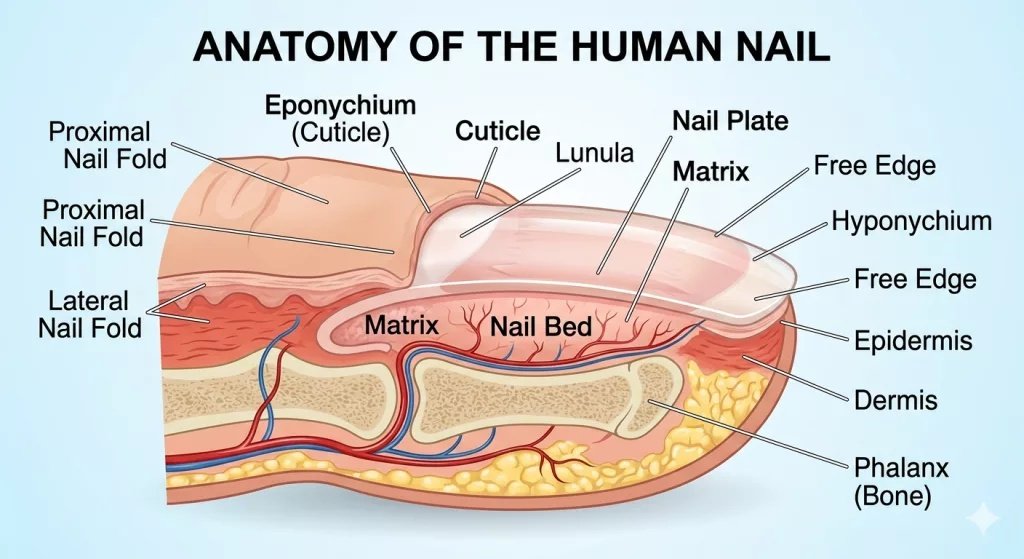
An illustration of the structure of a normal nail
In the base of the nail, you can notice a small, half-moon-shaped, whitish area called the lunula. This lunula is important because it may disappear or become difficult to see in certain nail conditions, including Terry’s nails.
Our healthy nails grow about 2–3 mm per month, although the exact rate may vary from person to person. They normally maintain a uniform pink color without significant discoloration or irregular patterns.
When a systemic disease occurs, the nails may also show subtle changes. These changes can sometimes be seen during careful observation. For this reason, doctors often examine the nails as part of a routine clinical examination.
What are Terry’s Nails?
Terry’s nails refer to a specific change in the color and appearance of the fingernails. In Terry’s nail, the pinkish coloration of the nail disappears, and most of the nail becomes white or pale. Only a narrow band of pink, red, or brown color remains near the tip of the nail. This distal band is usually narrow and typically measures about 0.5–3 mm in width.

An illustration of a normal nail compared with Terry’s nail
This unique pattern of Terry’s nails makes it quite easy for clinicians to recognize.
Key Features of Terry’s nails are:
- About 80-90% of the nail near the base becomes white or pale
- A thin band at the tip side remains colorized
- The lunula often becomes difficult to see or disappears.
- It usually affects both hands and multiple nails at the same time
- It may also affect the toenails in some individuals
Why is it named Terry’s nails?
In 1954, an American physician, Dr. Richard Terry, described this nail change while studying patients with liver disease. In his observation, 82 out of 100 cirrhotic patients had this distinctive nail pattern.
Because of his observations, this nail finding was later named Terry’s nails in recognition of his work.
Looking at this significant correlation, many researchers began exploring the relationship between nail changes and internal diseases.
Why do Terry’s nails occur?
Scientists do not fully understand the exact cause of Terry’s nails. They have proposed several mechanisms to explain why the nails lose their original appearance.
Researchers believe the following factors can contribute to the development of Terry’s nails:
- Reduction in the number of small blood vessels in the nail bed (skin below the hard nail)
- Changes in blood flow under the nail bed
- Increase in connective tissue (fibrous tissue) deposits in the nail bed
These changes reduce the normal pink color of the nail bed that is usually visible through the nail plate.
What Diseases Are Associated With Terry’s Nails?
Terry’s nails are harmless, but their presence may be a sign of an internal health problem.
The following are some of the important systemic diseases in which Terry’s nails occur.
Liver cirrhosis
In cirrhosis, there is irreversible scarring of the liver tissue, and liver functions become severely compromised.
Liver cirrhosis was the original disease in which Terry’s nails were described. In Dr. Terry’s observation, about 80% of cirrhotic patients developed Terry’s nails, which is indeed a significant association. However, later studies suggest that the prevalence may vary, and not all patients with cirrhosis develop Terry’s nails.
Besides nail changes, cirrhotic patients may also experience symptoms such as:
- Yellowed skin or eyes (jaundice)
- Abdominal swelling (ascites)
- Bleeding tendency
- Fatigue
- Itchy skin
However, not all cirrhotic patients develop Terry’s nails, and their absence does not rule out liver disease.
Other diseases in which Terry’s nails occur:
- Chronic liver disease
- Congestive heart failure
- Diabetes mellitus
- Chronic kidney disease
- Malnutrition
- Advancing age
As we can see, Terry’s nails can also occur as part of the normal aging process. But if they appear suddenly or alongside other symptoms, then it is important to consult your doctor for a complete evaluation.
How do Terry’s nails differ from other nail conditions?
There are several other nail patterns, which may resemble Terry’s nails. For this reason, a clinician should be able to distinguish Terry’s nails from these other nail patterns.
The following are some of the other nail patterns:
Lindsay’s nails
Lindsay’s nails are also known as “half and half nails.” These nails are somewhat different from Terry’s nails.
In Lindsay’s nails:
- The bottom half of the nail is white
- The top half appears pink, red, or brown
They are mostly seen in patients with chronic kidney disease.
Leukonychia
In leukonychia, there is a white discoloration that arises from the nail plate itself rather than the nail bed.

An image of Leukonychia
The discoloration usually appears as:
- White spots or streaks
- Patchy areas of discoloration
Also, the discoloration pattern is like spots or streaks, unlike a continuous pattern that occurs in Terry’s or Lindsay’s nails.
They are mostly caused by trauma or nutritional factors and rarely by systemic diseases.
Clubbing
Clubbing affects the shape of nails, while Terry’s nails affect the color.
In clubbing:
- The fingertips enlarge
- Nails becomes curved
They are mostly seen in lung disease, heart disease, and some cancers.
When Should Someone Seek Medical Advice?
You should consider seeking medical advice if you notice the following changes:
- Your nails suddenly start to appear pale or white without any obvious reason
- Multiple nails are affected on both of your hands at the same time
- The nail changes are persistent and don’t improve over time
You should also look into these symptoms besides nail changes, as they may indicate an underlying health problem:
- Yellowing of the skin or eyes
- Swelling of the legs or abdomen
- Shortness of breath
- Fatigue or weakness
Diagnosis of Terry’s Nails
In practice, such patients usually come to the clinic because of other symptoms related to their underlying disease. Due to this reason, the clinician usually starts by taking a detailed history of their symptoms by asking them questions about their medical problems and associated complaints.
After that, the clinician performs a general physical examination, during which he or she may notice the presence of Terry’s nails. Physical exam often includes careful inspection of all fingernails and toenails to distinguish Terry’s nails from other patterns.
Terry’s nails are easy to diagnose because of their unique appearance. On examination, the nails will appear pale or whitish, with a narrow band of pink, red, or brown color near the tip of the nail.
Laboratory Tests
If Terry’s nails are present, the doctors may ask for some lab tests depending on the presenting symptoms and clinical context.
For example:
- Liver Function Tests
- Kidney function tests
- Blood sugar level
- Echo-cardiography
- Complete blood count
The aim of these tests is to help physicians find out whether an internal disease is present.
Do Terry’s Nails Disappear with Pressure?
If you gently press on the nail bed in Terry’s nails, the whitish discoloration may briefly disappear. However, this disappearance lasts only for a moment, and the original paleness or whiteness returns once the pressure is released.
That brief fading of discoloration doesn’t treat Terry’s nails and requires proper treatment of the causative internal disease.
How Are Terry’s Nails Treated?
Terry’s nails by themselves, do not necessarily have to be treated. Instead, emphasis is put on controlling the underlying illness causing them. Once the underlying illness is well managed, there is a possibility of improvement in the appearance of the nails over time.
Your doctor will develop a treatment plan depending on the specific cause of Terry’s nails.
The following is an overview of the management of some of the major reasons for the development of Terry’s nails.
- Liver disease: Drugs, Lifestyle changes, Liver transplant.
- Heart failure: Drugs, Lifestyle changes.
- Kidney disease: Drugs, Lifestyle changes, dialysis, or a kidney transplant.
- Diabetes mellitus: Blood sugar control, drugs, or Insulin therapy.
How can you prevent further damage to the nails?
Although Terry’s nails are mainly related to internal diseases and therefore depend on the situation of your disease, maintaining good nail care and overall health may help prevent additional nail damage.
Some of the simple practices that might help you include:
- Eat a healthy and balanced diet
- Drink plenty of water to keep yourself well hydrated
- Avoid injuries and trauma to the nails
- Keep your nails clean and well-trimmed
- Minimize exposure of your nails to harsh chemicals
Regularly observing your nails can also help you identify new changes and the progression of your disease.
What is the Importance of Nail Examination in Medicine?
For medical students and doctors, the case of Terry’s nails serves as an excellent example of how subtle changes in the human body can indicate a bigger problem. Nails, thought as the simplest aspect of our body, can sometimes reveal what’s going on inside the body.
Even in the age of high-tech diagnostic medicine, it is very important to properly examine the patient in a systematic way. This not only helps in making early diagnosis but also prevents the need for unnecessary costly investigations.
Frequently Asked Questions (FAQ)
Are Terry’s nails dangerous?
Terry’s nails themselves are not harmful, but they may indicate the presence of an underlying systemic disease. For that reason, if these nail changes appear, then it is a good idea to undergo a medical checkup.
Can Terry’s nails go away?
It mostly depends on the associated disease. In most cases, if the underlying condition is treated or managed effectively, the nail appearance may gradually improve over time.
Are Terry’s nails always related to liver disease?
No, although they are mostly present in liver cirrhotic patients. They can be present in heart disease, kidney problems, diabetes patients, or even part of normal aging.
Do Terry’s nails cause pain, discomfort, or itching?
No, Terry’s nails usually do not cause pain, discomfort, or itching. The change is mainly cosmetic and is often noticed either by the patient or by the clinician during a routine medical examination.
Key Takeaways
Terry’s nails are a change in the appearance or color of the nails. In such nails, the majority of the nail becomes white or pale. Only a narrow band of pink, red, or brown color remains at the tip.
This condition was named after Dr. Richard Terry, who first described this nail pattern in patients with liver cirrhosis.
Terry’s nails can also occur in association with other systemic conditions such as heart failure, diabetes, kidney disease, and malnutrition. However, in some cases, it may be a part of the normal aging process.
The Management of Terry’s nails focuses on identifying and treating the underlying disease. When the underlying condition improves, the appearance of the nails may gradually return toward normal..
References
[1] Witkowska AB, Jasterzbski TJ, Schwartz RA. Terry’s Nails: A Sign of Systemic Disease.Indian J Dermatol. 2017;62(3):309–11.
[2] Clinical Methods: The History, Physical, and Laboratory Examinations.Chapter: Nails. NCBI Bookshelf.
[3] Growth rate of nails.Review Article– nail growth & anatomy.
[4] Liberski S, Marczak D. Terry’s nails: a review of the literature.J Educ Health Sport. 2018;8(8).
[5] Terry’s Nails. Cleveland Clinic Health Library.
[6] Terry’s nails vs Lindsay’s nails differential diagnosis. Klarity Health Library.
[7] Leukonychia description.ScienceDirect– Pediatric systemic disease nail disorders.
[8] Clubbing description and nail shapes.ScienceDirect– Pediatric systemic disease nail disorders.
[9] Witkowska AB, Jasterzbski TJ, Schwartz RA. Terry’s Nails: A Sign of Systemic Disease. Indian J Dermatol.2017;62(3):309–311. doi:10.4103/ijd.IJD_98_17.
[10] Terry’s nails. Physical Diagnosis PDX.(site/resource based on clinical practice).
[11] What Causes Terry’s Nails and How Do You Treat Them? Healthline.