
. It most often refers...)
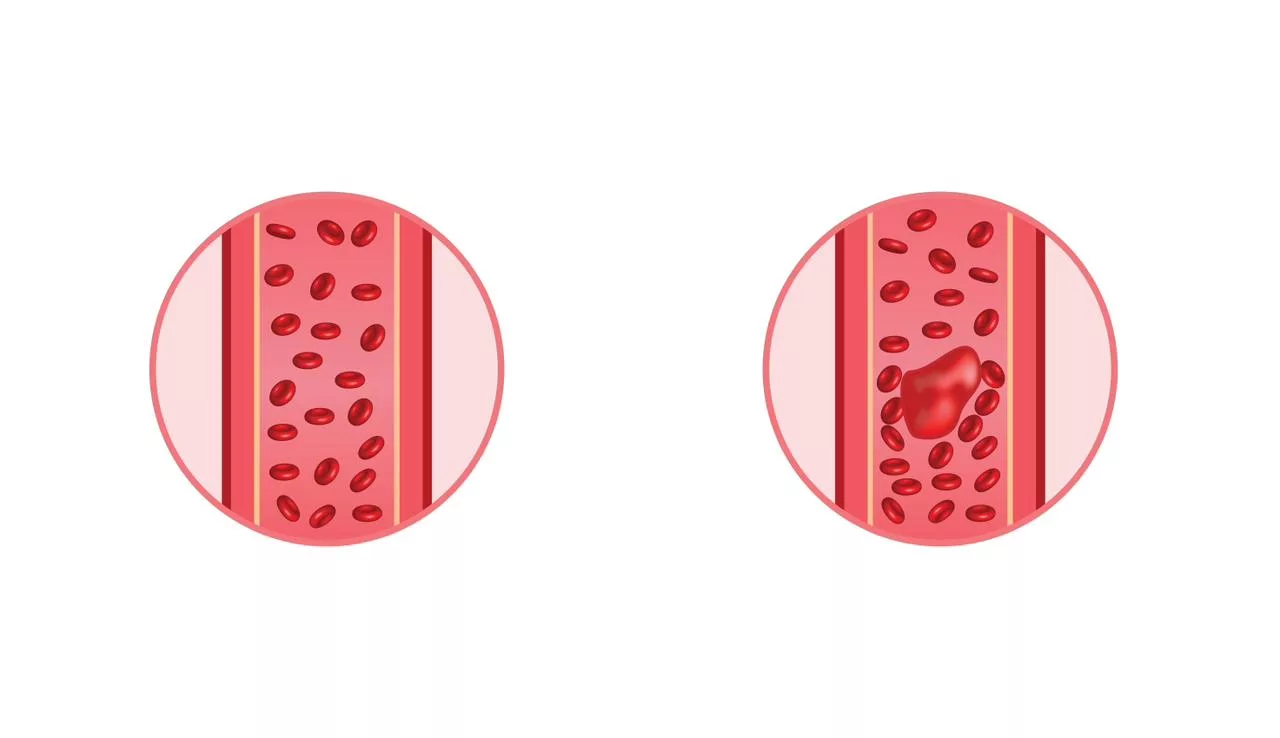
Thrombophlebitis Symptoms Care Thrombophlebitis is an inflammatory condition of a vein caused by a blood clot (thrombus). It most often refers to inflammation of superficial veins, while thrombosis of deeper veins is termed deep vein thrombosis (DVT). In superficial thrombophlebitis, the affected vein lies close to the skin surface, whereas in DVT, the clot develops in deeper veins within the muscle.[1] DVT carries a higher risk of serious complications, including pulmonary embolism. The common causes and risk factors include prolonged immobility, trauma, surgery, and underlying hypercoagulable states. Superficial thrombophlebitis is generally managed with anti-inflammatory treatment and sometimes anticoagulants, whereas DVT almost always requires anticoagulation. The annual incidence of venous thromboembolism (VTE), which includes both DVT and pulmonary embolism, is about 1 per 1000 individuals.[2] Superficial thrombophlebitis is more common but frequently underdiagnosed or underreported. Patients with this condition are also at increased risk of recurrent venous thromboembolic events.
Types of Thrombophlebitis: Thrombophlebitis Symptoms Care
Thrombophlebitis can occur in any vein of your body. Several named conditions in which thrombophlebitis occurs in a specific part or for a certain reason are:
Superficial Thrombophlebitis:
It happens in smaller veins of your legs or arms and is rarely severe. However, it can act as a sign that severe thrombophlebitis can occur and can also lead to other serious conditions.
DVT:
DVT happens when there is a blood clot in a major vein (usually in one vein). It can also lead to pulmonary embolism, so it needs immediate treatment.
Migratory Thrombophlebitis:
Migratory thrombophlebitis occurs when a blood clot and its associated inflammation initially affect one vein and then migrate to another. Sometimes the condition involves multiple clots and multiple veins at the same time. Also, the migration of a blood clot from a small vein to a larger one can put you at risk of severe complications. Migratory thrombophlebitis is strongly associated with underlying malignancy (Trousseau syndrome).
Septic Thrombophlebitis:
Septic thrombophlebitis occurs because of an infection. It often follows IV lines, catheters, or local infections. It can lead to serious conditions such as Lemierre syndrome (infection spread from the upper respiratory system to one of your jugular veins), pylephlebitis (inflammation of the portal veins), and septic embolism (septic clot breaks free from where it formed and gets stuck somewhere else in the body). This type of thrombophlebitis is especially dangerous as it can spread throughout the body.
Etiology & Risk Factors of Thrombophlebitis
Various risk factors can lead to thrombophlebitis. These include:
- Varicose veins (bulging, spider-like, or blue veins on your legs) are a great risk factor for thrombophlebitis.
- Reduced flow of blood due to immobility. There can be various reasons for prolonged immobility, such as general anesthesia, stroke, long flights, bed rest, and long surgical interventions. It has been observed that hospitalization longer than 72 hours and general anesthesia longer than 30 minutes are the transient risk factors for thrombophlebitis.[3]
- Anatomic variations in the venous anatomy.
- Hypercoagulation due to genetic deficiencies, such as antithrombin III deficiency, anticoagulation proteins S and C, and the factor V Leiden mutation.
- Increased venous pressure due to mechanical compression or functional impairment.
- Mechanical injury to the vein due to surgery, a peripherally inserted venous catheter, or intravenous drug abuse.
- Increased blood viscosity due to thrombocytosis, dehydration, and polycythaemia rubra vera.
- Infections, particularly bacterial, can precipitate thrombophlebitis, though viral causes are uncommon.
- Constitutional factors such as pregnancy, obesity, dehydration, oral estrogens, burns, smoking, and older age (above 60 years).[4]
- Predisposing medical conditions include inflammatory bowel diseases and systemic lupus erythematosus.
- Active cancers and specific medical conditions such as myocardial infarction, sepsis, heart failure, diabetes, hypertension, and nephrotic syndrome are persistent risk factors for this condition.
Pathophysiology of Thrombophlebitis
Superficial thrombophlebitis starts with microscopic thrombosis and subsequently forms macroscopic thrombi. In accordance with the Virchow triad, the main patho-physiological mechanisms of the condition include:
- Damage to the wall of a blood vessel (Endothelial Injury)
- Venous stasis
- Hypercoagulability
Formation of a blood clot is a protective mechanism to prevent the loss of blood and seal the damaged vessels. The whole mechanism of thrombophlebitis involves the role of venous flow, endothelium, leukocytes, platelets, and interactions between hemostasis and inflammation. When there is an alteration in the flow of venous blood, it triggers the endothelial activation.
There is a stimulation of the local cytokine production and adhesion of leukocytes and platelets to the endothelium. This process contributes to the activation of coagulation, trapping additional cells such as erythrocytes. Hence, this concerted interaction of these phenomena allows the formation and growth of the clot.[5]
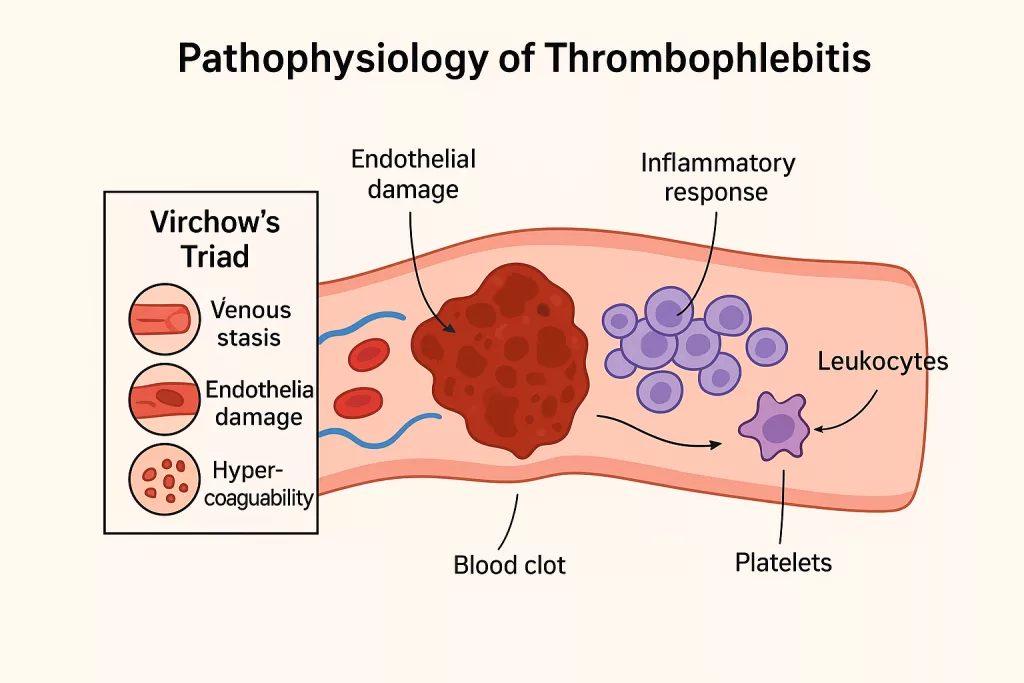
Illustration of thrombophlebitis pathophysiology with Virchow’s triad as the main cause of vein inflammation and clot formation.
Symptoms of Thrombophlebitis
Superficial thrombophlebitis typically presents with localized pain, tenderness, redness, warmth, and a firm palpable cord along the vein. DVT, in contrast, may cause diffuse limb swelling, pain, and heaviness, but can also be asymptomatic. The usual symptoms are listed below:
- Swelling is the most common symptom that appears suddenly. It appears in veins that are close to the skin. Visible swelling can even occur in the deeper veins. When there is more than one clot, there will be multiple swollen sites or bumps at the locations of the clots.
- Veins with clots, blockage, or inflammation feel firmer than normal veins.
- There is a palpable cord.
- The area around the clot feels sore, tender, and painful. In case of multiple clots, pain can be more severe.
- The area near the clot appears reddish or darker in colour, similar to a bruise or rash.
- The areas near and above the clot feel warmer to the touch.
Diagnosis of Thrombophlebitis
A variety of tests are performed to make a diagnosis of this condition.
History & Physical Examination:
The patient presents a firm, tender, and erythematous fibrous cord. A discrete cord is palpable in some persons. Patients also present with hot and swollen legs. In a superficial condition, the acute onset of pain occurs over a previously varicose vein. Sometimes the condition is associated with warm erythema. Pain is localized over the site of the clot, and deep pain is more diffuse and common in the lower extremities. Doctors thoroughly review the family history. They inquire about a history or symptoms that suggest congestive heart failure or heart disease. A history of recent surgery, trauma, prolonged bed rest, and immobilization can indicate the suspicion of thrombophlebitis. Some other findings include dizziness, weight gain, and bilateral extremity swelling.
Imaging Tests:
Doppler or duplex ultrasound is the primary imaging test used for diagnosing the condition. It uses sound waves to view the flow of blood in the veins and detect blood clots. Typical findings include wall thickening of veins, absence or normal compressibility of the vein, and presence of a clot. Additionally, it also distinguishes between superficial thrombophlebitis and DVT.
Some less common imaging tests include venography, magnetic resonance imaging, or computed tomography. Later ones are used in complex cases to visualize the veins in deeper or less accessible areas, such as the pelvis or abdomen. Venography is invasive but considered the gold standard. It utilizes X-rays and contrast dye to view the veins.
Blood Tests:
Common blood tests include prothrombin time, complete blood count, activated thromboplastin time, and serum chemistry. These tests assess the clotting abnormalities or inflammation.
D-dimer Test rules out the risk of thrombosis or assesses the risk of recurrence. Elevated levels indicate the presence of broken products of the clot, which suggests thrombus formation. However, D-dimer can also be at high levels in other conditions. It is not reliable for isolated superficial thrombophlebitis but is useful for excluding DVT.[6]
Management & Treatment of Thrombophlebitis
Management and treatment of this condition include a combination of symptom relief, prevention of clot extension, and addressing the underlying causes.
Non-pharmacological Management or Supportive Treatment:
- Apply warm compresses to the affected area. It will reduce the pain and inflammation of the affected area.
- If the affected area is one of your limbs, mainly the leg, then elevating or propping that limb up can minimize the swelling.
- Mobilization and exercise can prevent clot extension and DVT.
- Use compression stockings to enhance the blood flow and reduce swelling.
Pharmacological Management:
Anticoagulants and Nonsteroidal anti-inflammatory agents (NSAIDs) are commonly used medications for thrombophlebitis. Doctors use antibiotics only in patients with a suspicion of infection.
NSAIDs
They reduce pain, swelling, and inflammation. Common examples include ibuprofen and naproxen. Topical NSAIDS or heparinoid creams also offer the benefits of local symptom relief.
Anticoagulants
- The healthcare providers recommend anticoagulants when thrombophlebitis extends beyond superficial veins, and in cases where there is a high risk of clot propagation and DVT.
- Doctors use low molecular weight heparin (LMWH) or fondaparinux (2.5 mg per day for 45 days).[7]
- Recommended anticoagulants in cases of elevated risk of extension include warfarin and rivaroxaban.
Surgery & Other Treatment Options:
Surgical intervention is rarely required today and is generally considered for severe or recurrent cases. Surgery can involve the following procedures:
- Mechanical thrombectomy is a procedure that involves small incisions. It allows the surgeons to remove the blood clot from the vein.
- Endovenous ablation techniques and catheter-directed thrombolysis may be used to remove or dissolve clots and restore venous flow..
- Vein stripping is another effective method. It involves a few incisions to access the problematic vein and disconnect it from the rest of the circulatory system.
- Sometimes the surgeons take another section of the blood vessel from elsewhere in the body and use it to craft a new bypass vessel. This process restores the proper blood flow. However, traditional surgical procedures such as vein stripping or bypass grafting are rarely performed now, as modern minimally invasive methods are preferred.
Prevention
You can avoid thrombophlebitis by following these precautionary measures:
- Quit smoking
- Do not sit for extended periods. Get up and move around during long flights, working hours, and even in leisure time.
- Stay hydrated by drinking enough fluid to help lower the risk of developing thrombophlebitis.
- If you have anticoagulants in your medication routine, then take them regularly. Quitting them can increase the risk of clot formation.
- Quitting intravenous recreational drugs can significantly lower the risk of developing this condition.
- Eating a healthy diet and staying active can help reduce the risk of developing several severe conditions, including thrombophlebitis.
- Monitor your health regularly.
Differential Diagnosis
Other disorders that can be misdiagnosed as thrombophlebitis include:
- Lymphedema
- Tendonitis
- Hematoma
- Thromboembolic diseases
- Lymphangitis
- Vasculitis
- Venous insufficiency
- Sport-related injuries[8]
Prognosis
The prognosis of thrombophlebitis depends on the underlying cause. The prognosis of a low-risk condition is generally favorable. There is a risk of recurrence. In high-risk patients, the overall prognosis is also good with appropriate treatment.
Thrombophlebitis versus Thrombosis
Thrombophlebitis is a condition that refers to the inflammation of a vein caused by a clot. It mainly affects the superficial veins but can also occur in the deep ones. On the other hand, thrombosis is a general condition in which a blood clot forms inside a vessel. The clot can partially or entirely block the blood vessel. It can be both superficial and deep. The key differences between these two conditions are summarized in Table 1.
Table 1: Key Differences between Thrombophlebitis and Thrombosis
| Aspect | Thrombophlebitis | Thrombosis |
|---|---|---|
| Statement | Inflammation of the vein with a clot. | Formation of a blood clot in the vessel. |
| Location | Mainly occurs in superficial veins. | It can be both superficial and deep. |
| Symptoms | SwellingRednessWarmth localized over the vein | Mostly asymptomatic, but can also cause pain and tenderness. |
| Causes of symptoms | A clot obstructs the blood flow. It can be potentially embolizing. | Usually less severe, but it can lead to DVT. |
| Seriousness | Usually less severe, but can lead to DVT. | It is a potential medical emergency. |
| Treatment Urgency | Often managed after treating symptoms. Patients require anticoagulation if they occur near deep vein junctions or are extensive. | This condition requires immediate hospital admission and anticoagulation. |
| Risk of severe complications | It is a low-risk disorder. Superficial conditions are less likely to cause pulmonary embolism. | It is a high-risk disease, especially in deep veins. There is a greater chance of developing pulmonary embolism. |
Final Remarks
Thrombophlebitis is an inflammatory condition that is triggered by a blood clot. The condition most often occurs in the blood vessels of the arms and legs. You must go to visit your healthcare provider immediately if you have symptoms of blood flow blockage. Thrombophlebitis can be a warning sign of more severe conditions. It is not very dangerous on its own, but you need to see a medical professional to identify the problem. However, in case of the appearance of severe symptoms, you need to seek immediate medical care. With accurate diagnosis and prompt interventions, thrombophlebitis is less likely to cause major problems.
References
[1] Raval, P., Thrombophlebitis, in Reference Module in Biomedical Research. 2014.
[2] Belcaro, G., et al., Superficial thrombophlebitis of the legs: a randomized, controlled, follow-up study. Angiology, 1999. 50(7): p. 523-529.
[3] Stubbs, M., M. Mouyis, and M. Thomas, Deep vein thrombosis. BMJ, 2018. 360.
[4] Waheed, S.M., P. Kudaravalli, and D.T. Hotwagner, Deep vein thrombosis. 2018.
[5] Navarrete, S., et al., Pathophysiology of deep vein thrombosis. Clinical and experimental medicine, 2023. 23(3): p. 645-654.
[6] Nasr, H. and J. Scriven, Superficial thrombophlebitis (superficial venous thrombosis). BMJ, 2015. 350.
[7] Di Nisio, M., I.M. Wichers, and S. Middeldorp, Treatment for superficial thrombophlebitis of the leg. Cochrane Database of Systematic Reviews, 2018(2).
[8] Taute, B.-M., H. Melnyk, and H. Podhaisky, Alternative sonographic diagnoses in patients with clinical suspicion of deep vein thrombosis. Medizinische Klinik (Munich, Germany: 1983), 2010. 105(9): p. 619-626.