

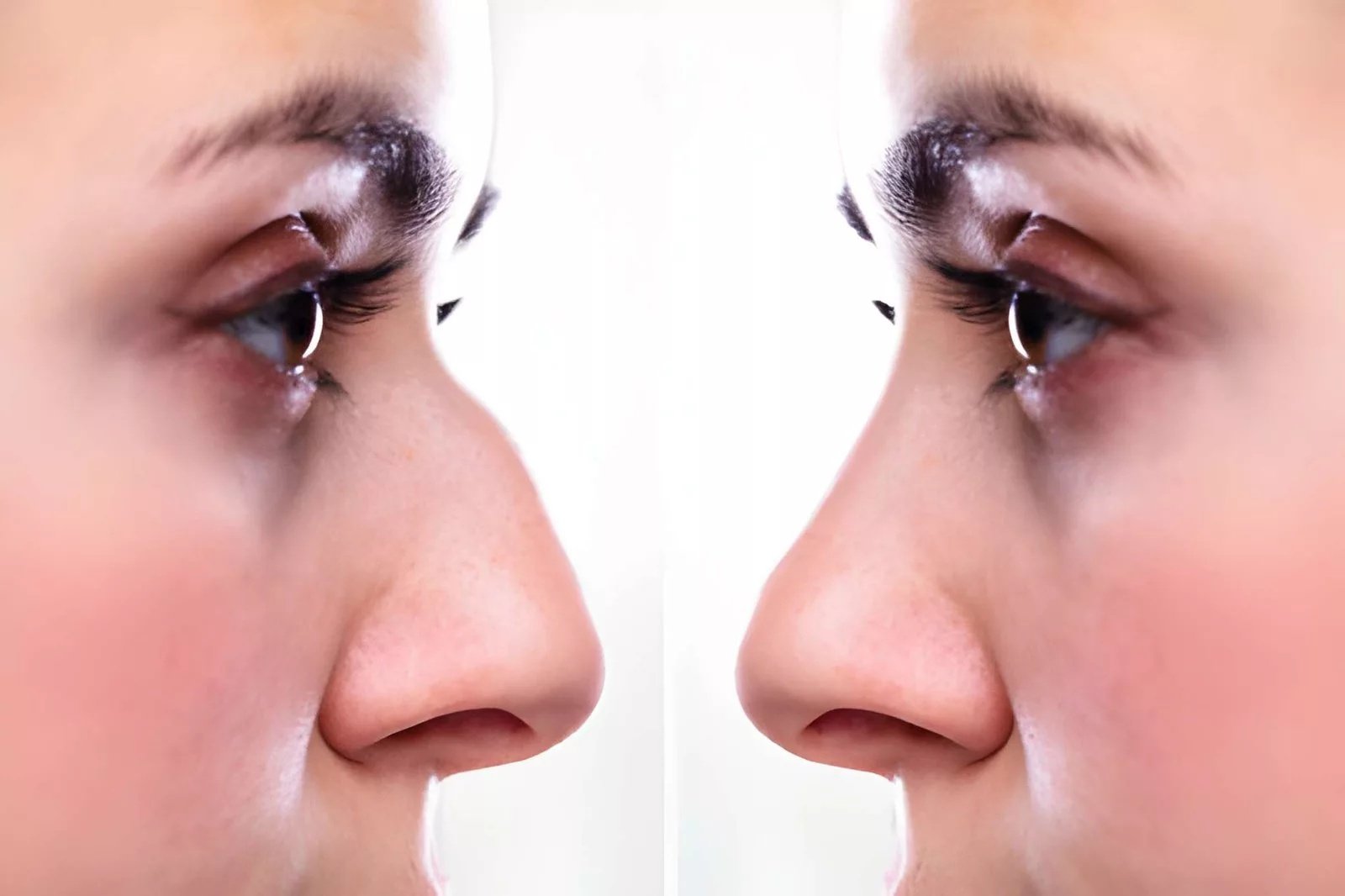
Rhinoplasty Everything You Rhinoplasty is much more than a nose job; it is a highly intimate practice that borders on art and science. Whether you want to improve breathing, enhance facial harmony, or restore your nose after an injury, choosing to reshape your nose is a significant decision. It is all about having a balance between the form and the aesthetics, making sure that the form precedes the function. An expert surgeon does not simply change a feature; rather, they make it perfect to match your face. After all, rhinoplasty does not involve perfection, but rather being comfortable, breathing easier, and looking at the mirror without losing yourself.
What Is Rhinoplasty?: Rhinoplasty Everything You
Rhinoplasty is a surgical procedure that can be performed to change the shape, size, or structure of the nose. The word comes into being out of Greek rhinos (nose) and plassein (to shape). Some individuals seek cosmetic rhinoplasty in order to make their nose look better. Others do a functional rhinoplasty, which involves the enhancement of breathing and the functions of the nose.
The majority of people refer to it by a much simpler name. Rhinoplasty is popularly referred to as a nose job. The third most popular type of facial plastic surgery is a rhinoplasty, with almost 45 000 in the United States in 2022, as estimated by the American Society of Plastic Surgeons.[1] That number provides you with an idea of the popularity of this surgery.
Why Do People Undergo Rhinoplasty?
There are many reasons why people are considering rhinoplasty. Some are cosmetic. Others are medical. Common reasons include:[2]
- Correcting a birth defect or congenital abnormality.
- Procedure to repair a broken or fractured nose.
- Surgical intervention to fix a deviated septum to assist breathing.
- Making the dents or sunken areas on the nose bridge smoother.
- To bend a broad, bulbous, drooping, or upturned tip.
- Dilation or constriction of the nostrils.
- To recover the nose after a wound or disease.
Rhinoplasty reconstructs the nose and may help right a bulbous, upturned, hooked, or droopy nose. It is also able to correct nostrils that are overly wide, overly narrow, or upwardly turned.
A nose job is not always about vanity. It is the desire of many to breathe better or correct a structural defect they were born with.
Types of Rhinoplasty
There is no single type of nose job. Depending on what has to change, the right approach varies.
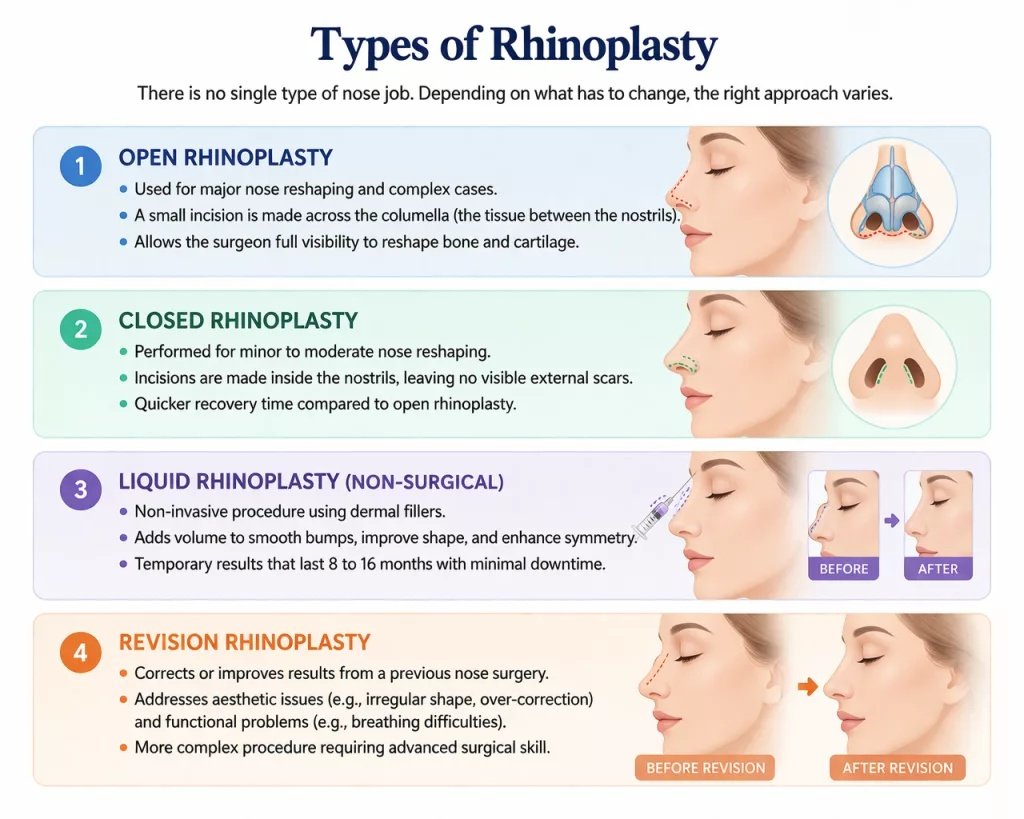
Types of Rhinoplasty: Open, Closed, Liquid, and Revision Techniques.
1. Open Rhinoplasty
Open rhinoplasty is applied in major nose reshaping. Incisions are made by the surgeon to completely separate both the nose skin and bone and cartilage. This is to give a clear view of the underlying anatomy. It is more suitable for complex cases.[3]
2. Closed Rhinoplasty
Closed rhinoplasty is a minor nose reshaping surgery. In the nose, the surgeon cuts to separate the skin and the bone and cartilage to reform it. External scars are not evident. Recovery time tends to be shorter.
3. Liquid Rhinoplasty (Non-Surgical)
Not everyone wants surgery. Liquid rhinoplasty is a non-invasive surgical procedure that can correct the size, shape, and symmetry of the nose with the help of a dermal filler. Fillers may be applied in order to improve contour or camouflage irregularities, such as a dorsal hump, by adding volume. Dermal fillers cannot reduce the size of the nose. These results are only temporary and can last between eight and 16 months. As it is a non-surgical procedure, downtime is very mild. But on the other hand, this procedure is not successful for structural problems, which are important to correct in breathing issues. If you’re looking to resolve crookedness, want to correct your breathing issues, or remove cartilage or bone, then go for traditional surgical rhinoplasty.[4]
4. Revision Rhinoplasty
Revision rhinoplasty is the second procedure done to patients who are not satisfied with the first nose surgery. It addresses both aesthetic concerns, such as over-correction or irregular shape, and functional issues. Such surgery is more complicated and more costly as a rule.[5]
Rhinoplasty Before and After: What to Expect
Among the common questions that have been asked by patients is: What will my nose look like after surgery? Before and after results of rhinoplasty are different in individuals.[6]
You will have a pre-operation meeting with your surgeon. In this appointment, your medical professional will inspect and scan your face and capture images. The two will negotiate about the surgery, its results, and risks. Digital imaging may be demonstrated to you as well to give you an idea of possible outcomes.
The changes will not be observed instantly after surgery. Swelling is normal. It takes the first four to six weeks before major improvements are noticed by most of the patients, although total recovery and final refinement may take six to twelve months or more as residual swelling subsides and tissues come to rest. The bridge and the end of the nose are the most difficult parts to perfect. Initial swelling takes several months to fade out, but even then, mild swelling stays, which resolves in a year.
As mentioned, your surgeon took images before the procedure, now you can compare with the after photos to have an idea about what has been done. Another piece of advice is to look at several pics of those who have the same structure as yours during your meetings with the surgeon.
The Rhinoplasty Procedure: Step by Step
This is a simplified view of what transpires during surgery day.
- Consultation – Your surgeon looks at your objectives and evaluates your nose.
- Anesthesia – You may receive general anesthesia or local anesthesia with intravenous sedation.
- Incisions– The surgeon either has internal or external incisions according to the method.
- Reshaping– Cartilage and bone are modeled, excised or reinforced.
- Closure – Incisions are closed, and a splint is applied to support healing.
- Recovery begins – You go home the same day in most cases.
Rhinoplasty is typically an outpatient procedure. Someone needs to drive you home and stay with you overnight.
How painful is rhinoplasty?
The truth is that the majority of people cannot believe how easy the discomfort is. The actual process itself will be performed with anesthesia, making you feel nothing. Then it is no longer a sharp pain, but a deep, dull one, such as the stuffiness and pressure of an ill sinus cold. The initial two days are the most uncomfortable, and prescription medication takes care of it. After three or four days, the vast majority of patients are simply coping with congestion and a bit of soreness, but not actual pain.[7]
Recovery: Week by Week
Rhinoplasty recovery is a gradual process. If you try to speed up healing, it is more likely to diminish your results.[8]
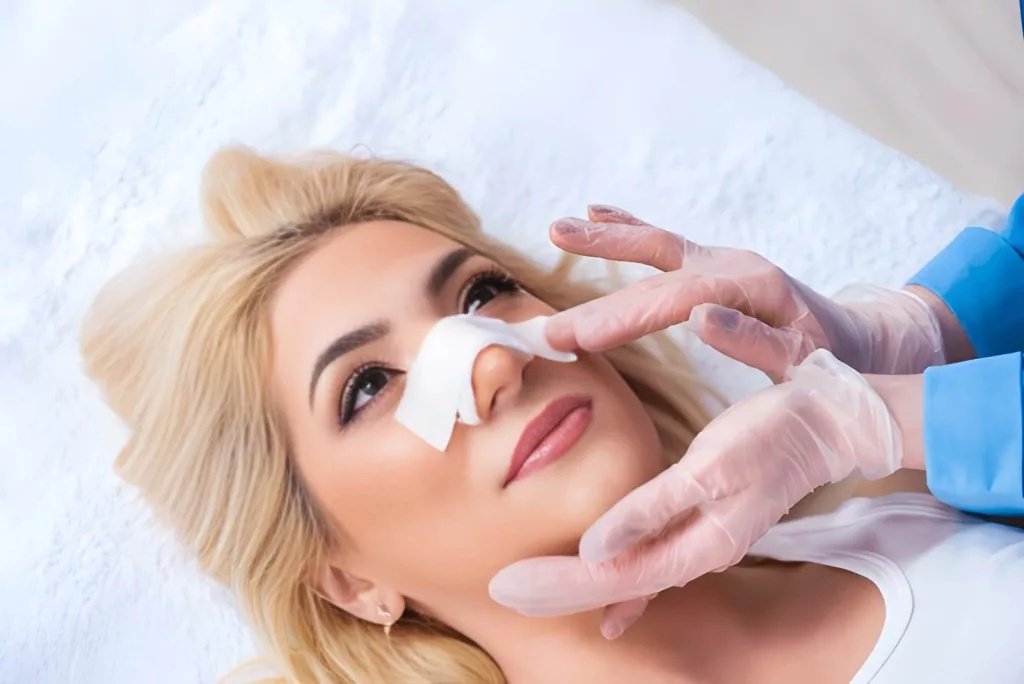
Postoperative care after rhinoplasty with a protective nasal dressing in place
As a general rule, all patients have some degree of bruising, swelling, tenderness, and nasal congestion during the rhinoplasty recovery period. All of these are normal during the recovery stage.
Here is a general rhinoplasty recovery timeline:
| Week | What to Expect |
|---|---|
| Week 1 | Splint on the nose, swelling and bruising at the highest point, sleeping at home |
| Week 2 | Bruising starts fading, splint is usually removed |
| Weeks 3–4 | Most visible swelling reduces, light activity resumes |
| Weeks 5–6 | Return to regular exercise is usually permitted |
| 3–6 Months | Nose shape becomes clearer, subtle swelling remains |
| 12 Months | Final results visible, complete healing achieved |
Research shows many patients can return to routine daily activity, including desk work, within about four days after surgery. More strenuous exercise should wait until four to six weeks or until cleared by a surgeon.
During rhinoplasty recovery, you should:
- Sleep with your head elevated
- Avoid blowing your nose
- Stay out of the sun
- Do not wear glasses that rest on the nose
- Attend all follow-up appointments
It is recommended that you avoid wearing glasses immediately after your rhinoplasty procedure. Any pressure from your frames can impact the healing process and potentially alter your results.
Procedure Cost: What Will You Pay?
Rhinoplasty cost varies quite a bit. There is no single price that applies to everyone.
The average cost of rhinoplasty is $7,637, according to the latest statistics from the American Society of Plastic Surgeons. This average cost does not include anesthesia, operating room facilities, or other related expenses.
According to recent data from the American Society of Plastic Surgeons, the average cost of rhinoplasty in 2025 ranges between $9,000 and $20,000 for primary procedures. For revision rhinoplasty, which involves correcting a previous surgery, the price often ranges from $15,000 to $35,000 or more.[9]
Several factors affect rhinoplasty cost:
- Surgeon’s experience – More skilled surgeons usually charge more
- Geographic location – Costs are higher in major cities
- Type of procedure – Revision rhinoplasty costs more than primary surgery
- Anesthesia and facility fees – These are usually billed separately
For those who want a less costly option, liquid rhinoplasty is much more affordable. The national average cost for a liquid rhinoplasty is $1,456, but the cost ranges between $500 and $5,500.
Rhinoplasty is not typically covered by health insurance unless it is correcting a functional problem or a defect caused by disease or facial injury. In those cases, insurance may cover part of the cost.
Complications: What Are the Risks?
Like any surgery, a nose job carries certain risks. Most are rare. Knowing them helps you make a smarter choice.
A study of 4,978 patients who underwent rhinoplasty reported the rate of major complications to be just 0.7%. Hematoma, infection, and pulmonary complications were the most common.[10]
Common rhinoplasty complications include:
- Bleeding or hematoma (blood pooling under the skin)
- Infection
- Breathing difficulties post-surgery
- Asymmetrical healing
- Scarring or skin changes
- Numbness around the nose or tip
Numbness after rhinoplasty in certain areas is frequent. The nasal tip and the inferior part of the columella are often involved. Normally, sensitivity recovers within 12 months.[11] More serious but rare rhinoplasty complications include:
- Septal perforation (a hole in the nasal septum)
- Skin necrosis
- Damage to surrounding structures
The likelihood of severe complications remains low, especially when patients select qualified surgeons and adhere strictly to pre- and post-operative instructions.
Revision surgery may also be needed in some cases. Postoperative deformities are considered the main risks of rhinoplasty, causing revision surgery in 5% to 15% of cases. This is one reason why choosing the right surgeon matters so much.
Liquid Rhinoplasty vs. Surgical Rhinoplasty
Still deciding between the two? Here is a quick comparison.[12]
| Feature | Liquid Rhinoplasty | Surgical Rhinoplasty |
|---|---|---|
| Invasiveness | Non-surgical | Surgical |
| Anesthesia | None needed | Local or general |
| Recovery time | Minimal (hours) | Weeks to months |
| Results | Temporary (8–16 months) | Permanent |
| Cost | $500–$5,500 | $6,000–$20,000+ |
| Suitable for | Minor shape adjustments | Major reshaping or functional repair |
| Breathing issues | Cannot fix | Can fix |
If you don’t want to go for surgery and try some changes before it, the Liquid rhinoplasty is a good option for you. But it can help you with only minor corrections. However, it cannot reduce the size of the nose or fix structural problems.
Who Is a Good Candidate for Rhinoplasty?
Not everyone is perfect for a nose job. Good candidates generally:[13]
- Are in good overall physical health
- Have a realistic knowledge of results
- Are non-smokers or willing to quit before surgery
- Are adults whose facial growth is complete (usually after age 15–16 for girls and 17–18 for boys). Surgery may also be conducted sooner, where necessary, in case of functional problems such as breathing difficulties.
- Want the procedure for personal reasons, not outside pressure
All these would be evaluated by your surgeon during your meeting.
Choosing the Right Surgeon
The success or failure of your results depends on the kind of surgeon you select. Look for:[14]
- Board certification in plastic or facial plastic surgery
- Specific experience and training in rhinoplasty
- A portfolio of before and after results
- Open discussion of risks and expectations.
Rhinoplasty has very rare, serious, or persistent side effects, and most of these can be prevented by selecting a very competent, well-trained, and board-certified plastic surgeon. Question about the number of rhinoplasties that your surgeon does annually.
Final Thoughts
Rhinoplasty is among the most transformative, sophisticated cosmetic surgery procedures. You desire a slight retouch or something more important like a structural adjustment, and some choices can satisfy virtually anyone. The low-risk entry point is with liquid rhinoplasty. Rhinoplasty surgery provides permanent outcomes to willing individuals.
The recovery of rhinoplasty is slow. It also takes even longer to see results. In the case of most patients, it is well worth the wait. The trick is to have a realistic expectation, get a competent surgeon, and allow your body time to heal appropriately.
Consultation is the first step if you’re going for a nose job. Ask questions. See before and after photos. The more you are informed, the better the experience is going to be.
References
[1] Tasman, A. J. (2007). Rhinoplasty – indications and techniques.GMS Current Topics in Otorhinolaryngology – Head and Neck Surgery, 6, Doc09. PMC2651560
[2] Çakır, B., Doğan, T., Öreroğlu, A. R., & Daniel, R. K. (2012). Rhinoplasty: Surface aesthetics and surgical techniques.Aesthetic Surgery Journal, 32(2), 195–217.
[3] Gupta, R., John, J., Ranganathan, N., Stepanian, R., Gupta, M., Hart, J., Nossoni, F., Shaheen, K., Folbe, A., & Chaiyasate, K. (2022). Outcomes of closed versus open rhinoplasty: A systematic review.Facial Plastic Surgery, 49(5), 569–579.
[4] Song, D., Wang, X., & Yu, Z. (2024). Nonsurgical rhinoplasty: An updated systematic review of technique, outcomes, complications, and its treatments.Aesthetic Plastic Surgery, 48, 4393–4406.
[5] Neaman, K. C., Boettcher, A. K., Do, V. H., Mulder, C., Baca, M., Renucci, J. D., & VanderWoude, D. L. (2013). Cosmetic rhinoplasty: Revision rates revisited.Aesthetic Surgery Journal, 33(1), 31–37
[6] Hassan, Y., Leveille, C. F., Gallo, L., Santos, J., Thoma, A., McRae, M. H., & McRae, M. C. (2020). Reporting outcomes and outcome measures in open rhinoplasty: A systematic review.Aesthetic Surgery Journal, 40(2), 135–146.
[7] Bhattacharya, S. (2008). Rhinoplasty: A functional approach.Indian Journal of Plastic Surgery, 41(Suppl), S20–S26. PMC2825048
[8] Mohan, R., Bhama, P. K., & Bhama, J. K. (2019). Evidence-based practices in postoperative rhinoplasty care.Facial Plastic Surgery & Aesthetic Medicine, 21(4), 251–259
[9] Zimmo, N., & Zimmo, M. (2021). Adult knowledge about postoperative complications of rhinoplasty in the Western Region of Saudi Arabia.Healthcare, 11(8), 1088.
[10] Layliev, J., Gupta, V., Kaoutzanis, C., Winocour, J., Yeslev, M., Grotting, J. C., & Higdon, K. K. (2017). Incidence and preoperative risk factors for major complications in aesthetic rhinoplasty: Analysis of 4978 patients.Aesthetic Surgery Journal, 37(7), 757–767.
[11] Jaberoo, M. C., Hassan, A., Pulido, M. A., & Saleh, H. A. (2016). A twin-center study of nasal tip numbness following septorhinoplasty or rhinoplasty.Ear, Nose & Throat Journal, 95(2), E1–E5.
[12] Bertossi, D., Giampaoli, G., Verner, I., Pirayesh, A., Nocini, R., & Nocini, P. (2019). Complications and management after a nonsurgical rhinoplasty: A literature review.Dermatologic Therapy, 32(4), e12978.
[13] Sinno, S., Mehta, K., Lee, Z. H., Kidwai, S., Saadeh, P. B., & Pearle, A. D. (2016). Objective assessment of the ideal nasal tip aesthetic and position.Plastic and Reconstructive Surgery, 137(1), 74–82.
[14] Rohrich, R. J., & Ahmad, J. (2011). Rhinoplasty.Plastic and Reconstructive Surgery, 128(2), 49e–73e. https://doi.org/10.1097/PRS.0b013e31821e7191. PMID: 21788838