


Viral Arthritis Post Viral arthritis is a temporary form of joint inflammation that occurs when your body fights off a viral infection. In contrast to chronic cases of arthritis, viral arthritis is usually self-limiting and therefore disappears after a few weeks as the infection clears.
What is Viral Arthritis?: Viral Arthritis Post
Viral arthritis is the pain, swelling, and inflammation in the joints, which appear as a side effect of a viral infection in your body. You can imagine that it is the reaction of your immune system to combating of a virus, and sometimes this reaction leads to a temporary inflammation of your joints.[1]
Viral arthritis is also known as post-viral arthritis because joint symptoms may appear during or shortly after a viral infection. Although numerous individuals have been infected with viruses, only a very small proportion acquire viral arthritis as a complication. Studies suggest that viral infections account for a small percentage of acute arthritis cases, though the exact proportion varies by population and outbreak patterns.
Compared to the other forms of arthritis that you might have heard of, the viral arthritis possesses three key traits:
- It is inflammatory: The inflammatory condition is caused by your immune system, and it combats the virus, which impacts your joints.
- It is acute: It means that it occurs suddenly and does not last long as compared to chronic arthritis conditions.
- It is generalized: It will generally manifest in more than just one joint in your body, but in various parts.
The positive thing is that viral arthritis is not permanent. When your body is healing from a viral infection, arthritis tends to wipe out too, without destroying your joints.
Viral Arthritis Causes
Arthritis can be triggered by many different viruses as the body reacts to them. The most common culprits include:
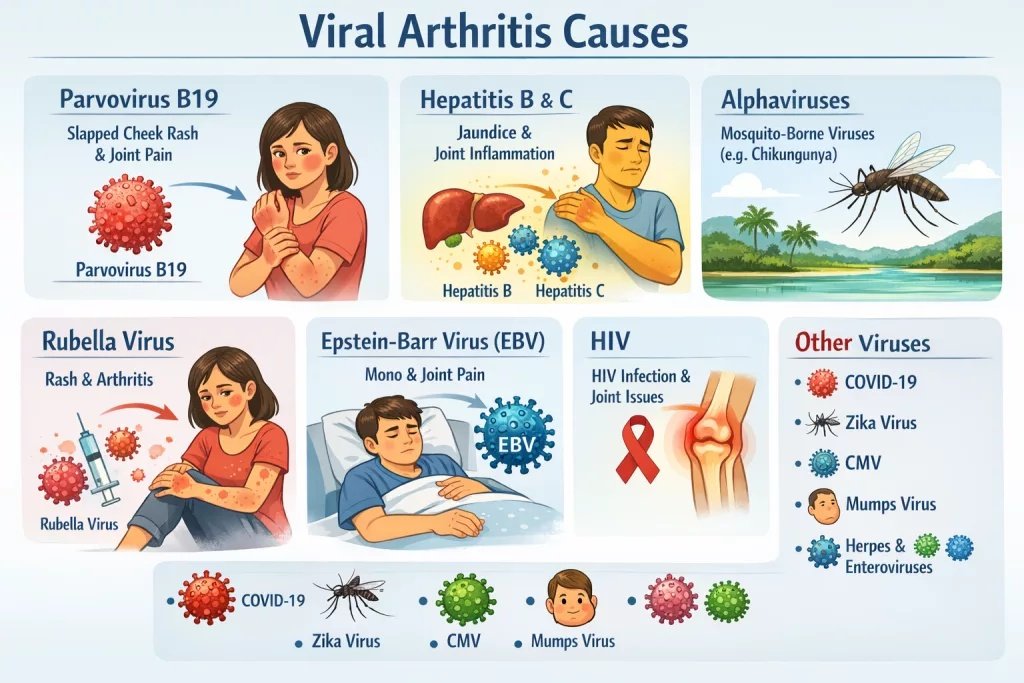
Common viruses that can trigger viral arthritis and joint inflammation.
Parvovirus B19:
The viral cause of arthritis is the Parvovirus B19, which is very common, particularly among adults. It is a virus that causes fifth disease or erythema infectiosum, which mostly occurs in children and is characterized by a slapped cheek rash. While children can occasionally develop joint symptoms, arthritis is far more common and more severe in adults. The study shows that up to 60% of the adults who are infected have joint symptoms. The illness is prevalent most among those people who see children regularly, i.e, school teachers or pediatric nurses.[2]
Hepatitis Viruses:
Viral arthritis is also commonly caused by hepatitis B and C, which causes 20-25 percent of viral arthritis. The one that tends to appear during the acute development of the infection is Hepatitis B-related arthritis, and can be accompanied by jaundice. Hepatitis C can cause acute and chronic arthritis, and could be associated with other complications such as cryoglobulinemia.[3]
Alphaviruses:
Mosquito-borne viruses are some of the viruses that would fall into this category and result in a major symptom such as arthritis. The most notable is the Chikungunya virus (CHIKV) that has caused epidemics in the Caribbean, Asia, and Africa. The other alphaviruses include Barmah Forest virus, Sindbis virus, and Ross River virus. These viruses may lead to the development of severe joint pains and, in other cases, permanent arthritis, which may still be experienced for months or even years.[4]
Rubella Virus:
Rubella was also a common viral infection before the mass vaccination. It is a female-dominant infection, which is transmitted through the respiratory droplet. There is a possibility that arthritis is a consequence of natural rubella infection and a mild and transient response to the rubella vaccine.[5]
Epstein-Barr Virus (EBV):
The EBV, which causes infectious mononucleosis, may rather be the cause of joint pains than arthritis. The arthritis thus developed is typically self-limiting and involves large joints.[6]
HIV:
Arthritis related toHIV can take place at any level of infection. The trend resembles other viral arthritis: the onset of acute, brief, and possibly recurrent, it may not be accompanied by erosive joint alterations.[7]
Other Viruses:
Other viruses that may result in arthritis are:
- COVID-19: New information on SARS-CoV-2 has revealed that some patients have inflammation of the joints.[8]
- Zika virus
- Mumps virus
- Cytomegalovirus (CMV)
- Herpes viruses
- Enteroviruses
The mechanism of its occurrence is not quite well known; however, it is supposed that the viral arthritis comes about as a consequence of the reaction of your immune system to the virus, because of which the inflammation spreads to the joints. In some cases, immune complexes (antibodies bound to viral particles) deposit in the joints, while in others, certain viruses, particularly alphaviruses, may directly infect joint tissues, leading to inflammation.
Viral Arthritis Symptoms: What to Expect?
The manifestation of viral arthritis is normally abrupt, with a few hours or days following the manifestation of other viral symptoms. The following is what you may have:[9]
Joint-Related Symptoms:
- Pain in multiple joints (polyarticular arthritis)
- Swelling and stiffness in affected joints
- Heat or erythema over joints
- Reduced range of motion
Most commonly affected joints are the hands, wrists, knees, and ankles
Accompanying Viral Symptoms:
- Fever
- Fatigue and a general feeling of being unwell
- Rash (depending on the virus)
- Muscle aches
- Headache
- Sore throat or respiratory symptoms
The typical viral symptoms are usually followed or preceded by the joint symptoms. To illustrate, when someone has parvovirus B19, a typical feature of this viral infection is the so-called slapped cheek rash and subsequent joint pain and swelling.
How Do Doctors Diagnose Viral Arthritis?
Viral arthritis can be difficult to diagnose since its symptoms are similar to those of other forms of arthritis. The following methods help make a correct diagnosis:
Clinical Evaluation
Your doctor will ask you about:
- Exposures or viral diseases in the recent past
- History of development of the symptoms
- Which joints are affected
- History (of tropical viruses) Travel
- Vaccination history
Laboratory Tests
- Blood tests to detect certain viruses: Tests of antibodies (IgM and IgG) to find out whether there has been a recent or previous viral infection or not.[10]
- Complete blood count (CBC)
- Inflammatory markers: ESR (erythrocyte sedimentation rate) and CRP (C-reactive protein) as an indication of the level of inflammation.
- Rheumatoid factor and ANA tests: RF may be transiently positive at low levels in viral arthritis, while ANA positivity is less consistent and usually low-titer.
Imaging Studies
- Other causes of joint pain can be eliminated by X-rays or ultrasound.
- In viral arthritis, these usually present with the appearance of soft tissue swelling without joint destruction.
The diagnosis lies in the recognition of the pattern: the onset of joint symptoms in more than one joint, the onset of symptoms of a viral disease, and the lack of signs of chronic arthritis.
Viral Arthritis vs Rheumatoid Arthritis
It is the concern of many individuals that they may have rheumatoid arthritis (RA), a chronic autoimmune disease that causes joint pain.[11] Here’s how to tell them apart:
| Feature | Viral Arthritis | Rheumatoid Arthritis |
|---|---|---|
| Onset | Sudden (hours to days) | Gradual (weeks to months) |
| Duration | Temporary (days to weeks) | Chronic (lifelong without treatment) |
| Associated symptoms | Fever, rash, viral symptoms | Morning stiffness lasting >1 hour |
| Joint damage | No permanent damage | Progressive joint damage if untreated |
| Pattern | Multiple joints, often asymmetric | Typically symmetric (both sides) |
| Blood tests | Low or negative RF/anti-CCP | High RF and anti-CCP antibodies |
| Treatment response | Resolves on its own | Requires disease-modifying drugs |
| Prognosis | Excellent, full recovery | Requires ongoing management |
Notable Observation: Sometimes, viral arthritis may also present like RA, particularly when a low level of rheumatoid factor may be found in the state of viral infections. These antibodies, however, tend to fade away once the infection has been cleared, as compared to the true RA, where they last.
Treatment of Viral Arthritis: How to Deal with Your Symptoms?
The positive fact about the treatment of viral arthritis is that it is generally simple and aims at curing symptoms as your body combats the infection.[12]
First-Line Treatment:
- Over-the-counter pain relievers:
- Acetaminophen (Tylenol)
- Ibuprofen or naproxen
- Dosage instructions should always be following and you should see your doctor in case of kidney, liver, or stomach problems.
Supportive Care:
- Rest affected joints when they’re painful
- Icing helps decrease swelling
- Light exercises in the range of motion after the acute pain
- Drink a lot of water and sleep so as to support your immunity
When Additional Treatment May Be Needed:
- In severe cases, short courses of corticosteroids may be considered under medical supervision after infection-related causes are confirmed.
- There is no need for antiviral drugs, but they can be pondered in particular viruses such as hepatitis B or C.
- In case of the longer than anticipated persistence of symptoms, the physical therapy can assist.
What NOT to Do:
- Do not use any disease-modifying antirheumatic drugs (DMARDs) when dealing with RA- these will not work with viral arthritis.
- Aspirin should not be used in children during viral diseases because of the possibility of Reye syndrome.
- Do not disregard the worsening of symptoms, as well as those that do not disappear within several weeks.
Viral Arthritis Duration: How Long Does It Last?
The most frequently asked question by the patients is: How long will this last? This depends on the type of virus that has symptomatic effects on you.[13]
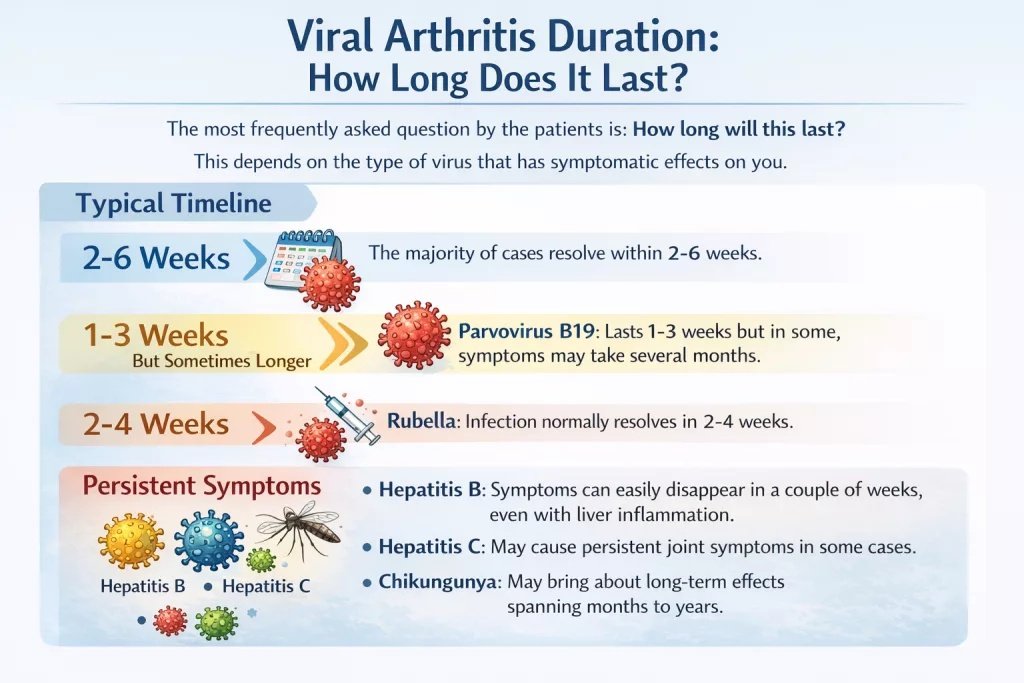
Typical duration and recovery timeline of viral arthritis by virus type.
Typical Timeline:
- The majority of the cases: 2-6 weeks to resolve.
- Parvovirus B19: It lasts 1-3 weeks, but in some individuals, symptoms may take several months.
- Hepatitis B: Symptoms can easily disappear in a couple of weeks, even in the case of liver inflammation.
- Hepatitis C: May cause persistent joint symptoms in some cases
- Chikungunya: It may bring about long-term effects in some patients that may span months to years.
- Rubella: The infection normally has a resolution in 2-4 weeks.
Factors Affecting Duration:
- The specific virus involved
- General wellness and immunity.
- Age: The symptoms tend to be long-term in adults as opposed to children.
- Prompt treatment of symptoms
The majority of people recover slowly throughout the course of several weeks. When the symptoms do not improve or get better after 6-8 weeks, see your doctor to eliminate other conditions.
Is Viral Arthritis Contagious?
It is a significant question with a subtle answer: The arthritis is not contagious, but the virus, which causes it, can be.[14]
Understanding Contagiousness:
- Arthritis cannot be contracted by a person with viral arthritis.
- Nevertheless, you can be infected with the virus that causes their arthritis.
- Once you contract that virus, you might or might not develop the symptoms of arthritis yourself.
Transmission Prevention:
- Practice good hand hygiene (wash hands frequently with soap and water)
- Do not be in close contact with individuals with active infections of viruses.
- Cover coughs and sneezes
- Do not share eating utensils, beverages, and personal things.
- Don’t go out when you are sick, as you will infect people.
Specific Virus Considerations:
- The parvovirus B19 is infectious before the development of rash and arthritis.
- Hepatitis B and C are transmitted in blood and body fluids, and not by chance.
- The viruses that are transmitted by mosquitoes (Zika, chikungunya) require the bite of a mosquito.[15]
When to See a Doctor?
Although viral arthritis is self-limiting, some cases need to be treated:
See Your Doctor If:
- The pain in the joints is almost unbearable or has a great impact on your day-to-day life.
- The symptoms continue after 6-8 weeks.
- You get feverish (more than 103degF /39.4 degC).
- Joints turn so very swollen, reddish, or hot.
- You are experiencing one swollen and painful joint (this may show bacterial infection).
- You acquire new symptoms, or already existing symptoms aggravate.
- You had some underlying health conditions with regard to your immune system.
Conclusion
Viral arthritis is a transitory disease that leads to joint pain and swelling during a viral infection or post-infection. It is usually self-limiting and can do no long-term damage. And these are the main differences between viral arthritis and chronic arthritis, including rheumatoid arthritis, particularly as the onset is acute, temporary, and the prognosis is excellent, and thus, on the occurrence of joint symptoms, you will need an appropriate diagnosis.
The majority of people are able to be cured in a couple of weeks, and it is accompanied by the intake of over-the-counter medications, rest, and other care. One must keep in mind that the virus can be contagious, but the arthritis is not, and, thus, proper hygiene can be used to ensure that you and others are safe.
You should not fear consulting your healthcare provider when you have pain in your joints and a viral issue since they will diagnose you properly and give you a treatment program that will assist you. Catching it early and managing it at the appropriate time may enable you to feel better sooner and give you the peace of mind of having your long-term joint health.
References
[1] Marks M, Marks JL. Viral arthritis. Clin Med (Lond). 2016 Apr;16(2):129-34. doi: 10.7861/clinmedicine.16-2-129.
[2] Reid DM, Reid TM, Brown T, Rennie JA, Eastmond CJ. Human parvovirus-associated arthritis: a clinical and laboratory description. Lancet. 1985 Feb 23;1(8426):422-5.
[3] Wands JR, Mann E, Alpert E, Isselbacher KJ. The pathogenesis of arthritis associated with acute hepatitis-B surface antigen-positive hepatitis. Complement activation and characterization of circulating immune complexes. J Clin Invest. 1975 May;55(5):930-6.
[4] Chang AY, Encinales L, Porras A, Pacheco N, Reid SP, Martins KA, et al. Frequency of chronic joint pain following chikungunya virus infection: a Colombian cohort study. Arthritis Rheumatol. 2018 Apr;70(4):578-584.
[5] Tingle AJ, Allen M, Petty RE, Kettyls GD, Chantler JK. Rubella-associated arthritis. I. Comparative study of joint manifestations associated with natural rubella infection and RA 27/3 rubella immunisation. Ann Rheum Dis. 1986 Feb;45(2):110-4.
[6] Rowe M, Young LS, Crocker J, Stokes H, Henderson S, Rickinson AB. Epstein-Barr virus (EBV)-associated lymphoproliferative disease in the SCID mouse model: implications for the pathogenesis of EBV-positive lymphomas in man. J Exp Med. 1991 Jul 1;174(1):237-47.
[7] Adizie T, Moots RJ, Hodkinson B, French N, Adebajo AO. Inflammatory arthritis in HIV positive patients: A practical guide. BMC Infect Dis. 2016 Mar 1;16:100.
[8] Parisi S, Borrelli R, Bianchi S, Fusaro E. Viral arthritis and COVID-19. Lancet Rheumatol. 2020 Nov;2(11):e655-e657.
[9] White DG, Woolf AD, Mortimer PP, Cohen BJ, Blake DR, Bacon PA. Human parvovirus arthropathy. Lancet. 1985 Feb 23;1(8426):419-21.
[10] Kandolf R, Kirschner P, Hofschneider PH, Vischer TL. Detection of parvovirus in a patient with “reactive arthritis” by in situ hybridization. Clin Rheumatol. 1989 Sep;8(3):398-401
[11] Masia R, Aparicio P, Canas F. High risk of misclassification of acute Parvovirus B19 infection into a systemic rheumatic disease. Rheumatol Adv Pract. 2024 Jun 7;8(3):rkae105.
[12] Sales GMPG, Barbosa ICP, Canejo Neta LMS, Melo PL, Leitão RA, Melo HMA. Treatment of chikungunya chronic arthritis: A systematic review. Rev Assoc Med Bras (1992). 2018;64:63-70.
[13] Chang AY, Hernández AS, Mejía JF, Tritsch SR, Mendoza-Torres E, Encinales L, et al. The Natural History of Post-Chikungunya Viral Arthritis Disease Activity and T-cell Immunology: A Cohort Study. J Cell Immunol. 2024;6(2):64-75.
[14] Anderson MJ, Higgins PG, Davis LR, Willman JS, Jones SE, Kidd IM, Pattison JR, Tyrrell DA. Experimental parvoviral infection in humans. J Infect Dis. 1985 Aug;152(2):257-65.
[15] Fonti M, Mader T, Burmester-Kiang J, Aberle SW, Horvath-Mechtler B, Traugott M, et al. Monkeypox associated acute arthritis. Lancet Rheumatol. 2022 Nov;4(11):e804.