
 in the large intestine of humans. It is...)
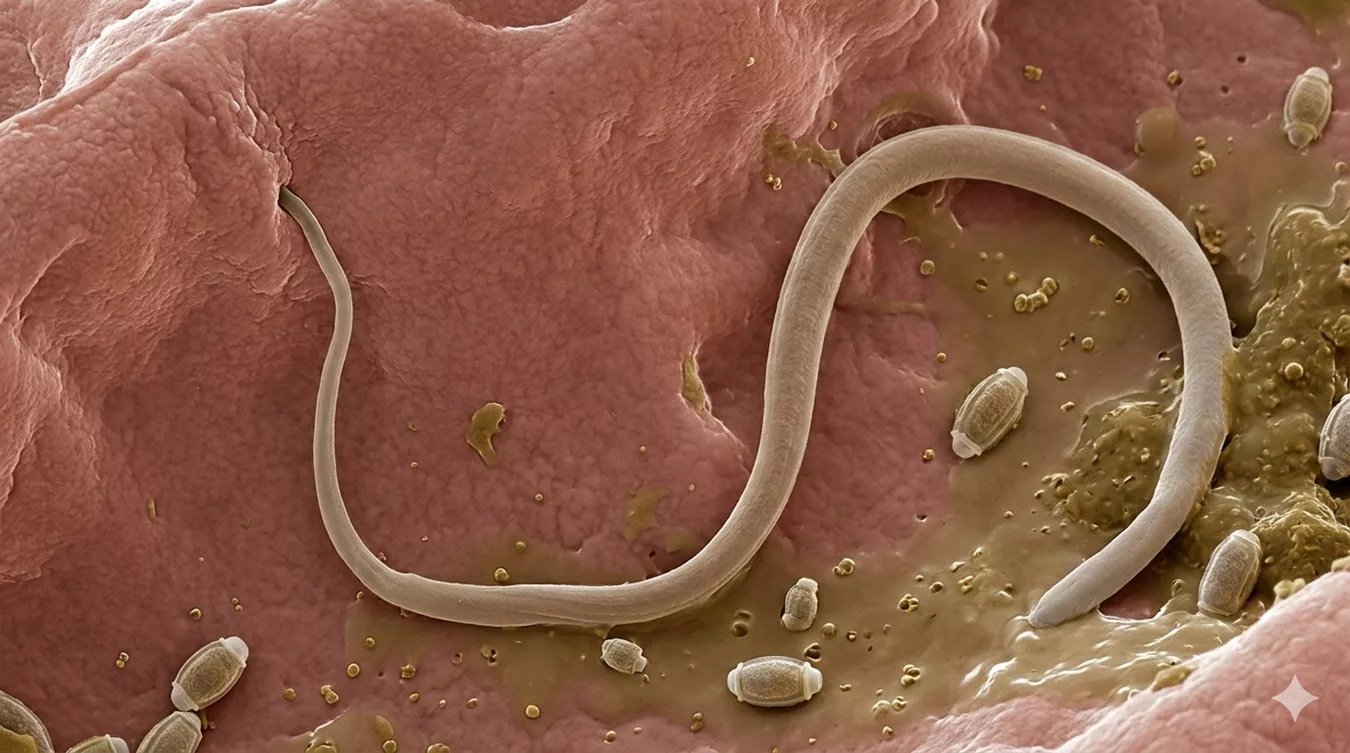
Whipworm Infection Trichuriasis Whipworm is a parasite that causes Trichuriasis (whipworm infection) in the large intestine of humans. It is transmitted when people ingest whipworm eggs from contaminated soil, food, water, or unwashed hands. Doctors diagnose it by detecting worm eggs in the stool using a microscope.
It is a very treatable condition, but if left untreated, it can cause significant complications. Therefore, proper treatment with antihelminth therapy is required in infected individuals. Besides treatment, we should also focus on preventive measures to reduce it to the lowest possible level.
What is Whipworm?: Whipworm Infection Trichuriasis
Whipworm is an intestinal parasite that causes Trichuriasis (whipworm infection). It is estimated that whipworm affects around 429 – 508 million people annually.Soil-Transmitted Helminths. 2024. About Whipworms.” style=”position:relative;color:#309b65;cursor:help;border-bottom:1px dotted #309b65;font-weight:bold”>[1] It is scientifically known as Trichuris trichiura. The worm belongs to the phylum Nematoda (roundworms). As the scientific name indicates, its genus name is Trichuris, and trichiura is its species name. They are among the soil-transmitted helminths because their eggs must first develop in soil before they cause disease in humans.
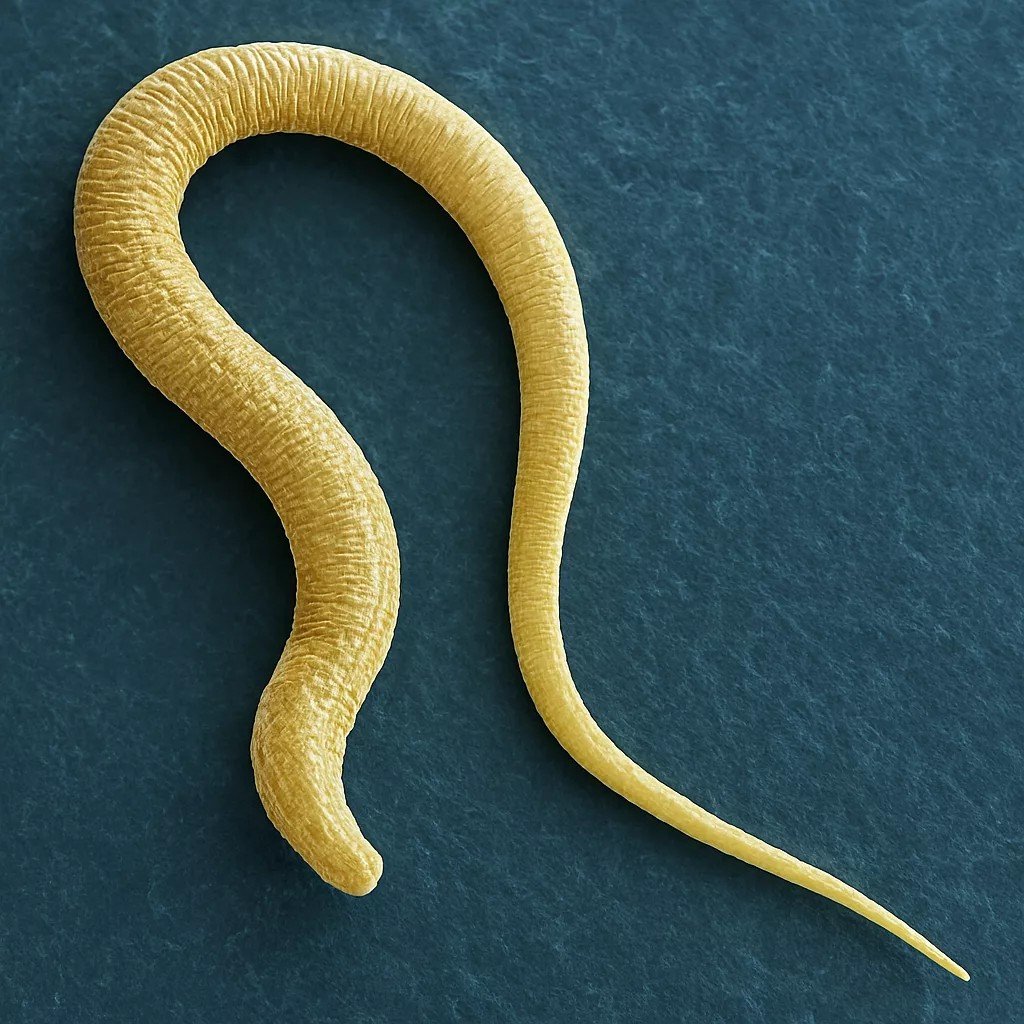
An illustration of whipworm
What Does the Whipworm Look Like?
The name “whipworm” comes from its whip-like appearance. The worm is thinner on the front 2/3rd like a thread. On the other hand, on the back 1/3rd, it is thicker like the handle of a whip. The size of the whipworm ranges from 3 to 5 cm in length.[2] The male is usually shorter than the female.
Who gets infected?
Whipworm usually infects school-going children between 5 and 15, especially those living in areas with poor sanitation. In these cases, human feces contaminate the soil and water with worm eggs. As children often play in soil, their chances of ingesting the worm eggs are higher, and hence they are usually infected.[3]
How do humans become infected?
The female worm lays around 3000-20,000 eggs per day.[4]As they are excreted in human feces (poop), they take around 10-21 days to mature. If other humans ingest these eggs from the environment, they can also get infected with whipworm. The worm lives in the large intestine and feeds on host tissue and secretions, causing disease in humans.
Life Cycle of whipworm
The life cycle of whipworm is quite simple, as it starts from eggs released in the stool. After a few weeks, the eggs mature, and on ingestion, they infect another host.
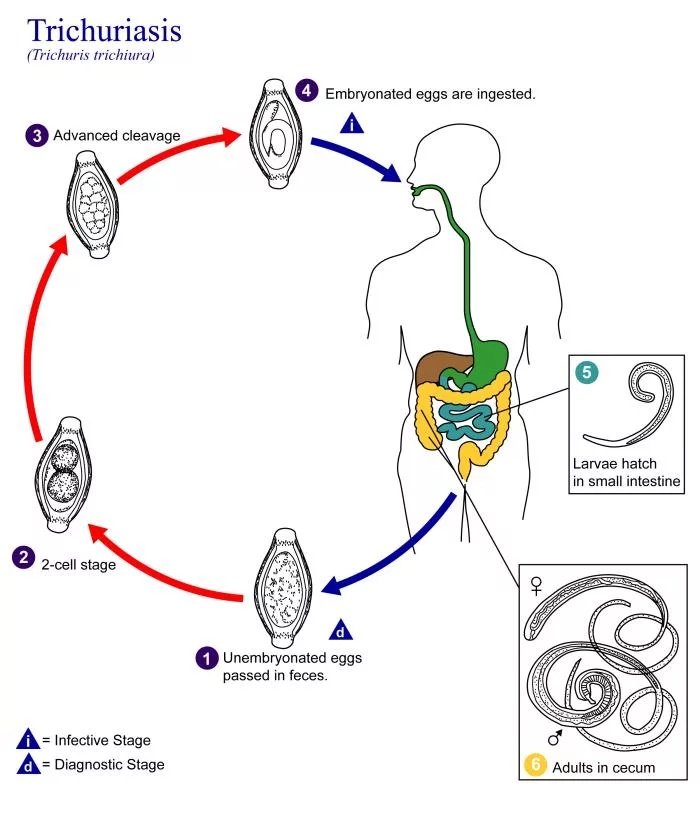
Illustration of the life cycle of whipworm. Public Domain image fromPHIL
Egg Release Stage
When someone is already infected with whipworm passes stool. The eggs in their stool go into the environment and contaminate the soil and water. The eggs are released in unembryonated (immature) form. It takes 2-3 weeks to get embryonated (mature).
Infective Stage
The embryonated eggs are capable of causing disease if someone ingests them. These eggs may stick to unwashed food, water, or dirty hands. Once they are ingested into the body, they can develop into larvae.
Larval Development in Humans
After ingestion, the eggs hatch into larvae in the small intestine. The larva is motile (able to move) and then migrates toward the cecum and large intestine, where they continue their development. At this stage, the host usually does not show symptoms.
Adult Worm in the large intestine
The larva develops into a full adult worm in the cecum and colon. As mentioned above, the worm has a thin front and a thick back portion. It embeds its thin part inside the intestinal wall while the thick portion hangs freely in the lumen. Here, the worm feeds and can live for years if not treated properly.[5] At this stage, the worm can cause disease symptoms such as abdominal discomfort, diarrhea, and anemia.
Egg Shedding & Environmental Contamination
Adult female whipworms can release thousands of eggs per day. These eggs leave the human body in feces and can potentially return to the soil. Without proper sanitation and hygiene measures, the cycle continues, infecting more people.
Risk Factors for Whipworm Infection
Anyone can be affected by whipworm, but some factors make it more likely to acquire it. They include:
- Open defecation and lack of sewage disposal
- Living in warm and humid areas
- Eating unwashed vegetables and poor hand hygiene
- Drinking contaminated water[6]
- Playing in contaminated soil
In short, anything that makes it more likely to come into contact with the worm eggs is a risk factor for whipworm infection.
But it should be noted that whipworm doesn’t directly spread from person to person through touching or sitting beside. Eggs passed in stool must mature in soil first to become infective, and it takes 2-3 weeks.
Symptoms of Whipworm Infection
The symptoms of the whipworm depend on the severity of the infection. Most of the people with whipworm infection don’t show any symptoms. While in some cases, it can cause serious complications.
Mild Infection
In mild cases, the infected individual may present with the following features.
- No obvious symptoms
- Vague abdominal discomfort
- Mild diarrhea
- Occasional stomach cramps
In these cases, the infection may go unnoticed for months or years. Although there are no strong symptoms, the parasite may still quietly affect nutrient absorption over time.
Moderate to Severe Infection
If the infection load increases, the patient may present with more severe symptoms such as
- Chronic diarrhea (with blood or mucus)
- Abdominal pain
- Nausea & Vomiting
- Painful defecation or tenesmus (straining during bowel movements)
- Frequent defecation
- Weight loss
- Anemia
- Headaches
- Reduced appetite
Complications (If untreated)
- Rectal Prolapse: It is a condition where part of the rectum slides out of the anus. It occurs mostly in children who are repeatedly straining to pass stool.
- Iron Deficiency Anemia: As mentioned above, serious infection can cause bloody diarrhea. Loss of blood from the body may cause iron deficiency anemia. It presents with pallor, weakness, and delayed development of the host.
- Stunted Growth: The worm feeds on the host and therefore may cause growth delay and affect both height and weight of the host.
Therefore, it is very important to maintain good hygiene and sanitation to prevent the occurrence of these complications.
Whipworm vs. Roundworm
Whipworm is a type of roundworm, but it gets its name from its special whip-like shape. Other roundworms include Ascaris and pinworm. Among these, Ascaris is the one most people simply call “roundworm.” Below is the comparison of whipworm and roundworm (Ascaris).

Image of Ascaris Lumbricoids, the causative agent of ascariasis
| Feature | Whipworm | Roundworm |
|---|---|---|
| Scientific Name | Trichuris trichiura | Ascaris lumbricoides |
| Phylum | Nematoda (roundworms) | Nematoda (roundworms) |
| Shape | Whip-shaped(thin front, thick back) | Long, cylindrical, like an earthworm |
| Size | Smaller (about 3–5 cm) | Larger (up to 15–35 cm) |
| Main Location in Body | Large intestine (colon) | Small intestine |
| Early Symptoms | Often mild or none | Ascaris can cause a cough during the lung migration phase |
| Severe Complications | Severe Whipworm can cause bloody diarrhea, anemia, and rectal prolapse (in children) | It can cause Intestinal blockage and malnutrition |
| Mode of Spread | It spreads from contaminated soil, food, or water | Similarly, it spread from Contaminated soil, food, or water |
Diagnosis of whipworm
Stool Microscopy
This is the primary and most common test to diagnose whipworm.[7] Your doctor will take a stool sample and examine it under a microscope for the presence of eggs. Whipworm eggs are barrel-shaped with characteristic bipolar plugs at both ends.
In mild infections, it may be difficult to detect the eggs in one test and may require multiple tests. In severe infections, a large number of eggs may be seen.
Complete blood count (CBC)
Your doctor may order a CBC to check for anemia and eosinophils (a type of white blood cell that rises in parasitic/worm infections).
Colonoscopy
Colonoscopy is not routinely required but may be used in severe infections. In this test, doctors insert a tube with a camera in the rectum through the anus. They are able to directly see worms attached at intestine wall. Also, a colonoscopy is helpful to rule out other conditions that present with similar symptoms.
When to seek medical care?
Mild whipworm infections may only cause a few or even no symptoms. Moderate to severe infections may present with serious symptoms. Seek medical attention if you or your child presents with the following:
- Persistent diarrhea
- Blood or mucus in stool
- Abdominal pain
- Unexplained weight loss
- Rectal prolapse (especially in children)
- Signs of anemia, i.e., pallor, weakness, fatigue
Children are more prone to these complications compared to adults. Therefore, make sure to consult your healthcare provider if you suspect these in your child.
Treatment of whipworm
First Line Management
The primary treatment of whipworm is anti-helminthic medications that target the parasite’s metabolism and survival. A 3-day course of therapy is given to ensure complete removal of the parasite from the body.
- Albendazole (400 mg once daily for 3 days)[8]
- Mebendazole (100 mg twice daily for 3 days)
They are safe for children of more than 1 year of age. However, if you are pregnant, you shouldn’t take it in the first trimester of pregnancy. Although you can use it in the 2nd and 3rd trimester if the benefits outweigh the risks, as per the WHO.
Severe Infections
When there is a severe infection, such as:
- Chronic diarrhea
- Anemia
- Rectal prolapse
- Growth retardation
Then doctors provide additional treatment such as:
- Iron supplements
- Nutritional support
- Treat dehydration with fluid intake
- Hospitalization in severe cases
Do whipworm infections resolve without treatment?
No, whipworm doesn’t go away by itself without proper anti-helminth therapy. Unlike self-limiting conditions, whipworms may live in the intestine for years. Without proper treatment, they will continue to cause damage to the host. Therefore, it is very important to promptly treat it and stop the transmission chain in the community as well.
Prognosis (outlook) of Whipworm Infection
Generally, the prognosis of whipworm in properly treated cases is excellent.[9] That means if you get appropriate treatment, you are very likely to fully recover. If you or your child doesn’t receive treatment, then it may cause complications in the long run.
How to Prevent Whipworm?
Whipworm is primarily transmitted due to poor hygiene and sanitation. Therefore, its prevention is mainly to adopt practices that reduce the transmission of worm eggs.
Hand hygiene
We should wash our hands before eating and after using the toilet. Washing hands reduces the chances of ingesting worm eggs if they stick to our hands. Similarly, we should supervise our children when they are playing, eating, and pooping.
Safe food practices
We can take safe food measures such as:
- Washing vegetables and fruits
- Properly cooking food
- Avoid eating raw
Sanitation & Toilet Use
As the primary source of infection is infected feces, it is very important to handle stool well. We should guide our children to use a toilet instead of open defecation.
Deworming Programs
In developing countries, mass deworming programs with albendazole and mebendazole are a very effective preventive method. These programs are a cost-effective way to significantly reduce the transmission chain of worm infestation.
Health education campaigns
These campaigns aim to teach healthy practices to the community. Creating awareness is really effective as it reduces stigma and encourages proper treatment and prevention.
Frequently Asked Questions (FAQ)
1. How long can whipworms live in the body?
If left untreated, whipworms have the potential to stay in the intestine and harm you for years.
2. Is whipworm dangerous?
If you have a mild infection, then it’s not dangerous at all; however, a heavy infection can cause serious complications. For example, bloody diarrhea, malnutrition, iron deficiency anemia, stunted growth, and rectal prolapse (in children).
3. Can adults get whipworm?
Yes. Anyone can get infected with whipworm. However, it is more common in children due to their frequent contact with soil and poor hand hygiene.
4. How soon do symptoms appear after infection?
Once infected with eggs, it can take weeks to months to develop into a fully mature worm. Symptoms may start to appear when there is a high load of whipworm, which is why it takes months before it causes problems
Wrap-up
Whipworm is a large intestinal parasite and causing Trichuriasis (whipworm infection). An already infected individual releases eggs in the stool. Children may ingest them due to their non-hygienic behaviour. Inside the intestine, it develops into an adult form. Usually asymptomatic, but may cause symptoms such as abdominal pain and bloody diarrhea in severe cases.
It is diagnosed using stool microscopy and treated with antihelminth medications. Whipworms have a good prognosis if treated properly; otherwise, they may cause complications. The best way to prevent it is to educate the community, practice cleanliness, and implement deworming programs.
References
[1] CDC. Soil-Transmitted Helminths. 2024. About Whipworms.
[2] Viswanath A, Yarrarapu SNS, Williams M. Trichuris trichiura Infection. In: StatPearls. Treasure Island (FL): StatPearls Publishing; 2025. PubMed PMID: 29939620.
[3] Trichuris trichiura – an overview. ScienceDirect Topics.
[4] Cleveland Clinic. What Is Whipworm?
[5] PhD SD. How Whipworms Tunnel Through the Gut. The Scientist.
[6] Silva NR de, Brooker S, Hotez PJ, Montresor A, Engels D, Savioli L. Soil-transmitted helminth infections: updating the global picture. Trends Parasitol. 2003 Dec 1;19(12):547–51. doi:10.1016/j.pt.2003.10.002. PubMed PMID: 14642761.
[7] Barda BD, Keiser J, Albonico M. Human Trichuriasis: Diagnostics Update. Curr Trop Med Rep. 2015 Dec 1;2(4):201–8. doi:10.1007/s40475-015-0063-x.
[8] Adegnika AA, Lötsch F, Mba RMO, Ramharter M. Update on Treatment and Resistance of Human Trichuriasis. Curr Trop Med Rep. 2015 Dec 1;2(4):218–23. doi:10.1007/s40475-015-0061-z.
[9] Whipworm infection: MedlinePlus Medical Encyclopedia.