

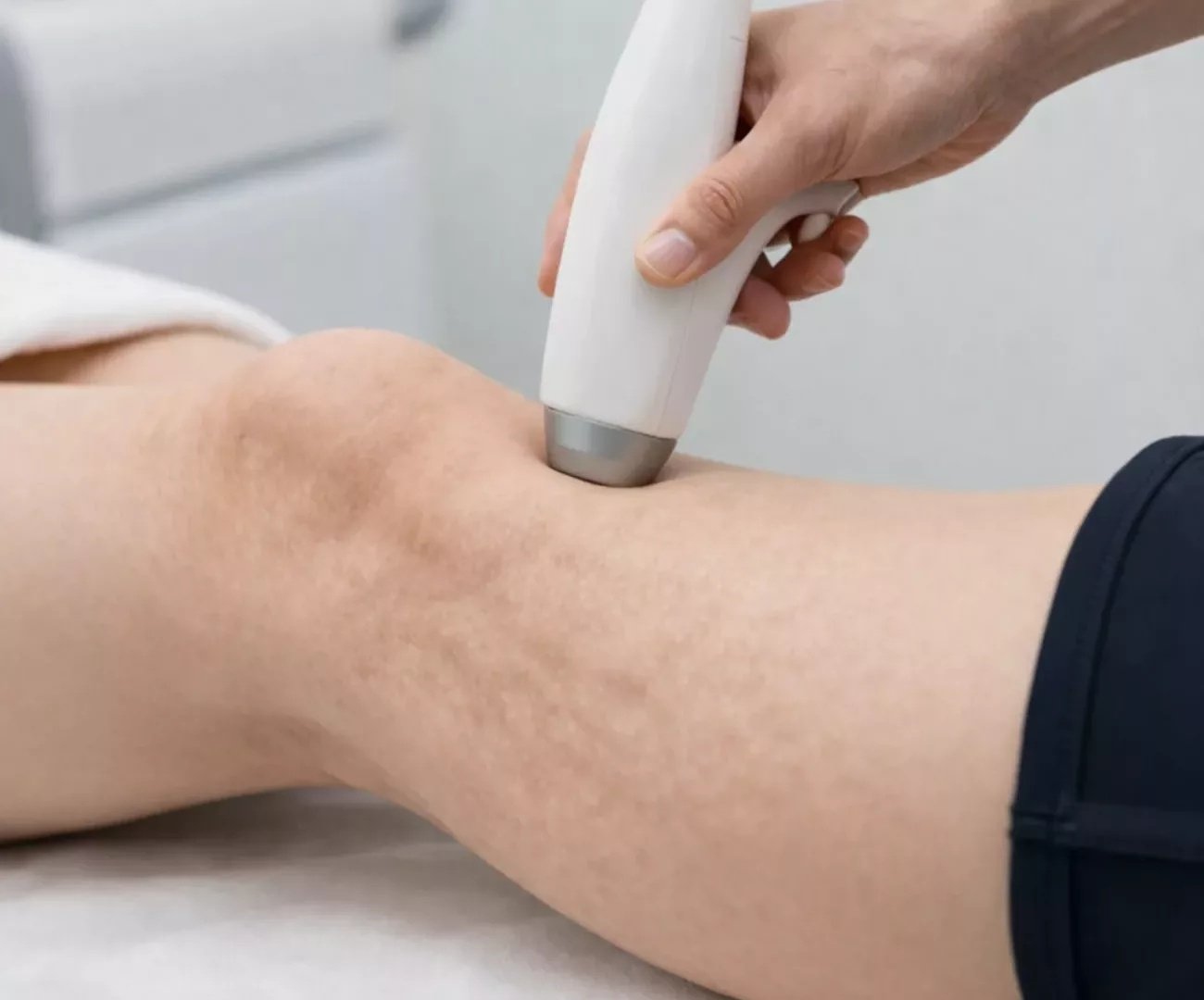
Cellulite It Happens Cellulite, also called Gynoid Lipodystrophy GLD, is defined as “a cosmetic condition characterized by the appearance of dimpled, lumpy skin on various areas of the body, particularly the buttocks, thighs, and abdomen. It occurs when fat deposits push through the connective tissue beneath the skin, creating an uneven surface.”[1] It is more prevalent in women due to the vertical arrangement of collagen fibers in the skin. Although it is harmless, it raises aesthetic concerns due to the lumpy appearance of the legs and buttocks. Your physician may manage it using non-invasive procedures, such as lasers or radiofrequency, or minimally invasive procedures like subcision, alongside lifestyle modifications.
Normal Anatomy of Our Skin:: Cellulite It Happens
To understand the mechanism of developing cellulite, one must understand the anatomy of our skin. Our skin has primarily three layers:Epidermis [Internet]. PubMed. Treasure Island (FL): StatPearls Publishing; 2024.” style=”position:relative;color:#309b65;cursor:help;border-bottom:1px dotted #309b65;font-weight:bold”>[2]
- Epidermis: It is the outermost layer, consisting of five layers of different types of cells, that helps make the epidermis waterproof. It is also responsible for giving our skin its color and protects our body from pathogens, UV rays, and injury.
- Dermis: It connects to the epidermis and is the second layer of the skin. It consists of two areas: the papillary dermis consists of loose connective tissue, whereas the reticular dermis is thicker, consisting of dense connective tissue that is made up of collagen fiber bundles. The dermis also contains blood vessels, sweat glands, sebaceous glands, hair follicles, hair, muscles, and nerves.
- Hypodermis: It is the deepest skin layer and contains adipose lobules, sensory neurons, blood vessels.
- Beneath the hypodermis is the “fascia.” This layer consists primarily of dense connective tissue, which comprises adipose tissue (fat cells) and collagenous fibers. There are fibrous septae (thick collagenous bands) running vertically from the dermal layer and connect onto the underlying fascia. These fibrous septae act as an anchor and a connection between the skin and the fascia.

Diagram showing the superficial and deep layers of mammalian skin with labels indicating relative depth. Image sourced from Doherty, S. P.Skin deep superficial. Wikimedia Commons, 23 January 2022. Licensed under theCC BY-SA 4.0license. Based on an original diagram by Sean P. Doherty, modified to indicate superficial and deep skin levels.
How Does Cellulite Develop?
Cellulite, as defined earlier, is the “lumpy,” “dimpled” or “orange-peel” appearance of the abdomen-thigh region. It is caused by multiple factors and has a complex etiology. Proposed mechanisms involve the subcutaneous adipose tissue, fibrous septae, microcirculation, and hormonal influences.
It is primarily caused by a combination of genetics, hormonal changes (especially estrogen), reduced skin elasticity with age, and structural differences in women compared to men. Collagen fibres (fibrous septae) in men are in a criss-cross pattern and placed at a 45-degree angle to the epidermis, whereas they are vertical in women. The vertical placement of fibrous septae in a woman’s skin causes the adipose tissue to bulge out from between the gaps present. The skin is anchored by the vertical fibrous septae, and the fat cells easily push up from between, consequently forming the “lumpy” effect.

Illustration demonstrating the proposed formation of cellulite within the subcutaneous tissue. The diagram highlights the interaction between skin, connective tissue septae, and underlying fat lobules, showing how weakening or structural alteration of fibrous bands, fat herniation toward the dermis, reduced microcirculation, and hormonal or inflammatory influences may contribute to the characteristic dimpled appearance of cellulite. Image sourced from Keegan Hurd, “Formation of Cellulite,” image published under the Creative Commons Attribution-ShareAlike 3.0 Unported (CC BY-SA 3.0) license, sourced fromWikimedia Commons.
Prevalence of Cellulite
Cellulite is more prevalent in women due to the structural difference of collagen fibers in the female skin, along with fat deposition in the buttocks/thigh area. Hormonal changes and estrogen stimulation, such as during pregnancy, can enhance the appearance of cellulite. About 90% of women undergo this condition at some point in their lives.
Men can experience cellulite, but it is very rare.
Grading of Cellulite
Cellulite is graded on a four-point scale, as follows:[3]
- Grade 0: No cellulite present. The skin is smooth in both standing and lying positions.
- Grade 1 (Mild): Skin is smooth when at rest, but dimpling appears when the skin is pinched or the muscle is contracted.
- Grade 2 (Moderate): Skin is smooth at rest (lying down), but dimpling appears when standing up.
- Grade 3 (Severe): Dimpling is visible at all times, including when at rest.

Close-up view of female hands gently compressing the thigh to demonstrate the characteristic dimpled “orange-peel” appearance of cellulite caused by underlying fibrous septae tethering the skin. This is considered Grade 1, since the dimpled skin is visible upon pinching the thigh. Image Credits: AI-generated medical illustration created for educational purposes, depicting the external appearance of cellulite on the female thigh.
How to get rid of Cellulite?
Due to the recurring nature of the condition, its management is challenging and does not guarantee permanent results. To reduce the appearance of dimpled skin, your physician will first advise lifestyle modifications and topical agents, and may then recommend non-invasive procedures such as radiofrequency, acoustic wave therapy, or laser-based treatments. Minimally invasive procedures, including subcision or injectable therapies, may be considered for more persistent cases. In clinical practice, your physician may opt for a combination treatment plan to address cellulite.[4]
These are the steps and procedures that may help you reduce your cellulite:[5]
1. Lifestyle modifications:6Menon A, Orr Shauly, Marxen T, Losken A, Faulkner HR. A Clinical Guide to the Treatment of Cellulite and Comprehensive Review of the Etiology, Pathophysiology, and Utility of Intervention. Aesthetic Plastic Surgery. 2023 Dec 6.
- A healthy diet can play a significant role in reducing mild cellulitis. Cutting down on sugar reduces inflammation and helps maintain healthy collagen in your skin. Reducing fats in your diet will aid in reducing the size of fat cells, and in turn help the dimpled appearance of the skin; however, omitting fats completely is not recommended.
- Exercise promotes the muscles to be toned, and that provides a smooth surface for your skin to rest on. Pilates exercises targeting the glutes, thighs, and hips can help reduce the appearance of cellulite by toning underlying muscles and improving circulation.
- Proper hydration will improve skin elasticity, and your skin will be firmer and stronger.
- If you smoke, that can be detrimental to the collagen and connective tissues in your body. It is important you quite somking.
- If you take alcohol, it can burden your liver, leading to toxin accumulation and dehydration, leading to increased appearance of dippled skin. Avoiding alcohol is crucial in rejuvenating your skin.
2. Topical Creams:7Gabriel A, Chan V, Caldarella M, Wayne T, O’Rorke E. Cellulite: Current Understanding and Treatment. Aesthetic Surgery Journal. 2023 Jun 21;5.
- Methylxanthines[6] are a group of naturally occurring compounds, namely caffeine, theophylline, and theobromine. They occur in coffee, tea, chocolate, etc., and also come in medical-grade topical ointments. Methylxanthines have a lipolytic role, and they promote lipolysis (breakdown of fat cells). They also inhibit the enzyme phosphodiesterase, and its inhibition plays an important role in reducing the size of fat cells. Henceforth, topical ointments containing 1-3% of caffeine are widely used as a temporary solution in reducing the appearance of cellulite. They may temporarily reduce the appearance of cellulite, but evidence is limited. Results last until the cream is used, and you may see a relapse after discontinuing it.
- Retinols (Vitamin A) promote collagen production. It does not directly treat cellulitis, but it induces skin remodelling and increases collagen production. Regular use of six months or more can decrease the pitted appearance of the skin due to increased skin thickness and elasticity.
3. Non-invasive procedures:
- Massages: Manual or machine-assisted vacuum massages (such as LPG Endermologie) can stimulate the lymphatic system. Activation of the lymphatic system will aid in draining the excess fluid accumulation and increasing microcirculation of the area.
- Radiofrequency:[7] This procedure uses electromagnetic waves that penetrate into the skin and heat up the deeper layers, i.e., the dermis and hypodermis. This stimulates collagen production, breaks down fat cells, and enhances circulation, resulting in tighter skin and smoother skin texture.
- Acoustic Wave Therapy (AWT): It uses sound waves that penetrate into the skin, working in a similar way to radiofrequency. But it is adjunctive, with modest evidence for improving skin appearance.
- Cryolipolysis (CoolSculpting): Fat cells are the most sensitive to cold therapy. Controlled cooling is applied to the target area, leading to the fat cells freezing, crystallize and going through apoptosis (cell death). Results are not instantaneous, but they appear over time as the fat cells dissolve. It does not address the root cause of cellulitis, but does help the condition.
- Red light therapy: This is a supportive and preventive measure that stimulates cellular metabolism to boost firmer skin. Alone, it does not produce any results, but effective treatments typically use a combination of red light (around 650nm) and near-infrared (around 850nm).
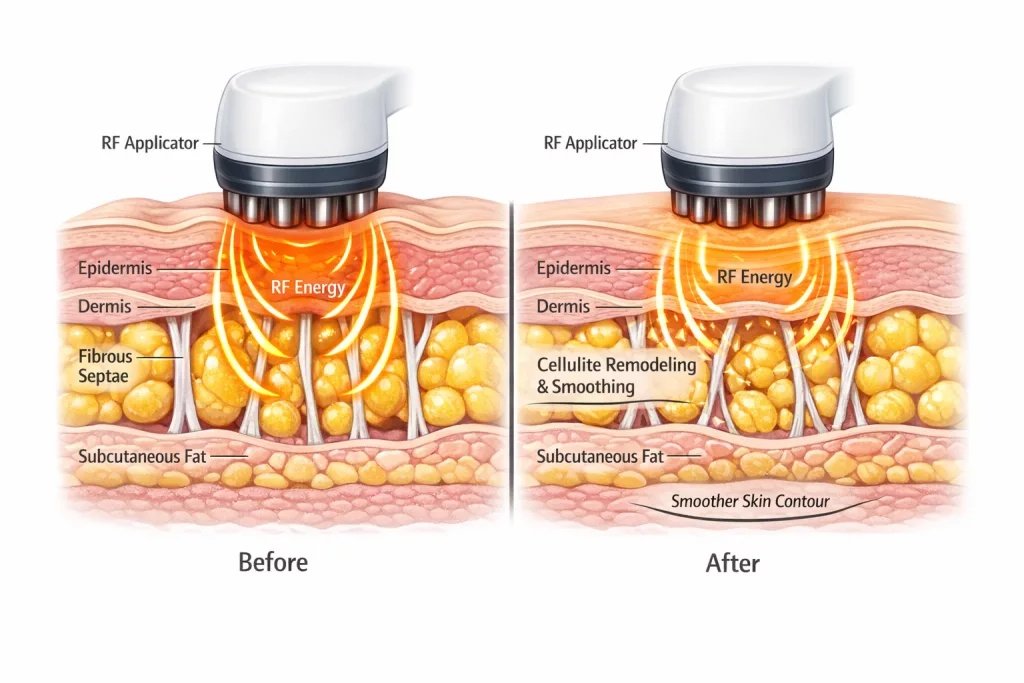
Cross-sectional medical illustration demonstrating the mechanism of radiofrequency (RF) treatment for cellulite reduction. An RF applicator delivers controlled thermal energy through the epidermis and dermis into the subcutaneous fat layer, targeting fibrous septae and fat lobules. The generated heat promotes remodeling of connective tissue, reduction of fat protrusion, and smoothing of the dimpled skin surface, resulting in improved skin contour after treatment. Image Credits: AI-generated medical illustration (DALL·E, OpenAI), created based on a custom prompt.
4. Minimally Invasive procedures:
- Laser Therapy: Lasers, such as Cellulaze, are considered minimally invasive procedures since a tiny probe or fiber is inserted via small incision lines. This laser heats the deeper layers of the skin. It releases the fibrous connective tissue bands (fibrous septae) that connect the dermis to the underlying deep fascia. It reduces the thickness of the fat layer, stimulates collagen production, and helps to improve skin elasticity and texture.
- Subcision (Cellfina): This is an FDA-approved technique that uses small needles to penetrate the skin and sever the fibrous septae present in the dermis. Severing these fibrous septae aids in the release of the epidermis and dermis from the deeper connective tissues. The space produced by the severed fibrous septae promotes the redistribution of fat cells, resulting in smoother skin. Since this targets the root cause of the condition, it is a highly effective treatment, and results may last from three to five years.
- Injections: Different types of injectables can be used:
5. Combination Therapy:10Davis DS, Boen M, Fabi SG. Cellulite: Patient Selection and Combination Treatments for Optimal Results—A Review and Our Experience. Dermatologic Surgery. 2019 Sep;45(9):1171–84.
In combination therapy, patient selection is key. You may see the best results in patients with mild to moderate grade cellulite, and in individuals with localized conditions, and minimal sun damage. If you have excess sagging and poor skin quality, these treatments may not be effective for you.
Your physician will initially advise lifestyle modifications, including a healthier diet and exercise. This is followed by a combination of non-invasive techniques with minimally invasive ones to produce the best result. Acoustic Wave Therapy (AWT) may be paired with laser or subcision. AWT will assist in lymphatic draining, and the minimally invasive laser will aid in collagen remodeling. Similarly, technologies like VelaShape work by combining vacuum massage, infrared light, and bipolar radiofrequency. This combined therapy increases circulation, boosts collagen, and reduces fat.
Key Takeaways
Cellulite is a skin condition occurring due to adipose tissue and fat cells bulging from between the fibrous septae. The treatment of cellulite is not a definitive cure, but the use of different modalities to address the root cause and enhance the aesthetically unappealing appearance of the dimpled skin. You can start on your own first by incorporating lifestyle changes and exercises such as pilates or strength training, or regular massages into your routine. Taking professional advice will also be beneficial in tailoring a custom plan for you to improve the unsightly appearance of cellulite. A composite treatment plan will help your condition, but results will only last for a certain period of time.
References
[1] Cellulite [Internet]. Yale Medicine. 2026 [cited 2026 Jan 27].
[2] Yousef H, Alhajj M, Sharma S. Anatomy, Skin (Integument), Epidermis [Internet]. PubMed. Treasure Island (FL): StatPearls Publishing; 2024.
[3] Young VL, DiBernardo BE. Comparison of Cellulite Severity Scales and Imaging Methods. Aesthetic Surgery Journal. 2020 Aug 12;41(6).
[4] Rawlings AV. Cellulite and its treatment. International Journal of Cosmetic Science. 2006 Jun;28(3):175–90.
[5] Salati SA. Cellulite: A review of the current treatment modalities. Journal of Pakistan Association of Dermatologists. 2021;31(3):500–10.
[6] Menon A, Orr Shauly, Marxen T, Losken A, Faulkner HR. A Clinical Guide to the Treatment of Cellulite and Comprehensive Review of the Etiology, Pathophysiology, and Utility of Intervention. Aesthetic Plastic Surgery. 2023 Dec 6.
[7] Gabriel A, Chan V, Caldarella M, Wayne T, O’Rorke E. Cellulite: Current Understanding and Treatment. Aesthetic Surgery Journal. 2023 Jun 21;5.
[8] Gottwalt B, Tadi P. Methylxanthines [Internet]. PubMed. Treasure Island (FL): StatPearls Publishing; 2023.
[9] Ulrich F, Elahi L, Schiraldi L, Grobbelaar A, Raffoul W. A rare complication of radiofrequency treatment for cellulite of the lower leg. JPRAS Open. 2022 Sep;33:21–5.
[10] Davis DS, Boen M, Fabi SG. Cellulite: Patient Selection and Combination Treatments for Optimal Results—A Review and Our Experience. Dermatologic Surgery. 2019 Sep;45(9):1171–84.