
 is a well-established psychological treatment used to help individuals overcome fears...)
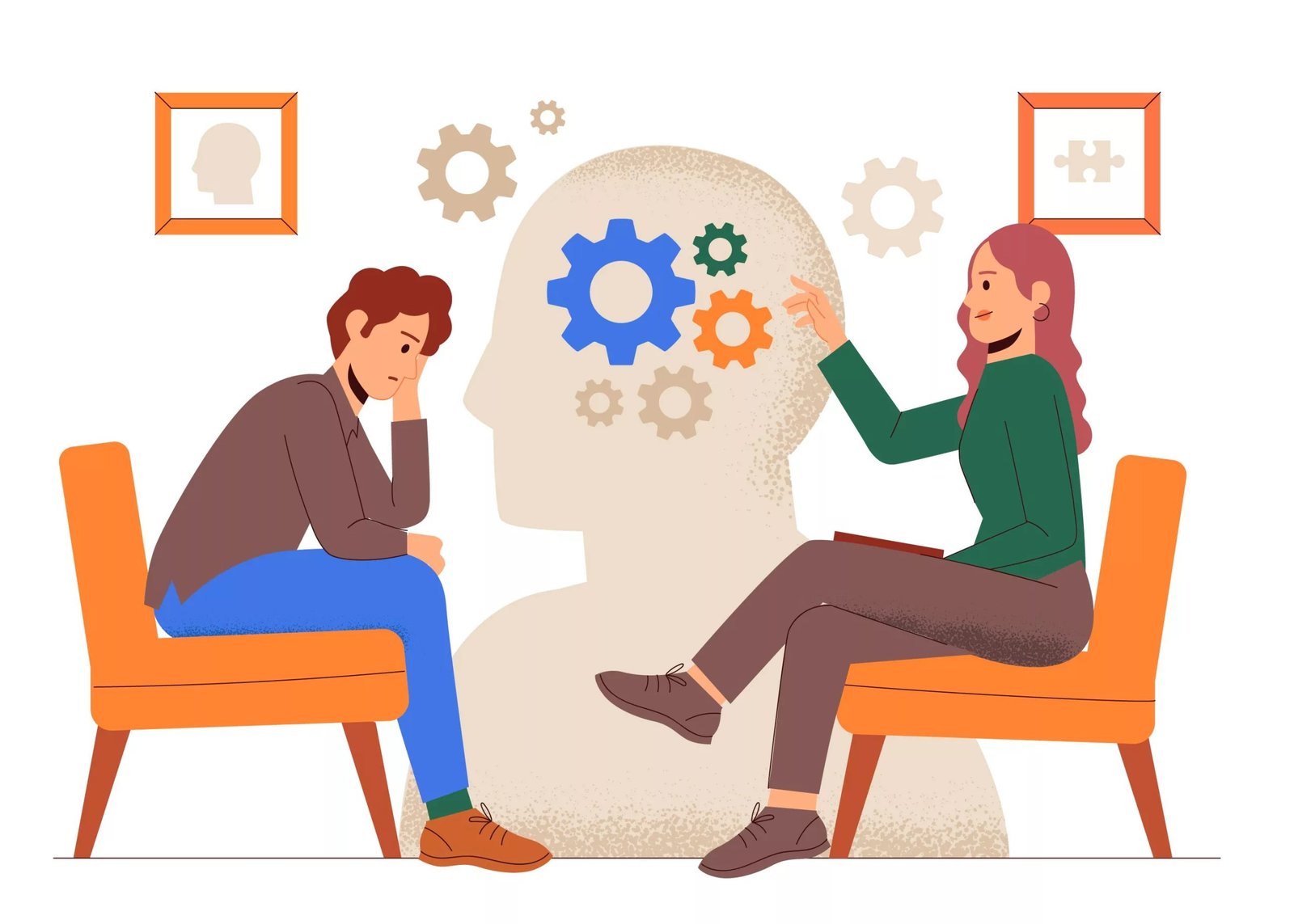
Exposure Therapy Explained Exposure Therapy (ET) is a well-established psychological treatment used to help individuals overcome fears associated with phobias, anxiety disorders, and post-traumatic stress disorder (PTSD), etc. As the name suggests, this therapy involves a trained mental health professional creating a safe environment for you to be slowly exposed to your fears and gradually overcome them. This therapy uses different techniques to help break down patterns of ‘avoiding’ the things or situations you fear the most.
How is Exposure Therapy carried out?: Exposure Therapy Explained
Exposure Therapy is done in the following steps:
- Assessment: You identify your fears, discuss them with your psychologist, and set goals with them for treatment.
- You list your fears, including objects, anxiety-provoking situations, or traumas that you need to overcome. Then you rank them from least distressing to most distressing, creating a fear ladder or fear hierarchy.
- Your psychologist will then conduct sessions in which they will slowly expose you to your fears in a safe and carefully curated environment. It could start with the lowest-ranked fear in your fear ladder.
- Upon exposure, the goal will be to eliminate any safety behaviours you’ve developed against the fear. These could include avoiding the situation, seeking reassurance, or performing compulsive behaviours (as seen in OCD). The exposure will be repeated until anxiety decreases and avoidance responses are reduced.
- You will gradually learn to prevent catastrophic thought processes and rewire your cognitive-emotional responses.
- Once you’ve overcome one fear, you can repeat and practice the same fear in different settings, or move towards higher fear-provoking situations.
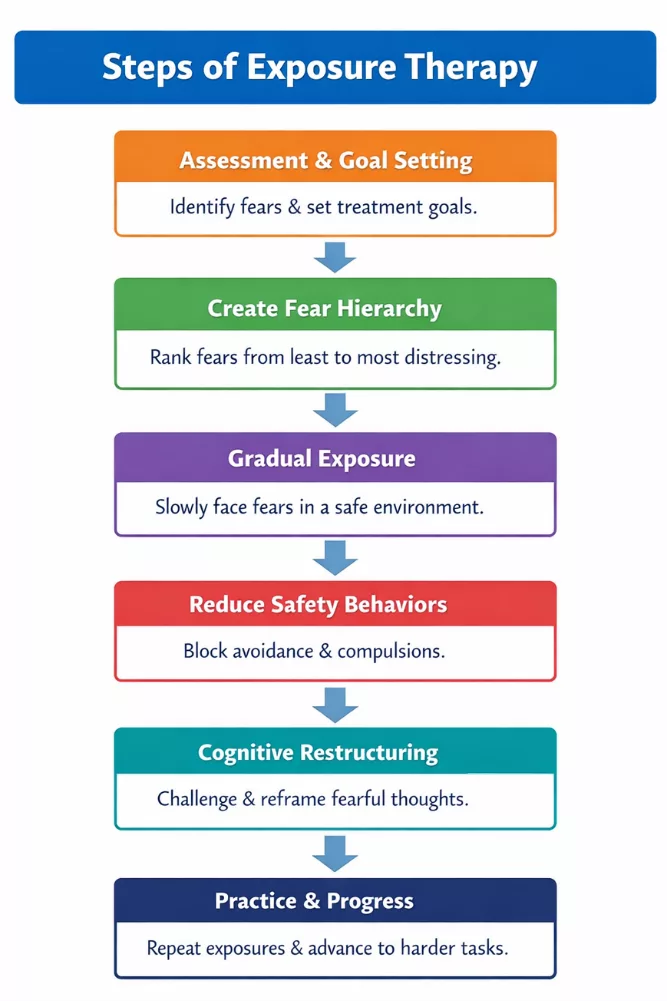
A summary of the steps taken during exposure therapy.
Which conditions are treated by ET?
Exposure Therapy is a well-researched treatment option for the following psychological conditions:
- Phobias: In vivo exposure therapy is the most efficacious intervention for a wide variety of phobias.specific phobia among adults: A rapid review. F1000Research [Internet]. 2020 Mar 19;9(1):195.” style=”position:relative;color:#309b65;cursor:help;border-bottom:1px dotted #309b65;font-weight:bold”>[1] Specific phobia, where you develop a phobia against a specific thing (e.g., flying, needles, etc.), is highly treatable by slowly and repeatedly exposing you to your fear in real life.
- Panic attacks: Interoceptive exposure and in vivo exposure help patients realise that panic symptoms are uncomfortable but not dangerous, even if they don’t avoid the situation.
- Generalised Anxiety Disorders and Social Anxiety Disorders: Graded exposure helps you face your fears gradually. Constant stimulation helps to weaken the association between fear and anxiety.
- Post-traumatic stress disorder (PTSD)[2]: Prolonged Exposure helps patients understand and process their trauma-related memories. Once they come to terms with it, it does not affect their daily lives as much as it used to.
- Obsessive-compulsive disorder (OCD): Exposure and Response Therapy involves the therapist exposing the individual to triggers that provoke the obsessive tasks. This is then followed by the patient consciously choosing not to do the compulsive behaviours, which helps reduce anxiety and break obsessive habits.
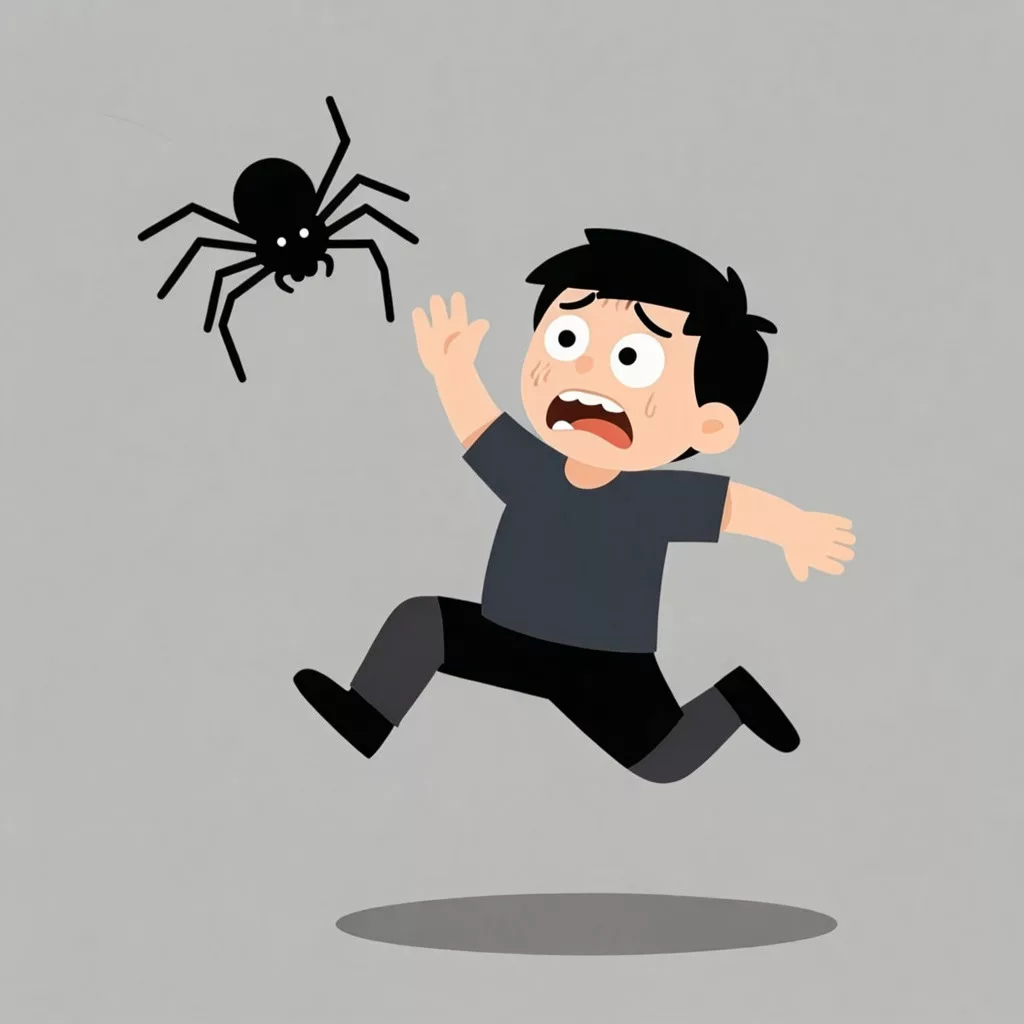
A boy having a phobia of spiders. Exposure Therapy helps decrease phobias. (AI-generated)
How does Exposure Therapy work?
Exposure Therapy uses a safe environment where you are gradually and repeatedly “exposed” to your fears or trauma. It uses the principles of Habituation, Extinction Learning, Self-Efficacy, and Emotional Processing to treat various psychological conditions.
Habituation
Habituation[3] refers to being accustomed to something to which you have repeated exposure. For example, a new ringtone may surprise you in the beginning, but over time, you become accustomed to it. Similarly, exposure therapy uses repeated exposure to something that distresses you or causes you anxiety. Over time, this leads to decreased negative response to the stimulus, and you overcome your fear.
Extinction Learning4Craske MG, Mystkowski JL. Exposure Therapy and Extinction: Clinical Studies. Fear and learning: From basic processes to clinical implications. 2006;217–33.
Extinction Learning, as the name suggests, is the “extinction” of a specific habit over time if the habit is not rewarded. For example, whenever you feed your dog, you ring a bell. The dog then associates food with the ringing of the bell and starts salivating even without the appearance of food. Over time, if you stop giving food after ringing the bell, or you don’t ring the bell after giving the food, the dog will slowly lose the association it has developed between the bell and the food. This means that its unintentional habit of salivating upon the ringing of the bell has gone “extinct.” In the same manner, exposure therapy focuses on breaking the association between the stimulus and the fearful response in your behaviour.
Self-Efficacy
Self-Efficacy[4]; is one’s own ability to believe that they can do or cope with something. It is the ability to endure stressful or anxiety-provoking situations without resorting to avoidance. High self-efficacy looks like: “I’ll figure it out even if it’s difficult”, whereas low self-efficacy would translate as: “I can’t do this.”
Emotional Processing
Emotional Processing[5] involves the change of your emotional reaction to a certain stimulus. It involves activating a fear in a safe environment and updating your brain with new emotions. In this way, your brain learns that the stimulus is not “scary” or “dangerous” anymore. You intentionally face a stressful situation and stay in that situation without avoiding it. This leads your brain to be rewired from “this is dangerous” to “this is manageable.”

Facing fear step by step, even sitting near what scares you, is progress. Exposure therapy helps turn fear into confidence, one small moment at a time.
What are the different types of Exposures?
Exposure to the feared element can be presented to the patient in different ways:
1. In-Vivo Exposure
In-Vivo Exposure is the most common type of exposure used. The individual is exposed to their fears in real life. This can be done by holding the object, creating a similar environment for the therapist, or attempting the activity in reality.
2. Imaginal Exposure
Imaginal Exposure[6], as the name suggests, is vividly imagining or repeatedly thinking about anxiety-provoking thoughts, images, or narratives.
3. Introceptive Exposure
Introceptive Exposure[7] is specifically aimed at reducing the fear of physical sensations. Patients are requested to engage in a series of exercises that are supposed to produce sensations similar to those that occur during a panic attack.
4. Virtual Reality Exposure
Virtual Reality Exposure[8] uses technology to create a safe simulation of a feared situation, commonly used for phobias like fear of flying or heights. Also known as immersion therapy, it is a specialised form of exposure that fully immerses the patient in a controlled, intense virtual environment. This offers higher controllability, safety, and efficiency than traditional in-vivo exposure. It provides a realistic, customizable experience without real-world risk.
5. Exposure and Response Prevention10Hezel DM, Simpson HB. Exposure and response prevention for obsessive-compulsive disorder: A review and new directions. Indian Journal of Psychiatry [Internet]. 2019;61(7):85–92.
Exposure and Response Prevention (ERP) is a specialised form used for OCD, where a person is exposed to triggering thoughts but forbidden from performing the compulsive ritual. “Exposure” is where the person is exposed to the anxiety-provoking stimulus, and “Response Prevention” is where this involves making a conscious effort to refrain from performing the rituals, compulsions, or safety behaviours used to reduce anxiety after an exposure.
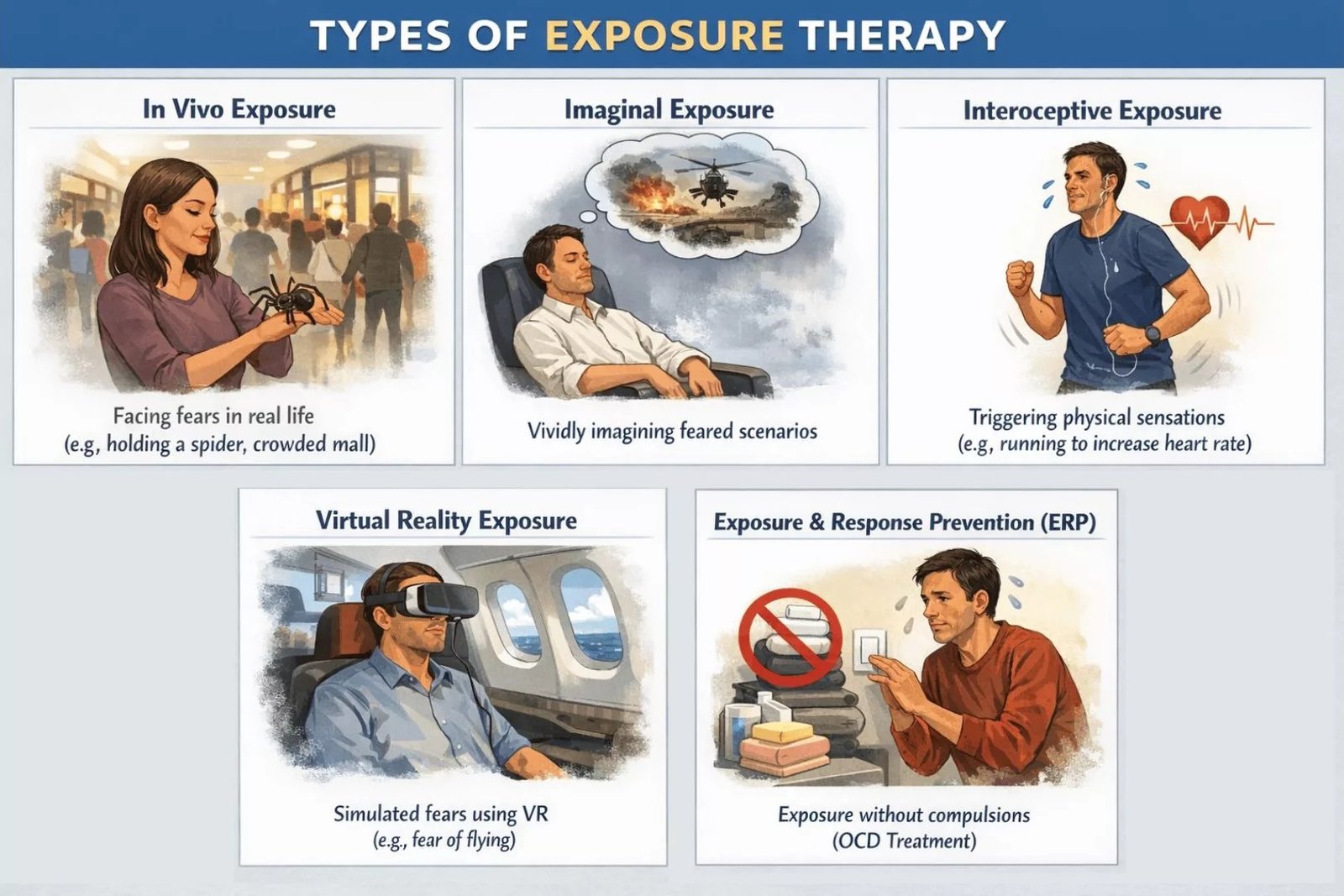
Five different types of exposure therapy: in vivo (real-life exposure), imaginal (mental visualization), interoceptive (physical sensations), virtual reality exposure, and exposure with response prevention (ERP) for OCD. (AI-generated)
Different techniques used for Exposure Therapy
1. Gradual Exposure (Systematic Desensitisation)11Abuso ABV, Hashmi M, Hashmi H, Khoo A, Parsaik A. Overcoming Fear of Flying: A Combined Approach of Psychopharmacology and Gradual Exposure Therapy. Cureus [Internet]. 2023 May 1;15(5):e39773.
Psychologists start with something that is least scary or anxiety-provoking for you, slowly building towards greater and more intense fears. It involves working up to a fear over time, rather than all at once, to allow habituation.
2. Graded Exposure (Hierarchy-Based)12Heo S, Park JH. Effects of Virtual Reality-Based Graded Exposure Therapy on PTSD Symptoms: A Systematic Review and Meta-Analysis. International Journal of Environmental Research and Public Health. 2022 Nov 29;19(23):15911.
This is similar to gradual exposure and involves collaborating with a therapist to list fears and rank them in a hierarchy. It includes you giving them a list of your fears, graded from lowest to highest, also known as the exposure ladder. The patient starts with mildly difficult exposures and, once comfortable, progresses gradually up the hierarchy to high-intensity situations.
3. Flooding13Boudewyns PA, Shipley RH. Flooding and implosive therapy: direct therapeutic exposure in clinical practice. New York: Plenum Press; 1983.
Starting with the most feared situation, it is a raid technique to generate fast results in psychological disorders. It “floods” directly to the visualisation of the highest of your fears. It includes long sessions and typically ends when the patient’s anxiety has significantly reduced. However, it is less commonly used in modern practice due to higher distress and dropout rates.
4. Prolonged Exposure
Prolonged Exposure teaches individuals to gradually approach trauma-related memories, feelings, and situations. It is done over a period of three months, with weekly sessions, gradually exposing to and processing trauma. These sessions can include practising the same exposure multiple times, building habituation, and inhibitory learning.
6. Variability Technique
This technique, as the name suggests, varies the conditions of exposure, such as setting, time of day, or intensity, to improve the generalisation of fear reduction. This helps prevent “context-dependent learning.”

A man sits with a psychologist, visibly distressed as he discusses his fears. This is an example of how exposure therapy begins with openly identifying and talking through anxiety in a safe setting.
What are the benefits of ET?
In exposure therapy, since the fear and anxiety are treated at the root, it provides various benefits. Since it breaks down the fearful association you had with something, you learn to overcome phobias and face situations you would normally avoid. Repeated exposure leads to rewiring of emotional responses, breaking avoidance cycles that lead to long-term positive results. It enhances focus, increases independence, and decreases mental load in severe disorders such as OCD, PTSD, etc. All of these improved symptoms lead to restored self-esteem and improved quality of life.
Take Away
Exposure Therapy is a well-established, evidence-based treatment that helps individuals overcome anxiety by directly confronting feared situations rather than avoiding them. Through gradual and repeated exposure in a safe, controlled environment, it weakens the learned association between a stimulus and fear. Built on principles such as habituation, extinction learning, self-efficacy, and emotional processing, it promotes both immediate anxiety reduction and long-term psychological change. As individuals move through their fear hierarchy, they learn to tolerate distress, challenge irrational beliefs, and gain confidence in their ability to cope. The goal of exposure therapy is not to eliminate fear, but to change one’s response to it. Over time, this leads to reduced anxiety, improved functioning, and greater independence. As a result, exposure therapy remains a cornerstone in the treatment of phobias, obsessive-compulsive disorder, post-traumatic stress disorder, and other anxiety-related conditions.
References
[1] Thng C, Lim-Ashworth N, Poh B, Lim CG. Recent developments in the intervention of specific phobia among adults: A rapid review. F1000Research [Internet]. 2020 Mar 19;9(1):195.
[2] Rothbaum BO, Schwartz AC. Exposure Therapy for Posttraumatic Stress Disorder. American Journal of Psychotherapy. 2002 Jan;56(1):59–75
[3] Benito KG, Walther M. Therapeutic process during exposure: Habituation model. Journal of Obsessive-Compulsive and Related Disorders [Internet]. 2015 Jul;6(6):147–57.
[4] Craske MG, Mystkowski JL. Exposure Therapy and Extinction: Clinical Studies. Fear and learning: From basic processes to clinical implications. 2006;217–33.
[5] Benito K, Pittig A, Abramowitz J, Arch JJ, Chavira D, Rianne de Kleine, et al. Mechanisms of Change in Exposure Therapy for Anxiety and Related Disorders: A Research Agenda. Clinical psychological science. 2024 May 25
[6] Hayes AM. Facilitating emotional processing in depression: the application of exposure principles. Current opinion in psychology [Internet]. 2015 Aug 1;4:61–6.
[7] Whiteside SP. Examining Community Clinicians Use of Imaginal Exposure with Childhood Anxiety Disorders. Research Square (Research Square). 2023 Apr 5;
[8] Lee K, Noda Y, Nakano Y, Ogawa S, Kinoshita Y, Funayama T, et al. Interoceptive hypersensitivity and interoceptive exposure in patients with panic disorder: specificity and effectiveness. BMC Psychiatry. 2006 Aug 16;6(1).
[9] Boeldt D, McMahon E, McFaul M, Greenleaf W. Using Virtual Reality Exposure Therapy to Enhance Treatment of Anxiety Disorders: Identifying Areas of Clinical Adoption and Potential Obstacles. Frontiers in Psychiatry. 2019 Oct 25;10(773)
[10] Hezel DM, Simpson HB. Exposure and response prevention for obsessive-compulsive disorder: A review and new directions. Indian Journal of Psychiatry [Internet]. 2019;61(7):85–92.
[11] Abuso ABV, Hashmi M, Hashmi H, Khoo A, Parsaik A. Overcoming Fear of Flying: A Combined Approach of Psychopharmacology and Gradual Exposure Therapy. Cureus [Internet]. 2023 May 1;15(5):e39773.
[12] Heo S, Park JH. Effects of Virtual Reality-Based Graded Exposure Therapy on PTSD Symptoms: A Systematic Review and Meta-Analysis. International Journal of Environmental Research and Public Health. 2022 Nov 29;19(23):15911.
[13] Boudewyns PA, Shipley RH.Flooding and implosive therapy: direct therapeutic exposure in clinical practice. New York: Plenum Press; 1983.