


What Is Frailty Syndrome?
Frailty syndrome develops in people in their later stages of life, and it affects their normal physical functioning. With age, normal organ, muscle, and bone function declines, making them vulnerable to many infections and diseases. Frailty syndrome is closely associated with aging, but is not an inevitable or universal part of the normal aging process. It actually reflects a decline in the body’s functional capacity rather than natural signs of aging. Frailty primarily affects physical reserve, but cognitive and psychological functions may also be involved or worsened by frailty.
Frailty Syndrome vs. Normal Aging
Frailty syndrome isn’t just a normal part of aging. While aging naturally slows strength and mobility, frailty reflects a pathological decline in physical and functional reserve, making older adults more vulnerable to falls, illness, and loss of independence. Unlike typical aging, frailty can be identified early and slowed or managed with exercise, proper nutrition, and medical care.
How Common is Frailty?
The prevalence of frailty among older people depends on various factors. These include the geographical location from which prevalence is estimated. For example, frailty is more common in institutionalized settings such as nursing homes. However, the prevalence of frailty is comparatively low in the community, ranging from approximately 7% to 16%. Moreover, there is variation in frailty prevalence across countries: around 8–12% in Europe, higher rates reported in Africa and Latin America (up to 20–25%), and intermediate rates in North America.
In addition to the geographical location, the epidemiology of frailty also depends on underlying mental conditions in older adults. These may include anxiety, depression, and bipolar disorders. Frailty frequently coexists with mental health disorders, and their combination is associated with increased morbidity, disability, and mortality.
Causes Of Frailty Syndrome
The cause of frailty syndrome primarily involves disturbances in many physiological systems of your body. A decline in the function of various systems, such as the cardiovascular, respiratory, and nervous systems, results in a decrease in the patient’s overall functional capacity.
Some studies show that frailty syndrome develops due to systemic inflammation. There is an increase in proinflammatory interleukin IL-6 in many older adults with frailty syndrome.
Some other conditions that play a significant role in the development of frailty syndrome are anemia (a decrease in hemoglobin concentration in the blood), sarcopenia (loss of muscle mass and overall strength), and deficiencies in certain hormones. In addition to these conditions, frailty syndrome also develops when the patient has resistance to insulin, higher levels of blood glucose, and many nutritional deficiencies. Physical inactivity, inadequate nutrition, chronic stress, and multimorbidity also play significant roles in causing frailty syndrome.
Moreover, when mitochondrial function is impaired due to age-related dysfunction, genetic susceptibility, or defective cellular respiration, it eventually decreases cellular energy levels and increases oxidative stress. These mechanisms contribute to the development and progression of frailty syndrome, particularly in older adults.
Signs and Symptoms of Frailty Syndrome
Signs and symptoms of frailty syndrome depend on a person’s lifestyle, social factors, and diet. If there is an avoidance of risk factors, the severity of signs and symptoms would be less.
Some common signs and symptoms of frailty syndrome are:
- A gradual decrease in muscle strength
- Slow body movements
- Troubles with walking steadily
- Depression
- Significant reduction in body weight
- Exhaustion and fatigue
- Cognitive decline or low mood
- Social isolation
- Urinary incontinence or reduced bladder control
How To Diagnose Frailty Syndrome?
The diagnosis of frailty syndrome largely depends on physical changes in the patient’s body, which can involve many systems. Clinical assessment usually begins with a detailed medical history and physical examination. Healthcare providers assess unintentional weight loss, muscle strength, walking speed, fatigue, level of physical activity, and functional independence. These findings help determine whether an older adult is robust, prefrail, or frail.
In addition to physical examination, many frailty scales and scoring systems are used to diagnose frailty syndrome. These tools help quantify functional decline and predict outcomes such as disability, hospitalization, and mortality.
Fraility Criteria
Frailty criteria are used to objectively identify frailty syndrome and distinguish it from normal aging or isolated disability. Several validated tools are available, and the choice of tool depends on the clinical setting and purpose of assessment.
Physical Frailty Phenotype (Fried criteria):
The Fried Frailty Phenotype is the most widely used diagnostic model and focuses on physical manifestations of frailty. The following five signs show the decline in various systems of the body:
- Unexplained/unintentional weight loss
- Exhaustion
- Weakness in many muscles of the body
- Slow and tired walk
- Decrease in the level of activity
Individuals meeting one or two criteria are considered prefrail and are at increased risk of progressing to frailty. People who have at least 3 of the above signs are known to have frailty syndrome.
Clinical Frailty Scale (CFS):
The Clinical Frailty Scale provides a global assessment of functional status, ranging from very fit to severely frail, and is commonly used for rapid bedside evaluation.
Performance-based tests:
Functional performance tests, such as the Timed Up and Go (TUG) test, are used to assess mobility, balance, and fall risk. These tests are especially helpful in outpatient, rehabilitation, and community settings.
Frailty Index:
The Frailty Index evaluates frailty based on the accumulation of health deficits. These deficits may include chronic diseases, physical and cognitive impairments, abnormal laboratory findings, and nutritional deficiencies. A higher number of deficits reflects greater frailty severity and a higher risk of adverse health outcomes.
Comprehensive Geriatric Assessment:
CGA typically involves the assessment of factors that cause or exacerbate frailty syndrome. These risk factors involve many aspects of health, such as physical, psychological, and social. It helps identify reversible contributors such as malnutrition, depression, polypharmacy, and mobility limitations.
Older people who undergo comprehensive geriatric assessment at the earliest stage of minor signs are more likely to survive and can lead healthier, more fulfilling lives. CGA helps people get better medical treatment in the early stages, improving the quality of care and reducing the risk of medical emergencies.
Management And Treatment of Frailty Syndrome
The progression of frailty syndrome can be slowed down by proper management and prevention. The treatment of frailty syndrome does not involve any medications. Instead, management of frailty syndrome primarily focuses on appropriate physical activity and a healthy diet.
Physical Activity and Nutrition:
Daily physical activity and a healthy diet go a long way toward managing frailty syndrome. Exercise helps regain muscle mass and improve overall fitness. Frailty syndrome weakens the effectiveness of many organs. It also weakens a person’s immune system. Therefore, a healthy, nutritious diet rich in protein and vitamins plays a key role in strengthening the immune system and keeping you strong and healthy.
A famous motto saying you can only change your life only wen you change your habits
Stress Management:
It is crucial to manage stress as stress increases the chances of frailty syndrome. Stress affects a person’s physical and mental health, making them more prone to weakness and an unhealthy lifestyle. Any triggering stress, such as surgery or infections, should be managed effectively.
Managing Underlying Issues:
Any underlying disease in the body puts strain on the organs, and people with such conditions are more likely to develop frailty syndrome. The management of the underlying illness should be managed first. These illnesses could be diabetes, hypertension, or depression. Treatment of these issues makes the frailty syndrome manageable.
Community Support:
Community support also helps manage frailty syndrome. People in old age should join community programs for exercise sessions, nutritional guidance, and interactions with other community members. It helps them to reduce their loneliness and also enhance their physical and emotional well-being.
Community support also helps people learn about the symptoms and signs of frailty syndrome, as well as its prevention and management.

Picture showing community support group that involves people with all types of races
What Are The Risk Factors Of Frailty Syndrome?
Some factors increase the risk of frailty syndrome. These risk factors touch many dimensions, including biological, psychological, and social.
Health-related factors:
In old age, people get several health issues, most of which contribute to developing frailty syndrome, and the most common are bone issues or diseases. These include sarcopenia, osteopenia, and osteoporosis. In sarcopenia, muscle mass decreases, leading to reduced strength. The severity of muscle loss largely depends on how much a person exercises and on their nutrition. The loss of muscle mass ultimately leads to disability.
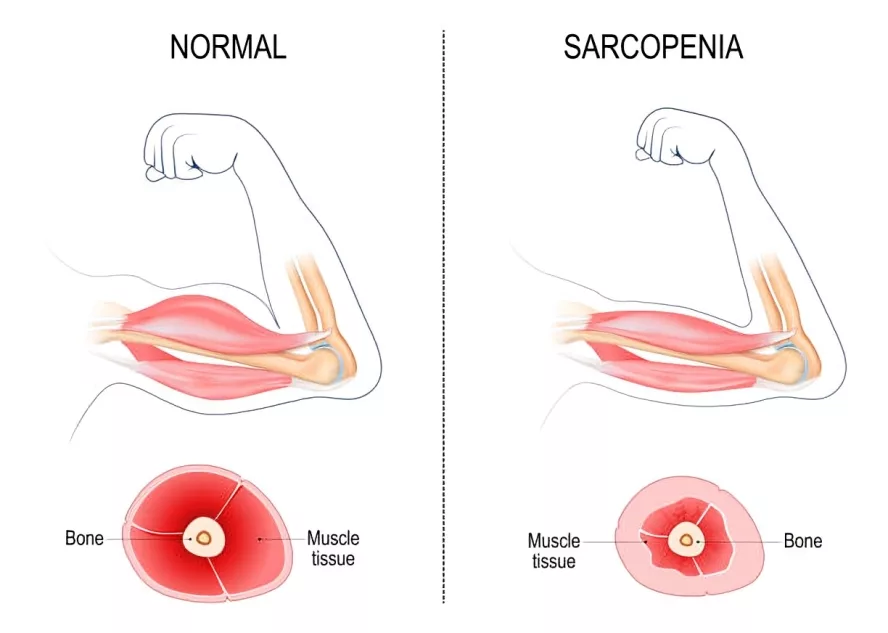
The picture shows the physiology of sarcopenia which involves a loss of muscle mass
A decrease in bone density is termed osteopenia and osteoporosis. When density decreases, the chances of sudden fractures increase. These bone diseases play a significant role in the development of frailty syndrome.
People with heart diseases are also at risk of developing frailty syndrome as a decrease in normal heart functions makes it difficult for them to move or stay active.
Lifestyle Factors:
A sedentary lifestyle is a significant risk factor for frailty syndrome. Smoking, lying inactive all day, and eating unhealthy food are a part of a sedentary lifestyle. It causes a loss of essential vitamins and minerals in your body, leaving you weak and prone to frailty syndrome.
Demography:
Demographic factors such as advanced age, female sex, low socioeconomic status, and limited education are consistently associated with higher frailty prevalence.
Social Factors:
Some social factors, like poverty, poor relationships, loneliness, no support system, or any abuse, affect the mental health of a person. Decline in mental health can eventually lead to frailty syndrome.
Life Expectancy In Frailty Syndrome
The life expectancy in frailty syndrome depends on its severity and the patient’s overall health. People with mild to moderate symptoms of frailty syndrome can live up to many years, especially if they remain active and take good care of their nutrition. While the people who neglect their fitness and health can get severe frailty syndrome, the prognosis of severe frailty syndrome is not good.
How To Prevent Frailty Syndrome?
It’s not necessary that every individual gets Frailty Syndrome in old age. You can prevent or delay frailty syndrome by avoiding its potential risk factors. Therefore, it is essential to identify these risk factors early.
Some factors that significantly help to prevent frailty syndrome are:
Diet:
A healthy diet helps delay the onset of frailty symptoms. A good, balanced diet involves using fruits, vegetables, and foods low in carbohydrates and high in protein. A good intake of vitamins such as Vitamin D, C, B9, and folate also helps slow the progression of frailty syndrome. Extremely restrictive diets are not recommended in older adults unless medically indicated.
Social Factors:
Some social factors, like good communication with people, can help people to reduce isolation and keep their minds healthy. People in old age should also take some training or sessions on how to use social media to interact with people and the community. It helps improve their confidence and become mentally fit.
Exercise:
Physical activity is one of the most critical factors in preventing frailty syndrome. As frailty syndrome makes people physically weak, exercise helps to regain their energy levels. Daily walks and strength-training exercises must be continued throughout a person’s life to stay physically and mentally healthy.
Conclusion
Frailty syndrome is not a regular part of aging, but a condition that can affect an older person’s strength, independence, and quality of life. It develops when your body slowly loses its ability to handle daily activities and stress. The good news is that you can prevent or delay the frailty with simple lifestyle changes. Regular physical activity, a balanced diet, and strong social support are significant. Managing long-term health problems and reducing stress also helps slow its progression. With early care and healthy habits, older adults can remain active and enjoy a better quality of life.
References
[1] Chen, X., Mao, G., & Leng, S. X. (2014). Frailty syndrome: an overview.Clinical interventions in aging,9, 433–441. https://doi.org/10.2147/CIA.S45300
[2] Collard RM, Boter H, Schoevers RA, Oude Voshaar RC. Prevalence of frailty in community-dwelling older persons: a systematic review.J Am Geriatr Soc.2012;60(8):1487–1492.
[3] Ofori-Asenso R, Chin KL, Mazidi M, Zomer E, Ilomäki J, Zullo AR, et al. Global incidence of frailty and prefrailty among community-dwelling older adults: a systematic review and meta-analysis.JAMA Netw Open.2019;2(8):e198398.
[4] Barrera, A., Rezende, L. F. M., Sabag, A., Keating, C. J., & Rey-Lopez, J. P. (2023). Understanding the Causes of Frailty Using a Life-Course Perspective: A Systematic Review.Healthcare (Basel, Switzerland),12(1), 22. https://doi.org/10.3390/healthcare12010022
[5] Khezrian, M., Myint, P. K., McNeil, C., & Murray, A. D. (2017). A Review of Frailty Syndrome and Its Physical, Cognitive and Emotional Domains in the Elderly.Geriatrics (Basel, Switzerland),2(4), 36. https://doi.org/10.3390/geriatrics2040036
[6] Allison, R., 2nd, Assadzandi, S., & Adelman, M. (2021). Frailty: Evaluation and Management.American family physician,103(4), 219–226.
[7] Fried, L. P., Tangen, C. M., Walston, J., Newman, A. B., Hirsch, C., Gottdiener, J., Seeman, T., Tracy, R., Kop, W. J., Burke, G., McBurnie, M. A., & Cardiovascular Health Study Collaborative Research Group (2001). Frailty in older adults: evidence for a phenotype.The journals of gerontology. Series A, Biological sciences and medical sciences,56(3), M146–M156. https://doi.org/10.1093/gerona/56.3.m146
[8] Rockwood K, Mitnitski A. Frailty in relation to the accumulation of deficits.J Gerontol A Biol Sci Med Sci.2007;62(7):722–727.
[9] Rockwood K, Song X, MacKnight C, Bergman H, Hogan DB, McDowell I, et al. A global clinical measure of fitness and frailty in elderly people.CMAJ.2005;173(5):489–495.
[10] Won C. W. (2020). Diagnosis and Management of Frailty in Primary Health Care.Korean journal of family medicine,41(4), 207–213. https://doi.org/10.4082/kjfm.20.0122
[11] Ni Lochlainn, M., Cox, N. J., Wilson, T., Hayhoe, R. P. G., Ramsay, S. E., Granic, A., Isanejad, M., Roberts, H. C., Wilson, D., Welch, C., Hurst, C., Atkins, J. L., Mendonça, N., Horner, K., Tuttiett, E. R., Morgan, Y., Heslop, P., Williams, E. A., Steves, C. J., Greig, C., … Robinson, S. (2021). Nutrition and Frailty: Opportunities for Prevention and Treatment.Nutrients,13(7), 2349. https://doi.org/10.3390/nu13072349
[12] Nair, P., Walters, K., Aw, S., Gould, R., Kharicha, K., Buszewicz, M. C., & Frost, R. (2022). Self-management of depression and anxiety amongst frail older adults in the United Kingdom: A qualitative study.PloS one,17(12), e0264603. https://doi.org/10.1371/journal.pone.0264603
[13] Wang, X., Hu, J., & Wu, D. (2022). Risk factors for frailty in older adults.Medicine,101(34), e30169. https://doi.org/10.1097/MD.0000000000030169
[14] Haapanen, M. J., Mikkola, T. M., Jylhävä, J., Wasenius, N. S., Kajantie, E., Eriksson, J. G., & von Bonsdorff, M. B. (2024). Lifestyle-related factors in late midlife as predictors of frailty from late midlife into old age: a longitudinal birth cohort study.Age and ageing,53(4), afae066. https://doi.org/10.1093/ageing/afae066
[15] Gill TM, Gahbauer EA, Allore HG, Han L. Risk factors and precipitants of frailty transitions in older persons.J Gerontol A Biol Sci Med Sci.2006;61(12):1254–1259.
[16] Herr, M., Arvieu, J. J., Ankri, J., & Robine, J. M. (2017). What is the duration of life expectancy in the state of frailty? Estimates in the SIPAF study.European journal of ageing,15(2), 165–173. https://doi.org/10.1007/s10433-017-0438-z