

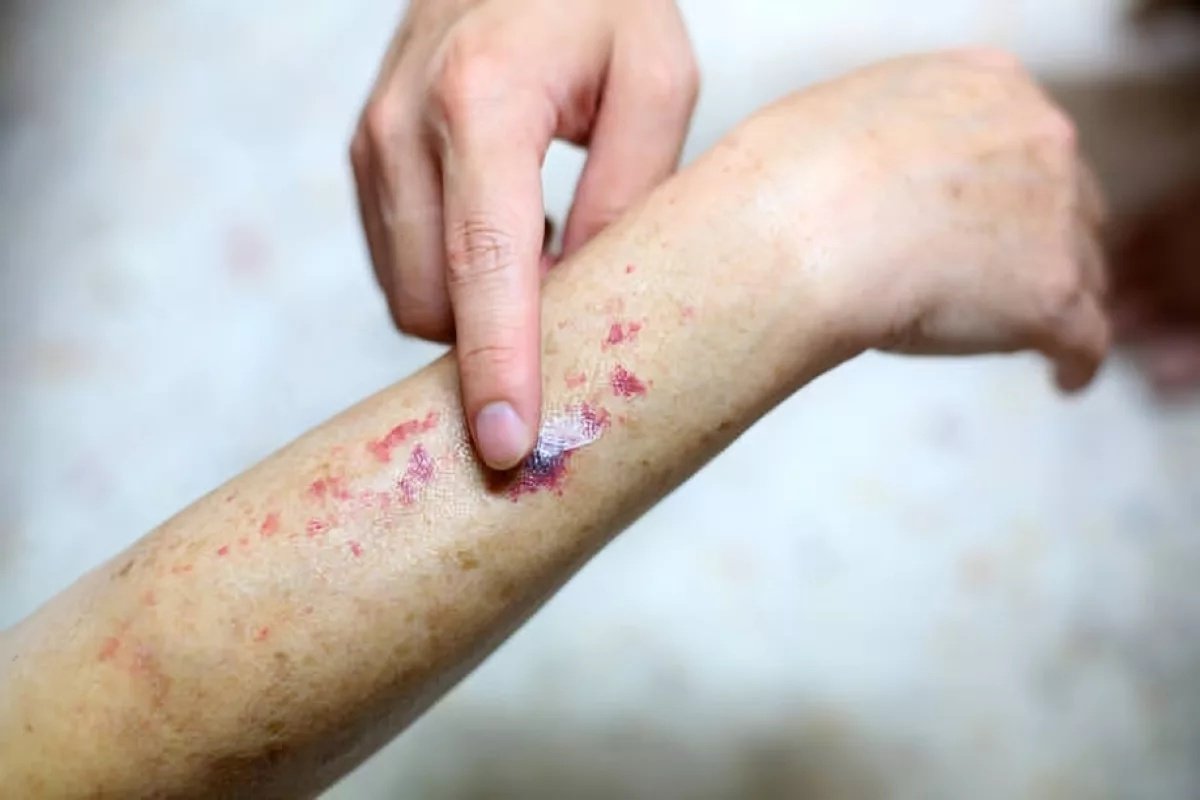
Senile Purpura Aging Senile purpura is a benign condition of the skin’s connective tissue. It occurs due to the fragility of small blood vessels and dermal tissue, often caused by long-term sun exposure and the natural aging process. Senile purpura mainly appears in older adults, as their skin becomes thinner and more sensitive with age. The skin shows dark purplish patches, most commonly on the forearms and backs of the hands. In 1818, a man named Bateman first described this condition. Therefore, senile purpura is also known as Bateman’s purpura, Bateman’s disease, or actinic purpura.[1]
Causes of Senile Purpura: Senile Purpura Aging
Senile purpura is classified under “Other nonthrombocytopenic purpura” in the International Classification of Diseases, 10th Revision (ICD-10).[2] This means it is a type of purpura that occurs without any problem in blood platelets or clotting. The leading causes of senile purpura are the fragility of the skin and the patient’s old age. As the age progresses, the fragility of the skin increases and making the skin more prone to damage. Additionally, people with fair skin are at increased risk of developing this disease. Prolonged exposure to ultraviolet (UV) rays from the sun further damages the skin, particularly in older adults with fair complexions. When a minor trauma happens to already damaged skin, the skin’s connective tissue cannot support the blood supply of that area. As a result, there is extravasation of blood into their dermis, and it appears as dark purple patches on the skin.[3]
To summarize, senile purpura primarily occurs due to age-related thinning of the dermis and increased fragility of small blood vessels. Chronic sun exposure accelerates this process by damaging collagen and elastin fibers in the skin.
Epidemiology of Senile Purpura
Older adults, especially those with fair skin and long-term sun exposure, are more likely to develop senile purpura. As people age and spend more time in the sun, their risk of developing this condition increases. About 12% of people over 50 develop it, which rises to around 35% after age 75.[4]
Pathophysiology of Senile Purpura
In older adults, the atrophy of the skin and fragility (weakness) of their blood vessels cause blood to extravasate into the dermis (middle layer of the skin). This happens especially after a minor injury to their skin. Chronic sun exposure is an additional feature that makes this process faster. Senile purpura develops in areas that are more exposed to the sun, like arms, faces, and necks.
Dermatoporosis (a condition in which the skin becomes weak and fragile) may contribute to senile purpura, as it reflects advanced skin atrophy and collagen degradation. However, it is not the primary cause.[5]
The pathophysiology behind the purple patches on the skin is the passage of blood in the middle layer of the skin. Collection of blood also deposits hemosiderin (a brown iron pigment) there. This results in the formation of purple patches and macules on the skin. Although macrophage activity may be reduced, it is not completely absent. Hemosiderin forms as a result of the breakdown of red blood cells within the dermis.
Signs & Symptoms
These include:
Patches & Macules:
Patients with this disease present with patches and macules on their sun-exposed areas, such as the forearms, backs of hands, and necks. This disease can also develop in some patients’ other areas, such as their neck and legs. Macules and patches of senile purpura have irregular edges and are dark purple in color. These lesions mostly range from 1 to 4 cm in diameter.

An old lady having senile purpura under her eyes
Patients with this condition mostly present with just the skin lesions. They don’t usually present with any skin tenderness or itching. The skin surrounding the lesions may change, such as becoming thin or pigmented. The lesions disappear in almost 1-3 weeks. However, in some patients, hemosiderin pigment leaves its brown color on the skin. Senile purpura can reappear many times due to already developed fragility of the skin and blood vessels. Nonetheless, it does not cause any serious complications.
The lesions do not blanch with pressure and are usually non-painful. They may recur frequently due to persistent dermal fragility.

Macules of senile purpura on the neck of an old woman
Other Signs:
In addition to skin lesions, patients with senile purpura also have other signs. These include photo-aging signs on the skin, such as wrinkling, lentigines (a small brown spot on the skin of elderly people), actinic keratosis (scaly skin), and pseudo scars.[6]
How to diagnose Senile Purpura?
The diagnosis is easy to make, and it mostly depends upon the history and physical examination of the patient’s skin.
History:
The dermatologist asks a few crucial questions in the history to diagnose, such as the patient’s age, history, duration of sun exposure, any history of trauma to the skin, and any history of any underlying skin disease. These questions are essential as this condition is strongly present in old age, especially after an injury to the skin.
Physical Examination:
The physical examination of the patient holds the same importance as the history. The dermatologist comprehensively examines the patient’s skin, such as its fragility, elasticity, and signs of aging (for example, wrinkles). He also examines the signs of any injury and the lesions on the skin. Lesions of senile purpura must be distinguished from other lesions of the skin associated with old age. Senile purpura has dark purple colored lesions in the form of patches and macules, especially on the sun-exposed areas of the skin.

Close-up of elderly woman with wrinkles on her face
Other Tests:
In some cases, dermatologists advise a skin biopsy of the lesions. The histopathological findings of lesions show changes in the skin’s dermis, reduction in the collagen fibers, and atypical elastic fibers of the skin. These changes mainly develop due to the aging factor. Some doctors also perform the Perls’ stain can confirm hemosiderin deposits, indicating prior blood extravasation. If neutrophilic infiltration is seen, other diagnoses such as vasculitis or neutrophilic dermatosis should be considered.
Treatment & Management of Senile Purpura
It is a benign condition that does not require any specific treatment. You can only prevent it by taking certain measures, such as using sunscreen. Yet there are some options:[7]
Tretinoin:
Some dermatologists recommend tretinoin (a vitamin A derivative) as it helps control skin damage caused by sun exposure and aging. Tretinoin also helps regenerate collagen in the skin. Although tretinoin may improve skin texture and reduce fragility, its direct benefit in treating senile purpura remains limited.[8]
Other Options:
In 2002, tissue-engineered skin was used in a patient to treat senile purpura, and it was a successful attempt. However, no other cases were reported after that. Another option to treat this condition is using human epidermal growth factor (EGF), as it helps reduce the skin lesions of senile purpura. Moreover, human epidermal growth factor plays a role in increasing the thickness of your skin. In this way, the skin is less prone to damage from the sun’s ultraviolet rays. The human epidermal growth factor should be used twice daily for six weeks for a better outcome.[9].
A study shows that a citrus bioflavonoid blend (containing diosmin and hesperidin) also helps to reduce the appearance of skin lesions in patients with senile purpura. There are no side effects of citrus bioflavonoid use. In addition, hydrating and moisturizing creams aid in treating skin dryness in patients with senile purpura.[10]
Complications of Senile Purpura
There are no serious complications of this disease, as it is a benign condition. It typically resolves in 1 to 3 weeks in many patients. However, extravasation of blood in the dermis may leave some pigmentation or scarring on the skin. Cosmetic concerns or repeated bruising may affect self-esteem in some individuals, but the condition has no systemic effects.
Differentials of Senile Purpura
Signs and symptoms of senile purpura resemble some conditions; it is crucial to differentiate them while diagnosing. These include:
- Steroid-induced purpura
- Trauma to the skin
- Use of anticoagulant drugs
- Scurvy due to Vitamin C deficiency
- Psychogenic purpura
- Vitamin K deficiency
Difference between Actinic Purpura & Senile Purpura
These two terms are synonyms of each other. The word actinic shows that there is skin damage due to the harmful rays of sunlight. Senile shows that this disease typically presents in older people. Actinic purpura or senile purpura is also known as Bateman disease.
How to prevent Senile Purpura?
This disease has no significant treatment options. Therefore, it is important to prevent the disease before it develops. Continuously using sunscreen while going out can prevent senile purpura by protecting your skin from ultraviolet rays. It is better to avoid direct sunlight by wearing a cap, using an umbrella, and wearing a dress with full sleeves.
Sunscreen with a low protection index does not provide adequate protection against the sun’s rays. That is why you should use sunscreen with a high protection index, mainly with a sun protection index (SPF) greater than 50. High SPF protects your skin from both UVA and UVB rays of the sun. You should apply sunscreen to your face and all sun-exposed areas of your body, like your neck, arms, legs, and feet.
Vitamins to Prevent Bruising in Old Age:
Senile purpura doesn’t have a definite management. However, vitamin C supports collagen synthesis and overall skin health. While deficiency does not directly cause this condition, adequate vitamin C intake may help reduce skin fragility and bruising tendency.
Regular moisturizing, maintaining skin hydration, and avoiding corticosteroid creams unless prescribed can also help reduce skin fragility.
Prognosis
The prognosis of this disease is good, as it resolves on its own in a few weeks or months. Although it may occur repeatedly throughout life, it is benign and does not cause serious complications. However, you may get residual hyperpigmentation or scarring on your skin afterwards.
Conclusion
In conclusion, Senile purpura is a harmless skin condition primarily affecting older people due to aging and long-term sun exposure. It appears as dark purple patches on sun-exposed areas like the arms and hands. Though it may look alarming, it doesn’t cause pain or serious health problems. The patches usually go away on their own within a few weeks, but they can return due to the skin’s fragility. Using sunscreen, protective clothing, and moisturizing creams can help prevent or reduce its occurrence. While no specific treatment is needed, some skincare products may help improve skin strength and appearance.
References
[1] Feinstein, R. J., Halprin, K. M., Penneys, N. S., Taylor, J. R., & Schenkman, J. (1973). Senile purpura.Archives of dermatology,108(2), 229–232.
[2] World Health Organization. (2019).International Statistical Classification of Diseases and Related Health Problems (10th Revision) – ICD-10: D69.2 Other nonthrombocytopenic purpura.World Health Organization. https://icd.who.int/browse10/2019/en#/D69.2
[3] Hafsi, W., Masood, S., & Badri, T. (2023). Actinic Purpura. InStatPearls. StatPearls Publishing.
[4] Schwartz, R. A. (2024). Actinic purpura. IneMedicine. Retrieved from https://emedicine.medscape.com/article/1087008-overview
[5] Karadag, A. S., Parish, L. C., & Lambert, W. C. (2017). Senile Purpura as a Stage of Dermatoporosis.Skinmed,15(2), 91–92.
[6] Cho, S. I., Kim, J. W., Yeo, G., Choi, D., Seo, J., Yoon, H. S., & Chung, J. H. (2019). Senile Purpura: Clinical Features and Related Factors.Annals of dermatology,31(4), 472–475. https://doi.org/10.5021/ad.2019.31.4.472
[7] Siperstein, R., & Wikramanayake, T. C. (2021). Intense Pulsed Light as a Treatment for Senile Purpura: A Pilot Study.Lasers in surgery and medicine,53(7), 926–934. https://doi.org/10.1002/lsm.23358
[8] Ceilley R. I. (2017). Treatment of Actinic Purpura.The Journal of clinical and aesthetic dermatology,10(6), 44–50.
[9] McKnight, B., Seidel, R., & Moy, R. (2015). Topical Human Epidermal Growth Factor in the Treatment of Senile Purpura and the Prevention of Dermatoporosis.Journal of drugs in dermatology: JDD,14(10), 1147–1150
[10] da Rosa, R. S., Garcia, R. C., Cury, A. A., & Faot, F. (2011). Management of the oral manifestations of senile purpura in an edentulous patient: a case report. Special care in dentistry: official publication of the American Association of Hospital Dentists, the Academy of Dentistry for the Handicapped, and the American Society for Geriatric Dentistry,31(3), 111–113. https://doi.org/10.1111/j.1754-4505.2011.00186.x