

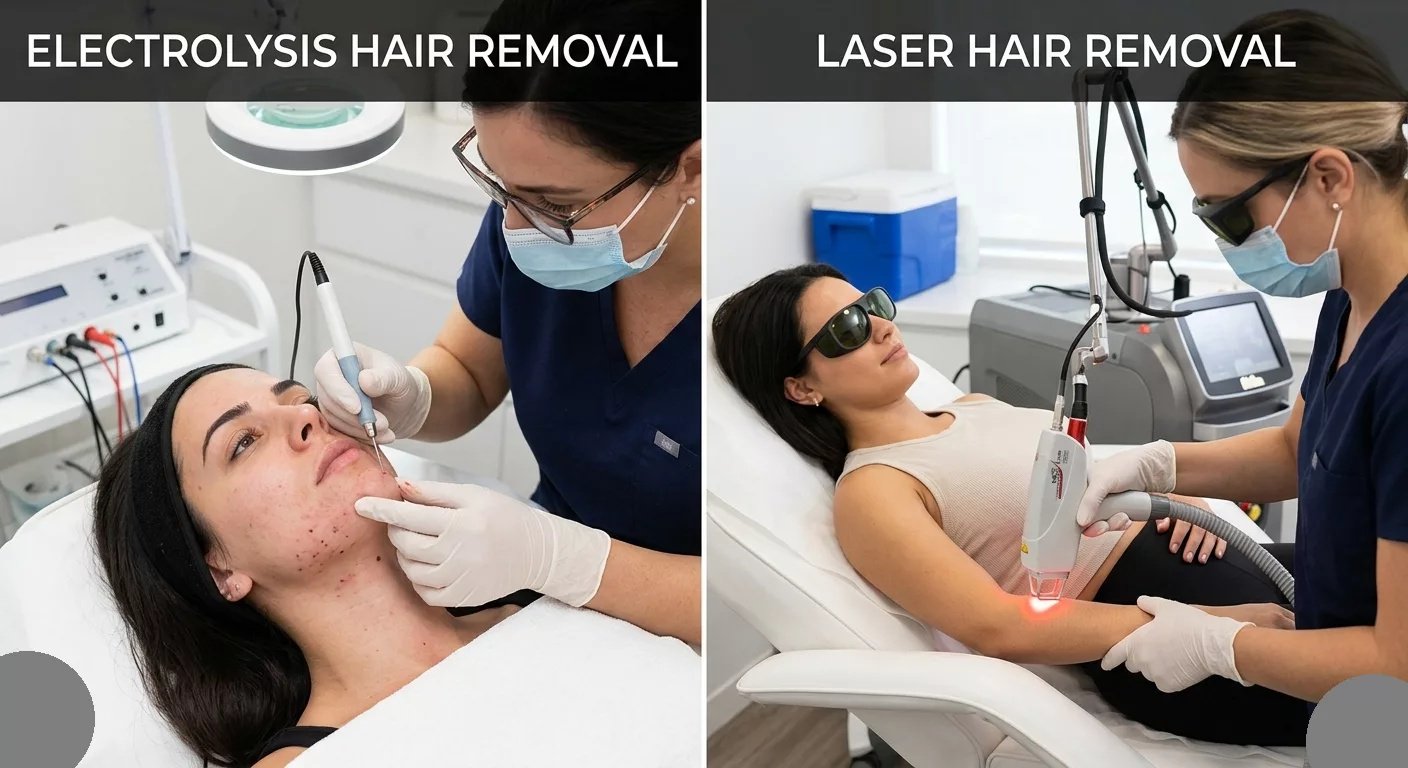
Electrolysis Laser Hair If you have excessive body hair and want a long-term solution for its removal, you may need to choose between electrolysis vs laser hair removal. These are currently among the most effective long-term hair reduction and removal options available.
The reason is that the traditional methods of hair removal, such as shaving, waxing, and threading, are often repetitive, time-consuming, and do not give permanent results. However, it is important to understand that like any medical procedure, electrolysis or laser also have their own risks.
What is Laser Hair Removal?: Electrolysis Laser Hair
It is a cosmetic procedure that works through a process called selective photothermolysis.In this process, a concentrated beam of light (laser) is used to target and damage the melanin (a pigment) within the hair shaft and follicle (a cavity where hair grows on skin).
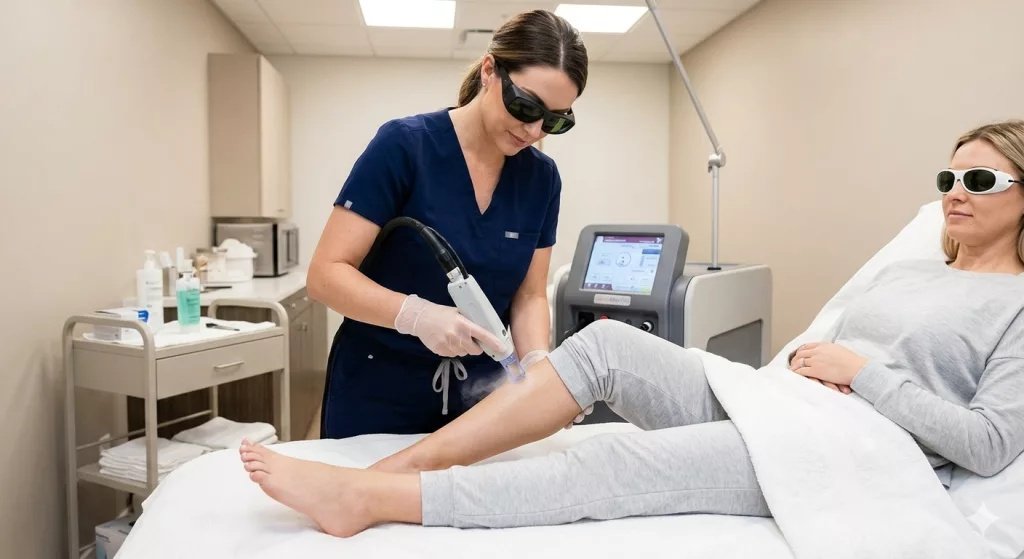
Laser hair removal
The light energy gets converted into heat, which damages the hair follicle. In this way, lasers lead to long-term hair reduction in the targeted area.
Is this a one-time procedure for permanent effects?
The laser selectively targets only those hair follicles that are actively growing hair (in anagen phase). Since not all hairs are in this phase at the same time, multiple sessions are required
Typically, you will need 6-8 sessions, with each 4-6 weeks apart. After that, you may need periodic maintenance sessions (often once or twice a year) to maintain results.
Which Skin and Hair Types are Suitable for Laser?
Laser hair removal is not for every skin type and has only shown the best results on:
- Black and dark brown, coarse hair (contains the highest concentration of eumelanin)
- Light skin tones
This is due to high contrast phenomena (high contrast between hair pigment and skin tone). That means if the hair is dark on light skin tone, it becomes easy for the laser to “lock on” to that hair and target its melanin, which results in hair removal.
On the other hand, lasers do not give good results on red, blonde, grey, or white hair. These colours contain very little melanin or a different type (pheomelanin). Therefore, it becomes difficult for the laser to destroy the follicle.
Modern Laser Hair Removal vs Older Systems
The traditional lasers, such as the Alexandrite (755 nm), are highly absorbed by melanin and are very effective on light skin tone. However, in darker skin types, there is more melanin in the skin epidermis and hence competes with the melanin of the hair follicle. Therefore, in dark skin, Alexandrite laser often leads to more energy absorption, which increases the risk of burns and pigmentary changes.
However, modern Nd: YAG lasers (1064 nm) are considered to be safe and effective for people with dark skin types (Fitzpatrick IV–VI) because they have a longer wavelength and thus penetrate deeper with relatively lower absorption by epidermal melanin. This reduces the risk of burns and pigmentary complications.
However, Nd: YAG lasers are generally slightly more painful than shorter wavelengths. Besides that, they usually require more sessions to achieve the same result due to their lower absorption by the pigment.
What are the common Treatment Areas?
Laser is popular for the removal of hair from areas such as:
- Underarm laser hair removal: Removal of hair decreases the trapping of bacteria, which helps reduce body odor.
- Bikini laser hair removal: It targets hair outside the underwear line.
- Brazilian laser hair removal: It removes most or all pubic hair
- Legs, arms, back, and chest: Laser helps in removing hair from these large areas effectively.
Overall, lasers provide a good option for permanently removing body hair, especially in larger areas.
At-Home Hair Removal Devices
This is another option in which individuals remove their hair with specific devices designed for home use. This is truly a convenient method compared to the clinic-based treatments. However, they’re generally less effective than clinic-based laser systems.
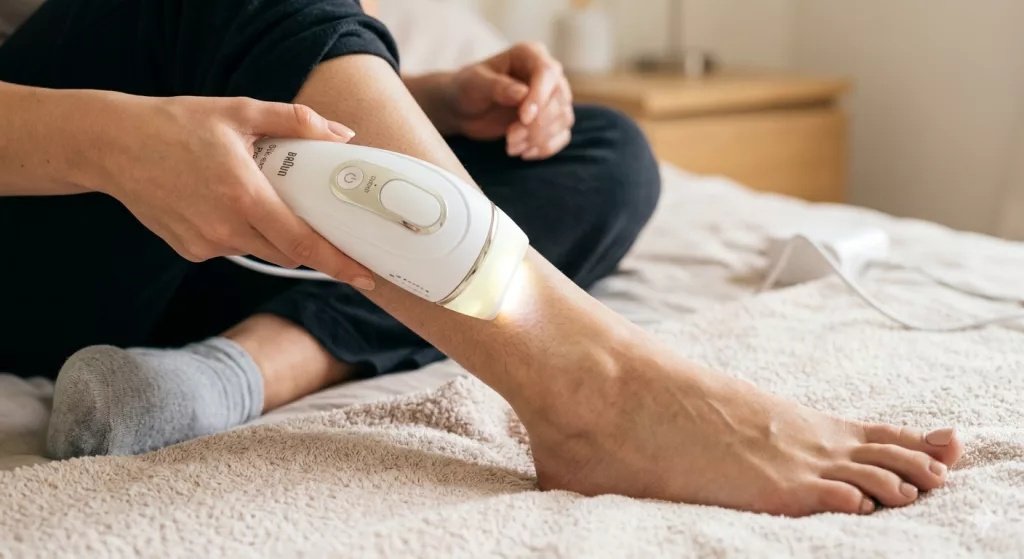
At-Home Hair Removal Device
These devices typically use Intense Pulsed Light (IPL) or low-energy laser technology to target the melanin in hair follicles with significantly lower energy levels for safety purposes.
How effective are At-home devices?
These devices are designed to be user-friendly, less aggressive, and safer for personal use, but they are not as effective as a professional laser. They produce a gradual hair reduction rather than long-term or permanent removal.
That’s why you may need more frequent and prolonged sessions to notice visible results.
Suitability of At-Home Devices
Similar to professional hair removal lasers, at-home devices also work best on individuals with light skin tones and dark hair, due to a similar mechanism. They do not give good results on blonde, red, grey, or white hair.
Besides that, people with darker skin tones should be careful while using them due to the risk of skin irritation or pigmentation changes. Fortunately, newer devices include skin tone sensors that reduce such risks.
Risks and Costs of At-Home Laser Hair Removal Devices
The price of an at-home laser is mainly the upfront device cost, which can be significant. However, having your own device also reduces the need for repeated clinic visits, potentially saving you a lot.
Regarding the risks, generally, at-home lasers are safe when used according to instructions. However, if misused, these devices can lead to burns, blistering, oreye injury (if protective measures are not applied). They are also not suitable for some body areas, such as around the eyes or on tattooed skin.
Overall, if we look at the complete picture, these devices do improve convenience, but they are not as effective as professional laser treatments for long-term hair removal.
What is Electrolysis Hair Removal?
Electrolysis hair removal is another method for removing unwanted body hair. It is the only method recognized by the FDA for permanent hair removal.
In this procedure, your electrologist will insert a very fine probe into your hair follicle to deliver an electric current to permanently destroy the follicle. He or she will focus on each individual hair rather than many hairs at once (as in laser).
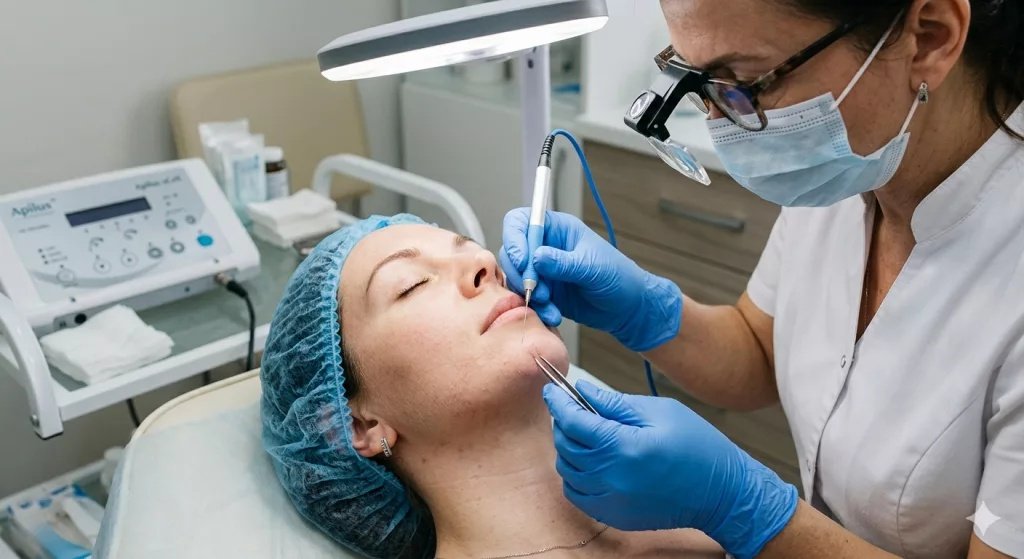
Electrolysis Hair Removal
Types of Electrolysis
Electrolysis hair removal has the following 3 types.
1. Galvanic electrolysis:
- It was developed in 1875, and it uses direct current (DC) to trigger a chemical reaction inside your hair follicle.
- In this method, your skincare provider will insert a needle and apply current, which reacts with the salt and water in the follicle tissue to produce sodium hydroxide (lye).
- This caustic lye is what chemically dissolves the follicle and not the electricity itself.
- It is very useful for distorted or curved follicles because the liquid lye can reach into areas where a needle can not directly reach.
- However, it is very slow and usually needs at least 30 seconds or more per single hair.
2. Thermolysis
- It was developed in the 1920s and uses an Alternating Current (AC).
- This high-frequency current causes the water molecules around the tip of the needle to vibrate and creates a localized heat.
- This heat destroys the follicle by a process called electrocoagulation.
- It is an extremely fast process; it takes a fraction of a second per hair.
- However, it is not suitable for deeply rooted or distorted hairs because it produces very local heat and does not reach those areas.
3. The Blend Method
- This method is a mix of both galvanic and thermolysis by combining their chemical action and heat, respectively.
- Experts consider it the “gold standard” for treating stubborn, coarse hair or follicles that have been distorted by years of plucking or waxing.
- It is moderately faster (takes 3–10 seconds per hair) and has a higher success rate as it combines the effects of both methods.
Suitability of Electrolysis
Unlike lasers, electrolysis is suitable for any skin or hair type. This includes people with gray, blonde, red, or dark hair. People of any skin tone can use electrolysis to permanently remove their hair.
Electrolysis is particularly used to remove facial hair, such as from the upper lip, chin, or eyebrows. These small body areas are usually sensitive and require precision.
Number of Sessions Required
There is no fixed number of sessions required for electrolysis, as it depends upon the hair density, area being treated, and individual hair growth cycles. Different hairs are in different growth phases at any given time.
The hair actually grows in cycles, in which some hairs are in one phase of the cycle while other on other stage and contain different melanin concentrations.
Now, as the electrolysis process involves individually treating every single hair follicle, each should be treated during its active growth (anagen) phase. Therefore, you would need multiple sessions over several months to years to achieve optimum results.
- Initial phase: Initially, when the procedure is started, you may need to visit your electrologist every 1–2 weeks to achieve “initial clearance” of all visible hair.
- Maintenance phase: After 1-3 months, your electrolysis session frequency reduces to every 3–4 weeks.
- Long-term: After several months, you only need occasional sessions for any regrowth.
Overall, your appointment frequency and duration decrease with the passage of time.
Cost of Electrolysis Vs Laser Hair Removal
The cost of these procedures varies depending on the region and the area of the body receiving treatment. Also, some clinics charge an hourly rate, especially for electrolysis, while others may charge you based on the area of treatment.
In the United States, for example, an electrologist may charge you $90–$200 for a 60-minute session. In Pakistan, a session of electrolysis could cost you somewhere between PKR 2,500 and PKR 15,000. These are just approximations to give you an idea; however, you should consult your provider for exact costs.
The Laser sessions often cost more than electrolysis per session. However, in the long run, electrolysis often requires more sessions than laser, therefore leading to high cost overall.
Are Electrolysis and Laser Hair Removal Painful?
Both electrolysis and laser hair removal involve targeting hair follicles with energy, which can cause you some level of discomfort. However, they differ significantly in the intensity and sensation of the feelings.
The intensity of the pain depends upon the treatment area (sensitive areas hurt more), skin sensitivity, device, and practitioner skill.
A laser feels like “a rubber band snapping against the skin,” while the electrolysis feels like “a sharp or stinging sensation” for each hair. Users often describe laser as less painful than electrolysis; the true discomfort varies depending on the device, treatment settings, and individual pain tolerance.
You can reduce the pain perception by numbing the area of treatment with topical numbing creams 30-60 minutes before the procedure.
What is the effectiveness of these methods?
Electrolysis can achieve permanent hair removal in the treated follicles. You would typically have to take multiple sessions to make sure all of the follicles are destroyed.
Laser provides long-term hair reduction but does not guarantee complete or permanent removal, and maintenance sessions are often needed.
In rare cases, paradoxical hypertrichosis (increased hair growth) may occur after laser treatment.
What are the Side Effects of these procedures?
These procedures are generally safe when a qualified skincare professional performs them. However, like any medical procedure, they too have the potential to cause adverse effects.
In the mild cases, they may cause redness (erythema), swelling, or mild irritation, which resolves in 24-48 hours.
The skin may temporarily become darker (hyperpigmentation) or lighter (hypopigmentation). This is more common in individuals with darker skin tones or those who have had recent sun exposure.
Besides that, there is a risk of burns, especially with improper laser use. There is also a risk of skin scarring, although rare, that may occur with improper electrolysis technique.
Generally, electrolysis is usually safe across all skin tones; however, lasers need caution in darker skin types.
Quick Summary of Electrolysis vs Laser Hair Removal
| Feature | Laser Hair Removal | Electrolysis |
|---|---|---|
| Mechanism | Uses a laser to target melanin | Uses electricity to destroy hair follicles |
| Treatment Session Duration | Quick, as it covers large areas | Time-consuming due to a hair-by-hair approach |
| Sessions Required | Multiple (6–8 typical) | Many sessions over months |
| Hair Type Effectiveness | Best for dark hair | Works on all hair types |
| Skin Compatibility | Limited in darker skin (improving) | Suitable for all skin tones |
| Precision vs Coverage | Covers large areas quickly | Highly precise |
| FDA status | Approved for permanent hair reduction | Approved for permanent hair removal |
Which One Should You Choose?
Now comes the question, and to answer this, you need to analyze your specific hair/skin type, area of treatment, budget, and pain tolerance.
For people with light skin tone and dark coarse hair on larger areas, the laser is an appropriate option. This is also budget-friendly and results in less pain. For other individuals with Light or fine hair, especially on facial areas, the electrolysis suits them better.
You should talk to your skincare provider to make your personalized plan based on your specific skin type and budget.
References
[1] Olsen EA. Methods of hair removal.J Am Acad Dermatol. 1999;40(2 Pt 1):143–155.
[2] Anderson RR, Parrish JA. Selective photothermolysis: precise microsurgery by selective absorption of pulsed radiation.Science. 1983;220(4596):524–527.
[3] Sadick NS, Weiss RA. Advances in laser hair removal.Dermatol Clin. 2002;20(1):107–115.
[4] Haedersdal M, Wulf HC. Evidence-based review of hair removal using lasers and light sources.J Eur Acad Dermatol Venereol. 2006;20(1):9–20.
[5] Alster TS, Tanzi EL. Laser hair removal: a review.Dermatol Surg. 2009;35(8):1299–1307.
[6] Goldberg DJ. Laser hair removal and light-based therapies.Clin Dermatol. 2007;25(5):443–449.
[7] American Academy of Dermatology Association. Laser hair removal: overview and safety considerations.J Am Acad Dermatol. 2018;79(2):S1–S15.
[8] Healthline Editorial Team. Electrolysis vs. Laser Hair Removal: Benefits and Risks. Healthline; 2023.
[9] Mayo Clinic Staff. Electrolysis for hair removal. Mayo Clinic; 2022.
[10] Cleveland Clinic. Laser Hair Removal: Procedure, Risks, and Results. Cleveland Clinic; 2023.